Sunday, March 13, 2016

Some images and links for your biographies (I)

The following are some links for your biographies about the main figures of Spain's history in the 19th century:

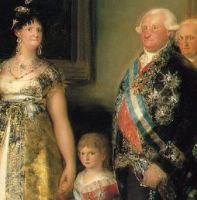
- CHARLES IV


Source: http://s.libertaddigital.com/fotos/noticias/sugoyafamiliacarlosiv.jpg

http://www.biography.com/people/charles-iv-of-spain-21389243#abdication-of-the-throne

http://www.nndb.com/people/910/000097619/

-FERDINAND VII


http://www.encyclopedia.com/topic/Ferdinand_VII.aspx

http://www.heritage-history.com/index.php?c=academy&s=char-dir&f=ferdinand7s

-JOSEPH I


Source: http://www.napoleonicsociety.com/images/tartt209.jpg


- MANUEL GODOY


http://www.infoplease.com/encyclopedia/people/godoy-manuel-de.html

http://biography.yourdictionary.com/manuel-de-godoy-y-alvarez-de-faria

- EL EMPECINADO


http://thebiography.us/en/martin-diaz-juan

http://www.biografiasyvidas.com/biografia/e/empecinado.htm

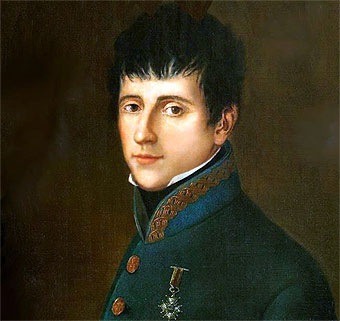
- COLONEL RIEGO


http://www.biografiasyvidas.com/biografia/r/riego.htm

https://en.wikipedia.org/wiki/Rafael_del_Riego

- CARLOS MARÍA ISIDRO


- MARÍA CHRISTINA OF BOURBON-TWO SICILIES


- GENERAL BALDOMERO ESPARTERO


http://www.archontology.org/nations/spain/spain_1808_68s/espartero.php

https://en.wikipedia.org/wiki/Baldomero_Espartero,_Prince_of_Vergara

Friday, March 11, 2016

Thursday 10th

Hi! Last Thursday 10th of March the people who didn't do the project, took the exam of the industrial revolution. I didn't take the exam so I don't know which questions appeared in it but whe the class finished some people commented that it was easy for them. I hope they'll get high marks on this exam.

On my project I talked about a kid called Max in which he experimentated the revolution first in the country with his uncle, aunt and cousins where he leant the improvements which were made and how his lefe changed when he came back with his parents into the city, his work on the factories and the life conditions he had on it.

While they were taking the exam Paqui showed us the presentation of the project on which we have to work in class which completed the information Paqui gave us on Tuesday.


The people who didn't took the exam were making exercises, revising for an exam or reading the presentation which Paqui put in the white board.

Tuesday, March 8, 2016

8th March 2016

Today in class of social sciences paqui has given us the marks of the projects about the unit 4.

Later we have put for groups, and have begun the following project.

This project is about to do a  comic with different dorwings about  the topics that Paqui has given us.

In our group we have begun summarizing Charles IV's reign, and we write that in 1793 Spain declared war to the revolutionary France, and the spanish armies were defeted in 1795.
In 805 Spain and France declared war to the United Kingdom.
In October 1807 Godoy signed the Treaty of Fontainebleau.
In March 1808  Godoy moved the royal family to Aranjuez. This situation was used to Prince Ferdinand to prepare a conspiracy against his father.
Charles repented later and wrote a letter with Napoleon.
The Peninsular War started for a rumor of the abduction of the spanish royar family.
And in Bayonne Napoleon got thar Ferdinand and Charles renunced to their crown and he gave the crown to his brother Joseph I.

Presentations for your project about Spain's history in the 19th century


Here you have them. Have a look on them to make your characters look alike to the real ones. You can also get some ideas for some of the scenes.


Monday, March 7, 2016

7th March 2016

Hi, I'm María and today is my turn to write the journal.

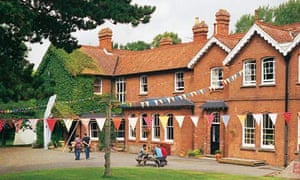
At the beginning of the class we have talked about Summerhill an Anarchist and british boarding school based on the principles of educating children in complete freedom. The fees of this school are really expensive: from £8,568 to £14,889 per year, depending on the level.


Also we have talked about the right of the public schools, and we have said that the people think that the innovations are only in private schools. In the past only the rich families could go to school.


After this introduction we started to learn the last point of the unit.

Engels and Marx considered that all the workers of the world had fight together against the capitalism, so the International Workingmen's Association (also called IWA).

This association was an intetnational organization created in London in 1864 to coordinate all the workers' efforts against capitalism. The first international included Marxists, Anarchists and Trade unionists. The slogan of this association was " Workers of the world, unite! ".


Currently, there is a famous graffiti with this slogan in London, crated by the famous artist Banksy.
Banksy is an England-based graffiti artist, political activist and film director whose identity is not proven. His satirical street art and subversive epigrams combine dark humour with graffiti executed in a distinctive stenciling technique.

Then we have talked about the 2nd international. The 2nd international was created in 1879. It only included Marxists, and they created the workers' anthem (L'Internationale), the 1st of May became the Labour Day and also they created a campaign for 8 woriking hours. 
Some of them wanted to make revolution to reachpower and others wanted to participate in the elections, so for that they didn't have coordination and The Second International dissolved during the First World War.


We have finished the unit and then Paqui has picked up the projects of the industrial revolution. Then Paqui has explained the new project that we have to do for the next term. The project consist in a comic or a video about Spain in the 19th century. In this project we have to include drawings, dialogues and at the end the biography of all the biggest of that period. Then Paqui said us the groups and we have started to organize it.


NEW VOCABULARY:
"Workers of the world, unite!" - "¡Proletarios del mundo, uníos!"

Sunday, March 6, 2016

Thursday, 3rd March

Hello everyone!
I'm Jorge and I'm going to explain you what we've learnt in Social Sciences lesson. Today in Social Sciences we've talked about Anarchism. First of all, we've talk about the main ideas, that were the following:
 -People were free but institutions limited their possibility of developing their capabilities 
 -They destroyed everything that limits people's capabilities and let the people decide.
 -A collective property 
 -Trust in revolutionary capabilities

We have differentiated some people:


      Mijail Bakunin                         Pierre Joseph Proudhon                          Piotr Kropotkin

Kropotkin Nadar.jpg
               Portrait Pierre-Joseph Proudhon.jpg

After that, Paqui has showed as a photo with a phrase:
 -"Anarchism stands for the abolition of oppresive and explotative social relations"
This sentence would mean the organization of an egalitarian and co-operative society.

In this period, many anarchists defended the use of violence to eliminate the representatives of capitalism and they prepared terrorist attacks against many people. We can see:

Friday, March 4, 2016

Summerhill, one example of anarchist school

summerhill school


Here you have some links about Summerhill, a British boarding school based on the principles of educating children in complete freedom. It was founded by Alexander S. Neill in 1921. Students choose what they want to do and learn. The fees are really expensive: from £8,568 to £14,889 per year, depending on the level (from 11,075 to 19.246 € per year). 

This is the school website: 


And here you have some links in English and Spanish: 


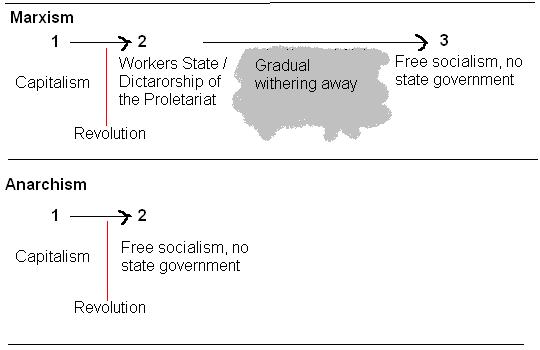
Differences between Marxism and anarchism


Mijail Bakunin and Karl Marx


Here you have some schemes with the main differences between Marxism and anarchism:


Source: https://libcom.org/forums/theory/marxism-anarchism-30032008


Source: https://blogger.googleusercontent.com/img/b/R29vZ2xl/AVvXsEhU7KoVY2f870ew_vkComVYwFrVK0yfztTPlMhp0xhrNtaun8at2IvC4eDlFYZI3k6K1JlEEbKY6URxy2f59N6ChgYmQtrLUELzd1hzWSUJJs65i8ri9NkCiGO5VQGP_2f6nDttLIAW3T0/s1600/Presentaci%C3%B3n1.gif

Wednesday, March 2, 2016

Tuesday, March 1, 2016

Tuesday, 1st, march

Hi classmates!

I'm Fátima and today I'm going to explain you what we've learnt in Social Sciences lesson.
Today in Social Sciences class we've learnt about scientific socialism or marxism
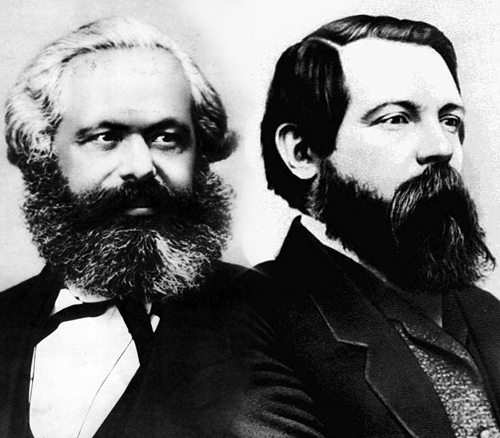
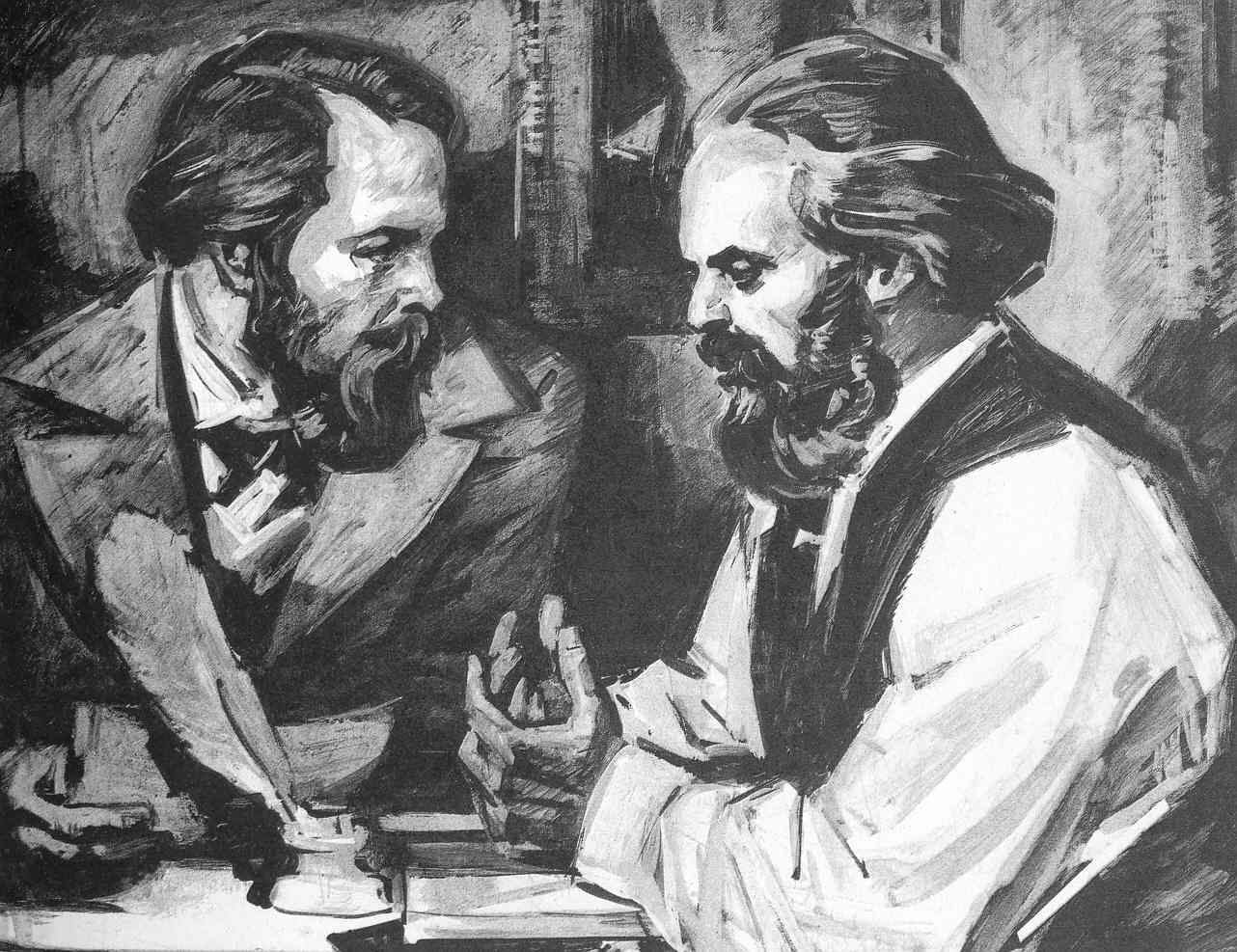
It was created by Marx and Engels. Marx belonged to a generation of German scholars who appropriated but diverged significantly from the teachings of Hegel. Engels grew up in the environment of a family marked by moderately liberal political views, a steadfast loyalty to Prussia and a pronounced Protestant faith.


https://www.marxists.org/archive/marx/photo/art/marx-eng3.jpg

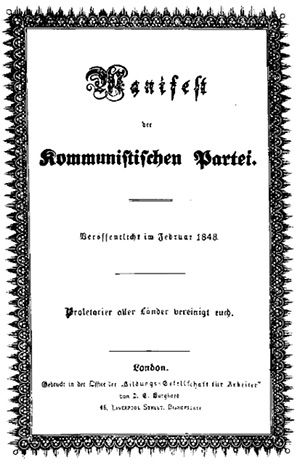
When they were studying capitalism, they reached some conclusions, reflected on several books like the " Communist Manifesto " and " The Capital ". The Communist Manifesto was written in late 1847 and published in February 1848.


http://www.historytoday.com/sites/default/files/communistmanifesto.jpg

The main ideas were:

- Class strugle and proletarian revolution:

Class struggle between oppresors and oppresed. In the 19th century, the class struggle was between the burgueoisie and workers. The workers' conditions and exploitation by the burgeoisie, lead to the proletarian revolution, that was divided into two stages:
   The 1st stage was the dictatorship of the proletariat. They wanted to take the State and used it to make private property collective.
   The 2nd stage, where they formed de Communist society. It was a society without classes,State. or 
private property

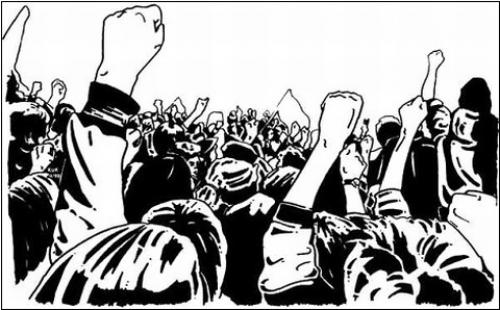
http://www.leftcom.org/files/styles/galleryformatter_slide/public/2008-03-11-pugni-alzati.jpg

- Proletariat empoverishment
- Trust in industrial workers only (as revolutionary)
- Workers' organization:

They considered that workers have to organise themselves in parties and unions to get ready for the revolution, but also to participate in politics, so different socialist parties like PSOE (Spain) were created following marxist ideas. 

http://petreraldia.com/wp-content/uploads/2014/05/logo-psoe.jpg

- Surplus value:

Workers produced profits with they work, but they didn't enjoy because they contributed to increase capitalist's wealth. 


https://anticap.files.wordpress.com/2015/01/money-trick.jpg

- Workers' alienation:

Workers became slaves of the machines due to the monotonous work in factories. This situation destroyed creativity. 

At the end of the class Paqui has tell us to complete a scheme about anarchism, that is what we're going to learn next day.

We've also learnt some new vocabulary:

alienation: alienación
class struggle: lucha de clases
commune: comuna
surplus value: plusvalía
scientific socialism:socialismo científico
material things: cosas materiales
wellbeing: bienestar

That's all today! See you in class :)