Marx and Engels working together
Karl Marx studied Law and later Philosophy and he was also interested in Economics and History. He worked as a journalist temporarily, but he spent most of the time writing books, where he explained his ideas.
Friedrich Engels´s father owned a textile factory in Manchester and Engels worked there, although he didn´t like the job. In Manchester Engels knew about the workers´ poverty and suffering and this caused a strong impression on him. Engels often helped Marx economically, lending him money, so that he could maintain his family.
In 1848 Marx and Engels, who were members of the Communist League, were in charge of writing one of the most influencial books in history: the Communist Manifesto. This book started with the following words: "A spectre is haunting Europe- the spectre of communism".
Marx wrote many other books. His major work was The Capital. Marx only finished the first of its three volumes. When he died, Engels completed and edited the two other volumes.
Marx read a lot of books and drew inspiration from several thinkers:
- The German Philosophers Hegel and Feuerbach.
- The British theorists of Economic Liberalism: Adam Smith and David Ricardo.
- The French socialists Blanqui, Proudhon and Blanc.
Here you have some of the conclusions Marx reached from his studies:
- Dialectical Materialism was the instrument used by Marx to analyze history. "Dialectical" comes from "dialogue" and it means reaching conclusions through debate, discussion. "Materialism" comes from "matter" and it means a scientific explanation of the world, letting divine explanations apart. According to Marx, humanity had moved forward due to a continuous fight between opposites. This confrontation (struggle) made change possible and gave birth to new situations.
Dialectical Materialism
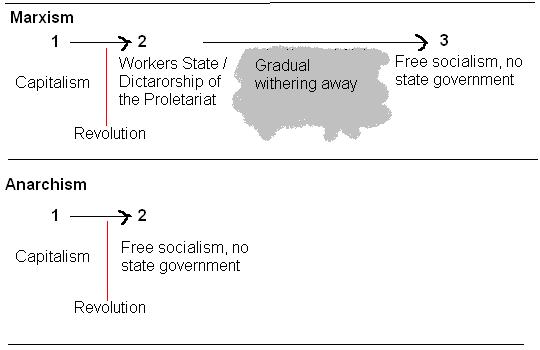
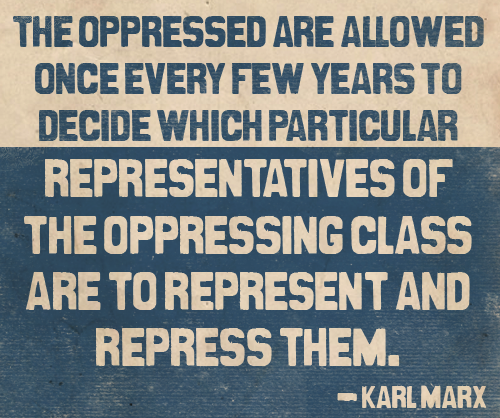
Marx observed that human history had been a continuous confrontation between oppressors and oppressed. Social harmony was impossible, because the domination of one social group was based on oppressing and exploiting other groups. For him class struggle was necessary for human progress. In the 19th century the two confronted groups were the bourgeois and the proletarians (workers) and their struggle would result into a proletarian revolution and lead to a communist society after a transition stage (dictatorship of the proletariat).
Dialectical Materialist analysis on history
- During the French Revolution the bourgeois had fought to defend freedom and private property. They had succeeded and then the citizens were free in theory. But for most of the population (those who didn´t own properties) the only freedom they had was the freedom of selling themselves, the freedom of selling their labour force to survive. Marx considered private property as the maximum form of alienation, because it obliged people to sell themselves in order to get things. The more things one had, the less of himself he had. And he also considered that much of the evil things of the world came from the defense of private property: wars, misery, crimes, discrimination, slavery... That´s why he predicted that in the future a revolution would end with private property and change it into collective.
- Marx was convinced of the fact that the internal contradictions of capitalism would lead to its destruction, because the workers wouldn´t stand the way they lived and they would start a revolution. Marx considered that workers had to be ready for revolution and they had to unite and form unions and political parties. However, Marx considered that labour parties could help workers get some concessions from the capitalists, but that wouldn´t modify the exploitation situation and revolution would be unavoidable.
- Marx also studied women´s condition and was a defender of women´s emancipation. He considered that in the family women were as proletarians and their husbands were as the bourgeois.
Marx´s works were read and interpreted by many people. Sometimes his ideas were misinterpreted to such a degree that Marx said "I´m not a Marxist". This means that he didn´t feel identified with many of the ideas considered to be Marxist. You don´t have to forget that Marx´s ideas were predictions, conclusions extracted from his studies, but not recipes or instructions about how to make a revolution.
The Communist Manifesto:
The Marx and Engels Internet Archive: