Showing posts with label scientific socialism. Show all posts

Thursday, February 12, 2015

Thursday, 12th February

Hello everybody!

Today it's my turn to do the journal and I'm starting in the break time because as I have two exams tomorrow I won't have enough time to do it. First of all Paqui has showed us a post that she has written about inequality with the distribution of money in the world. Then, Paqui has explained us the Utopian Socialism and when we were talking about the failed project of extending the New Lanarks to the U.S.A, Paqui has showed us a video that shows in a very good way how this model communities worked (with hydraulic power) and what they were like (with a lot of space, clean...) The teacher has also invited us to visit a website that talks about New Lanarks: www.newlanark.org


Today I have learnt that the Count of Saint Simon said that inheritance had to be forbidden because he thought that this money had to come back to the State, because if not, there would be people who would like comfortable with the inheritance they received, instead of working to earn money. According to the Count of Saint Simon, these people are the same as useless and parasitical as the kings, nobles...
Now I'm going to write two examples about this point of view:


  1.  Warren Buffet (one of the richest persons in the world) didn't leave his inheritance to his children, instead of this, he left his inheritance to charities. His children were agree with this decision because as they earn a lot of money by themselves they don't need more.    
  2. Paris Hilton is rich because of her father's inheritance. She doesn't work and she lives comfortably without doing anything. Another parasitical person (according to the Count of Saint Simon)

There's a lot of difference, don't you think?

We have also learnt that Charles Fourier's project of phalanstères failed because (as always) in his factory, there were people committed to their jobs and there were people who weren't committeed and took advantage of the committe's workers. So, the project was a complete chaos.
There was like an equivalent in Spain during the Civil War: The Anarchist communes. The difference is that in Spain it worked.

Phalanstère

Finally Paqui has explained us the Scientific socialism (or Marxism) ,she has written a scheme which included, the thinkers (Marx and Engels), the books they wrote explaining their ideas (The Communist Manifesto and The Capital) Their main ideas... For example, they predicted that there would be a proletarian revolution if the worker's conditions continued to be so bad. They said that this revolution would have two stages:

  1. Dictatorship of proletarian--> People would take the State to change property into collective property
  2. Communist society--> The creation of a society without classes, states and private property
For homework we have to complete the scheme until the part of Anarchism
Here you are the words we have copied on the glossary:

  • Industrialist: industrial, propietario de fábrica
  • Free housing: alojamiento gratuito
  • Committed: comprometido
  • Goal: objetivo
  • Parasitical: parásito (adjective)
  • Useless: Inútil
  • Phalanstère: falansterio 
  • Trustworthy: merecedor de confianza
  • To take advantage: aprovecharse
  • Commune: Comuna
  • Misinterpretation: mala interpretación
  • To foresee: predecir
  • Struggle=fight
Sources: http://en.wikipedia.org/wiki/New_Lanark
              https://mariocancel.wordpress.com/tag/charles-fourier/

That's all for today! See you next day!!

Thursday, February 28, 2013

Marxism for beginners


If you want to learn something else about Marxism, here you have some more information: 

- You can start reading the following post I wrote last year. It includes information about dialectical materialism, class struggle, Marx´s conclusions about private property and how it alienates people and his opinion about women´s submission and need for emancipation: 

http://todayinsocialsciences.blogspot.com.es/2012/01/something-more-about-marxism.html

- On the following link you can read the book Marx for beginners, written by a Mexican cartoonist called Rius in 1972. Rius used cartoons to explain the main ideas of Marxism, making them easier to understand: 

http://es.scribd.com/doc/28012909/Marx-for-beginners-by-RIUS

If some of you is interested in reading this book in Spanish, I can lend it to you.


- This is another link  from the Marxists Internet Archive, which includes different websites to start reading some Marx´s selected texts:

http://www.marxists.org/subject/students/index.htm

- This is a video I´ve found, made by a high school student, which explains in a very simple way some concepts developed by Marx and Engels, like the surplus concept and how extreme differences of wealth lead to impoverishment and cyclical crises in capitalism. This student based her video on Sophia´s World (El Mundo de Sofía), a book of Philosophy for teenagers. She made a really good work and you can draw inspiration from her work to do your projects: 


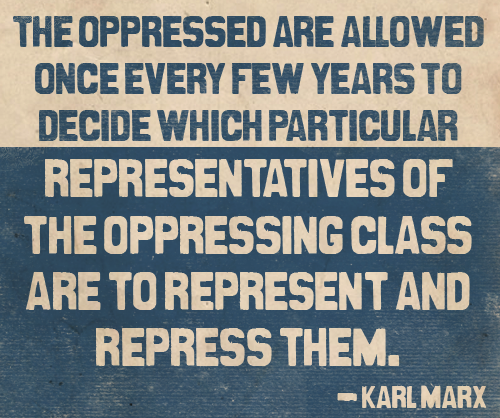
And finally, this is a Marx´s quote about the oppressed and the oppressors and their role in society:

- Karl Marx and his wonderful views on society

Wednesday, February 1, 2012

Eugene Debs


Eugene Debs was an important organizer of the workers in the USA in the last decades of the 19th century and the first decades of the 20th century. He also ran for president in several elections, but he didn´t get many votes. This is part of his interesting story: 

He started working when he was 14 years old in a railway company. He worked as a locomotive fireman and joined the Broterhood of Locomotive Firemen, a mutual benefit society for the railway workers. He also went to a night school to learn more and became an important figure in the Broterhood. But he thought that broterhoods were only focused on their members and he decided to create a union in 1893: the American Railway Union, which was one of the first industrial unions created in the USA. 

In 1894 the workers of the Pullman Company (the one that made the train cars) decided to go on strike, because the company had reduced their salaries by 28%. Debs considered that the union was not strong enough to go on strike yet, but the strike extended and he finally decided to join the strikers. The USA government got a warrant from the Court to oblige the workers to come back to work, because thay had obstructed the distribution of U.S. mail, and sent the army to end with the strike. Debs was arrested and sent to prison for six months. 

The time he spent in prison was crucial for him. He received thousands of letters and he read books about socialism and became aware of the injustice of the capitalist system. When he went out from prison, more than 100,000 people received him in Chicago. 

After his experience in jail, Debs went on with the organization of workers and contributed to the foundation of the Social Democratic Party in the USA and the Industrial Workers of the World (IWW), an international union. Although he was a prominent and influencial figure, he rejected to be considered as a leader. He though that workers had to decide by themselves and not to follow others´ ideas. He said: "You must use your heads as well as your hands and get yourself out of your present condition". 

Debs ran for the presidence of the USA in 1904, 1908, 1912 and 1920, but he didn´t get much support of the workers. His best result was in 1912, when he got 6% of the votes (901,551 votes).


In June 1918 he made a speech in Canton, Ohio, against military conscription for World War 1. As many Socialists, he considered that war to be in the interest of capitalists. Here you have part of his speech, read by the actor Marc Ruffalo:


No wonder Sam Johnson declared that “patriotism is the last refuge of the scoundrel.” He must have had this Wall Street gentry in mind, or at least their prototypes, for in every age it has been the tyrant, the oppressor and the exploiter who has wrapped himself in the cloak of patriotism, or religion, or both to deceive and overawe the people.

Every solitary one of these aristocratic conspirators and would-be murderers claims to be an arch-patriot; every one of them insists that the war is being waged to make the world safe for democracy. What humbug! What rot! What false pretense! These autocrats, these tyrants, these red-handed robbers and murderers, the “patriots,” while the men who have the courage to stand face to face with them, speak the truth, and fight for their exploited victims—they are the disloyalists and traitors. If this be true, I want to take my place side by side with the traitors in this fight.

Wars throughout history have been waged for conquest and plunder. In the Middle Ages when the feudal lords who inhabited the castles whose towers may still be seen along the Rhine concluded to enlarge their domains, to increase their power, their prestige and their wealth they declared war upon one another. But they themselves did not go to war any more than the modern feudal lords, the barons of Wall Street go to war. The feudal barons of the Middle Ages, the economic predecessors of the capitalists of our day, declared all wars. And their miserable serfs fought all the battles. The poor, ignorant serfs had been taught to revere their masters; to believe that when their masters declared war upon one another, it was their patriotic duty to fall upon one another and to cut one another’s throats for the profit and glory of the lords and barons who held them in contempt. And that is war in a nutshell. The master class has always declared the wars; the subject class has always fought the battles. The master class has had all to gain and nothing to lose, while the subject class has had nothing to gain and all to lose—especially their lives.

They have always taught and trained you to believe it to be your patriotic duty to go to war and to have yourselves slaughtered at their command. But in all the history of the world you, the people, have never had a voice in declaring war, and strange as it certainly appears, no war by any nation in any age has ever been declared by the people.

And here let me emphasize the fact—and it cannot be repeated too often—that the working class who fight all the battles, the working class who make the supreme sacrifices, the working class who freely shed their blood and furnish the corpses, have never yet had a voice in either declaring war or making peace. It is the ruling class that invariably does both. They alone declare war and they alone make peace.

Yours not to reason why;
Yours but to do and die.

That is their motto and we object on the part of the awakening workers of this nation. 

If war is right, let it be declared by the people. You who have your lives to lose, you certainly above all others have the right to decide the momentous issue of war or peace.

This speech was considered to be anti-patriotic and Debs was prosecuted by treason and sentenced to 10 years and disenfranchised (deprived of the right to vote) for life. President Wilson refused to pardon him. In 1921 President Harding commuted his sentence, because Debs was ill, and he was released on the 25th December 1921. A crowd of 50,000 people received him at home. 


Eugene Debs died in 1926. His life was an example of fight for the ideas he believed in and consistency with the defense of his principles. 


Tuesday, January 31, 2012

Something more about Marxism


Marx and Engels working together


Karl Marx studied Law and later Philosophy and he was also interested in Economics and History. He worked as a journalist temporarily, but he spent most of the time writing books, where he explained his ideas.

Friedrich Engels´s father owned a textile factory in Manchester and Engels worked there, although he didn´t like the job. In Manchester Engels knew about the workers´ poverty and suffering and this caused  a strong  impression on him. Engels often helped Marx economically, lending him money, so that he could maintain his family. 

In 1848 Marx and Engels, who were members of the Communist League, were in charge of writing one of the most influencial books in history: the Communist Manifesto. This book started with the following words: "A spectre is haunting Europe- the spectre of communism". 

Marx wrote many other books. His major work was The Capital. Marx only finished the first of its three volumes. When he died, Engels completed and edited the two other volumes. 

Marx read a lot of books and drew inspiration from several thinkers: 
- The German Philosophers Hegel and Feuerbach.
- The British theorists of Economic Liberalism: Adam Smith and David Ricardo.
- The French socialists Blanqui, Proudhon and Blanc.

Here you have some of the conclusions Marx reached from his studies:

- Dialectical Materialism was the instrument used by Marx to analyze history. "Dialectical" comes from "dialogue" and it means reaching conclusions through debate, discussion. "Materialism" comes from "matter" and it means a scientific explanation of the world, letting divine explanations apart. According to Marx, humanity had moved forward due to a continuous fight between opposites. This confrontation (struggle) made change possible and gave birth to new situations.

Dialectical Materialism

Marx observed that human history had been a continuous confrontation between oppressors and oppressed. Social harmony was impossible, because the domination of one social group was based on oppressing and exploiting other groups. For him class struggle was necessary for human progress. In the 19th century the two confronted groups were the bourgeois and the proletarians (workers) and their struggle would result into a proletarian revolution and lead to a communist society after a transition stage (dictatorship of the proletariat).


Dialectical Materialist analysis on history


- During the French Revolution the bourgeois had fought to defend freedom and private property. They had succeeded and then the citizens were free in theory. But for most of the population (those who didn´t own properties) the only freedom they had was the freedom of selling themselves, the freedom of selling their labour force to survive. Marx considered private property as the maximum form of alienation, because  it obliged people to sell themselves in order to get things. The more things one had, the less of himself he had. And he also considered that much of the evil things of the world came from the defense of private property: wars, misery, crimes, discrimination, slavery... That´s why he predicted that in the future a revolution would end with private property and change it into collective.

- Marx was convinced of the fact that the internal contradictions of capitalism would lead to its destruction, because the workers wouldn´t stand the way they lived and they would start a revolution. Marx considered that workers had to be ready for revolution and they had to unite and form unions and political parties. However, Marx considered that labour parties could help workers get some concessions from the capitalists, but that wouldn´t modify the exploitation situation and revolution would be unavoidable.

- Marx also studied women´s condition and was a defender of women´s emancipation. He considered that in the family women were as proletarians and their husbands were as the bourgeois.

Marx´s works were read and interpreted by many people. Sometimes his ideas were misinterpreted to such a degree that Marx said "I´m not a Marxist". This means that he didn´t feel identified with many of the ideas considered to be Marxist. You don´t have to forget that Marx´s ideas were predictions, conclusions extracted from his studies, but not recipes or instructions about how to make a revolution. 

The Communist Manifesto: 


The Marx and Engels Internet Archive: