Showing posts with label figures. Show all posts

Thursday, December 13, 2012

Maximilien Robespierre: a vindication

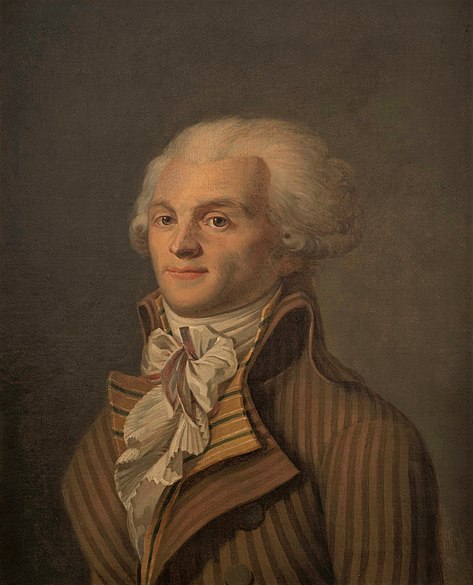
File:Robespierre.jpg


Maximilien Robespierre, called The Incorruptible, was the main figure of the Jacobins and has gone down in history as the personification of the Reign of Terror. His name has always been linked to the period of extraordinary measures which included executions by guillotine of the suspected counter-revolutionaries. He was presented as a bloodthisrty dictator, responsible for uncountable atrocities. This image dates back to the Thermidorian Reaction: those who deposed the Jacobins and presented themselves as moderates and claiming for order spread a very negative vision of the Jacobins and found the perfect scapegoat in Robespierre. The winners of the French Revolution, the respectable bourgeois who got the rights they were looking for, used the Jacobin period as a threat and a symbol of chaos and injustice. But what part of this is true? Who was Robespierre and what were his main ideas?

Robespierre was born in Arras, in North Western France. His family belonged to the low bourgeoisie: his father was a lawyer and his maternal grandfather owned a brewery. When he was 11 years old, he received a grant to study in Paris, where he became a lawyer too. Back in Arras, he started working and soon became very popular, because he participated in some very famous trials, defending workers against the abuses of the privileged. He also used the trials to criticize injustice and the bad running of the structures of the Ancien Régime. When Louis XVI called the Estates General in 1788 Robespierre wrote the book of grievances of Arras shoemakers´ guild and was elected deputy of the Third Estate. Once in Versailles, he joined the Club Bréton and later the Jacobin Club in Paris. In the National Constituent Assembly and also in the Jacobin Club he participated in a lot of debates, where he exposed his ideas and expectations: 

- He opposed to the death penalty and explained that forgiving a hundred guilty people was preferable to sacrificing one innocent person.

- He defended the abolition of slavery and equal rights fot the inhabitants of the colonies

- He defended the participation of women in political clubs

- He supported universal suffrage, was against the division into active and passive citizens and believed in democracy

- He fought for the equality of rights for Jews and Protestants, defended religious tolerance and clerical marriage. He believed in God and thought that the decisions against the Church (like dechristianization) could be very negative to the Revolution. In fact, during the Jacobin Convention, he rejected the cult of Reason and proposed the alternative cult of the Supreme Being, as a way of reconciling religious beliefs with the revolutionary ideas. 

- He was against press censorship and martial law and defended freedom of speech, freedom of press,  protection of communications and freedom of association for workers.

- He considered that the right to survive was above other rights and was against punishing people who had committed crimes due to famine or because they wanted to live better. 

- He considered that people were good by nature, defended social justice, education and the fight for improving the living conditions of the poorest. 

- He was against wars of conquest and considered that the only wars worth fighting were the ones against tyrants, not against other peoples. 

- His definition of nation included all the people who had expressed their will of living together under common laws, no matter where they were born.

Could a person with these ideas be considered the monster most books of history have depicted? Why did he change his mind about some of his principles? The answer can be found in circumstances. Many revolutionaries had to make important decisions when they were confronted with the dilemma of  defending the achievements of the revolution and going on with changes or surrendering to counter-revolution. There were two opposed alternatives and they had to decide which one they preferred and what sacrifices were worth being done.  

Robespierre was not obsessed with the idea of founding a Republic, because he was aware of the risk of eliminating monarchy, but when Louis XVI tried to flee from France and his conspiracy against the Revolution was discovered, Robespierre supported the supression of the monarchy and the execution of the king (he said "It is with regret that I pronounce the fatal truth. The king must die so that the country can live"). He became one of the most important figures of the National Convention and when the Jacobins took the control, he was elected member of the Committee of Public Safety. His responsibility in the extraordinary measures the Committee took was shared with the other members of this organ. He detested violence, but also knew that revolutions had always been violent. Violence was very present in the 18th century and the urgency of the situation in France demanded quick and extraordinary actions. Deciding against his principles had an extraordinary cost to Robespierre´s health and during the last month of his life he was constantly sick and felt very weak, but the responsibilty of building a new and fairer society made him come back to the Convention. A conservative reaction against the policy the Jacobins were following deposed them and on the 28th July 1794 he was executed by guillotine without previous trial, together with other Jacobin leaders. The memory of their efforts was hidden by the bloody stories the winners told about them. They invented the expression Reign of Terror to define the Jacobin period and spread the ideas everybody links to Robespierre. But the Jacobin Convention and especially the Incorruptible deserve a fairer study. 

Here you have one paragraph of one of Robespierre´s most important speeches, on political morality: 

In our land we want to substitute morality for egotism, integrity for formal codes of honor, principles for customs, a sense of duty for one of mere propriety, the rule of reason for the tyranny of fashion, scorn of vice for scorn of the unlucky; self-respect for insolence, grandeur of soul for vanity, love of glory for the love of money, good people in place of good society. We wish to substitute merit for intrigue, genius for wit, truth for glamor, the charm of happiness for sensuous boredom, the greatness of man for the pettiness of the great, a people who are magnanimous, powerful, and happy, in place of a kindly, frivolous, and miserable people—which is to say all the virtues and all the miracles of the republic in place of all the vices of the monarchy. . . .
On Political Morality, 5th February 1794 


File:Robespierre exécutant le bourreau.jpg

Satirical drawing of Robespierre executing the executioner after having guillotined everyone in France


Most of the content of this post comes from two books in Spanish I´ve read recently: 

- McPHEE, Peter, Robespierre: una vida revolucionaria, Ed. Península, Barcelona 2012. This is an extraordinary and documented biography, written by an Australian historian. Here you have some links about this book in English and Spanish: 


- GARCÍA SÁNCHEZ, Javier, Robespierre, Galaxia Gutenberg, Círculo de Lectores, Barcelona, 2012. This is a very long historical novel (more than 1,000 pages) that I still haven´t finished, but it has a very interesting post scriptum about how historians have treated Robespierre and the Jacobins and the reasons for this bad treatment. Here you have a review of this novel in Spanish: 


And finally, here you have some Robespierre´s quotes: 

- The secret of freedom lies in educating people, whereas the secret of tyranny is in keeping them ignorant. 

- To punish the opressors of humanity is clemency; to forgive them is cruelty.

- Any law which violates the inalienable rights of man is essentially unjust; it is not a law at all. 

- We must smother the internal and external enemies of the Republic or perish with it; now in this situation, the first maxim of your policy ought to be to lead the people by reason and the people's enemies by terror.

Wednesday, March 28, 2012

The trigger for war: the dead, the killer and the ultimatum


Archduke Franz Ferdinand and wife


Gavrilo Prinzip, the Serbian student who killed the Austro- Hungarian heirs to the throne. 

After the assassination of the heirs to the Austro- Hungarian throne in Sarajevo (Bosnia-Herzegovina), the killer, Gavrilo Prinzip, was arrested and Austria- Hungary sent a 48-hours ultimatum to Serbia. Here you have the text: 


The Royal Serbian Government [will] further undertake:


1. To suppress any publication which incites hatred and contempt of the Austro-Hungarian monarchy and the general tendency of which is directed against territorial integrity;

2. To dissolve immediately the society styled “Narodna Odbrana,” to confiscate all its means of propaganda, and to proceed in the same manner against other societies and their branches in Serbia which engage in propaganda against the Austro-Hungarian Monarchy. The Royal government shall take the necessary measures to prevent the societies dissolved from continuing their activities under another name and form;

3. To eliminate without delay from public instruction in Serbia, both as regards the teaching body and also as regards the methods of instruction, everything that serves, or might serve, to foment the propaganda against Austria-Hungary;

4. To remove from military service, and from the administration in general, all officers and functionaries guilty of propaganda against the Austro-Hungarian Monarchy whose names and deeds the Austro-Hungarian government reserve to themselves the right of communicating to the royal government;

5. To accept the collaboration in Serbia of representatives of the Austro-Hungarian Government for the suppression of subversive movement directed against the territorial integrity of the monarchy;

6. To take judicial proceedings against accessories to the plot of 28th June who are on Serbian territory; delegates of the Austro-Hungarian government will take part in this investigation relating thereto;

7. To proceed with out delay to the arrest of Major Voija Tankositch and of the individual named Milan Ciganovitch, a Serbian State employee, who have been compromised by the results of the magisterial inquiry at Serajevo;

10. To notify the Imperial and Royal government without delay of the execution of the measures compromised under the preceding heads.

The Austro-Hungarian Government expect[s] the reply of the Royal Government by 6 o’clock on Saturday evening the 25th July.


Source of the text:

http://www.historyteacher.net/EuroProjects/DBQs2002/DBQ2002_WW2_DifferentChoices.htm

Wednesday, February 1, 2012

Eugene Debs


Eugene Debs was an important organizer of the workers in the USA in the last decades of the 19th century and the first decades of the 20th century. He also ran for president in several elections, but he didn´t get many votes. This is part of his interesting story: 

He started working when he was 14 years old in a railway company. He worked as a locomotive fireman and joined the Broterhood of Locomotive Firemen, a mutual benefit society for the railway workers. He also went to a night school to learn more and became an important figure in the Broterhood. But he thought that broterhoods were only focused on their members and he decided to create a union in 1893: the American Railway Union, which was one of the first industrial unions created in the USA. 

In 1894 the workers of the Pullman Company (the one that made the train cars) decided to go on strike, because the company had reduced their salaries by 28%. Debs considered that the union was not strong enough to go on strike yet, but the strike extended and he finally decided to join the strikers. The USA government got a warrant from the Court to oblige the workers to come back to work, because thay had obstructed the distribution of U.S. mail, and sent the army to end with the strike. Debs was arrested and sent to prison for six months. 

The time he spent in prison was crucial for him. He received thousands of letters and he read books about socialism and became aware of the injustice of the capitalist system. When he went out from prison, more than 100,000 people received him in Chicago. 

After his experience in jail, Debs went on with the organization of workers and contributed to the foundation of the Social Democratic Party in the USA and the Industrial Workers of the World (IWW), an international union. Although he was a prominent and influencial figure, he rejected to be considered as a leader. He though that workers had to decide by themselves and not to follow others´ ideas. He said: "You must use your heads as well as your hands and get yourself out of your present condition". 

Debs ran for the presidence of the USA in 1904, 1908, 1912 and 1920, but he didn´t get much support of the workers. His best result was in 1912, when he got 6% of the votes (901,551 votes).


In June 1918 he made a speech in Canton, Ohio, against military conscription for World War 1. As many Socialists, he considered that war to be in the interest of capitalists. Here you have part of his speech, read by the actor Marc Ruffalo:


No wonder Sam Johnson declared that “patriotism is the last refuge of the scoundrel.” He must have had this Wall Street gentry in mind, or at least their prototypes, for in every age it has been the tyrant, the oppressor and the exploiter who has wrapped himself in the cloak of patriotism, or religion, or both to deceive and overawe the people.

Every solitary one of these aristocratic conspirators and would-be murderers claims to be an arch-patriot; every one of them insists that the war is being waged to make the world safe for democracy. What humbug! What rot! What false pretense! These autocrats, these tyrants, these red-handed robbers and murderers, the “patriots,” while the men who have the courage to stand face to face with them, speak the truth, and fight for their exploited victims—they are the disloyalists and traitors. If this be true, I want to take my place side by side with the traitors in this fight.

Wars throughout history have been waged for conquest and plunder. In the Middle Ages when the feudal lords who inhabited the castles whose towers may still be seen along the Rhine concluded to enlarge their domains, to increase their power, their prestige and their wealth they declared war upon one another. But they themselves did not go to war any more than the modern feudal lords, the barons of Wall Street go to war. The feudal barons of the Middle Ages, the economic predecessors of the capitalists of our day, declared all wars. And their miserable serfs fought all the battles. The poor, ignorant serfs had been taught to revere their masters; to believe that when their masters declared war upon one another, it was their patriotic duty to fall upon one another and to cut one another’s throats for the profit and glory of the lords and barons who held them in contempt. And that is war in a nutshell. The master class has always declared the wars; the subject class has always fought the battles. The master class has had all to gain and nothing to lose, while the subject class has had nothing to gain and all to lose—especially their lives.

They have always taught and trained you to believe it to be your patriotic duty to go to war and to have yourselves slaughtered at their command. But in all the history of the world you, the people, have never had a voice in declaring war, and strange as it certainly appears, no war by any nation in any age has ever been declared by the people.

And here let me emphasize the fact—and it cannot be repeated too often—that the working class who fight all the battles, the working class who make the supreme sacrifices, the working class who freely shed their blood and furnish the corpses, have never yet had a voice in either declaring war or making peace. It is the ruling class that invariably does both. They alone declare war and they alone make peace.

Yours not to reason why;
Yours but to do and die.

That is their motto and we object on the part of the awakening workers of this nation. 

If war is right, let it be declared by the people. You who have your lives to lose, you certainly above all others have the right to decide the momentous issue of war or peace.

This speech was considered to be anti-patriotic and Debs was prosecuted by treason and sentenced to 10 years and disenfranchised (deprived of the right to vote) for life. President Wilson refused to pardon him. In 1921 President Harding commuted his sentence, because Debs was ill, and he was released on the 25th December 1921. A crowd of 50,000 people received him at home. 


Eugene Debs died in 1926. His life was an example of fight for the ideas he believed in and consistency with the defense of his principles.