Today, it has been the last Social Sciences' lesson of this second term. Only 13 people have come to the lesson, so it has been a relaxed lesson and we have talked about different topics.
Salva has asked Paqui about the birth of the
Nazarenos tradition and about the origin of the "
capirote" (conned hood), so Paqui has shown us some information about this topic.
A
capirote is a pointed hat of conical form which is used in Spain.
Historically, the capirote was a cardboard cone that flagellants (practitioners of an extreme form of mortification of their own flesh by whipping it with various instruments) in Spain would use.
It was also used during capital punishment in Spain, and also during the Inquisition, when the condemned person was forced to wear one conned hood and be put under public humiliation. It is also the uniform of some brotherhoods including the Nazarenos during Easter observances and reenactments in some areas of Spain.
First, Paqui has shown us a post on the blog about the
Sanbenitos and the Holy Inquisition.
The word Sanbenito comes from "
saco bendito" (blessed sack) and it was a penitential dress worn, originally, by Catholic people to show, publically, their repentance for the sins they had committed. Then, it was worn by the convicted heretics condemned by the Holy Inquisition. It was a way of public slander and shame. The convicted had to wear the Sanbenito during the auto-da-fe and later, until they finished their penance. Those who were condemned to death wore the Sanbenito until the moment they were executed.The sambenito was worn over everyday clothes and for periods of one year or lifetime. When the convicted finished their penance or after their execution, all the Sanbenitos were collected by the Church officials and publicly displayed in parish churches, with the names of the convicted. With this, the Inquisition intentionally looked for the persistence of the crime and the embarrassment of the heretics and their descendants. The condemned suffered social and labor rejections.
There were different types of Sanbenitos; the colours and drawings indicated the crimes the convicted had committed and the punishments they deserved:
- The
Samarra was used by those condemned to death, frequently burnt at the stake. It consisted of painted dragons, devils, and flames and the image of the convicted.
- The
Fuego revolto was used for those who had repented. The flames were painted downwards, showing that they had escaped death.
- The
Sambenito was commonly used by those in penitence and those who had committed "lighter" crimes, such as blasphemy or adultery. It included the cross of Saint Andrew.
The convicted also wore a pointed cap, called "coroza", rosaries and candles of different colours. This "coroza" is similar to the one worn by the Nazarenos (penitents).
There is an expression in Spanish related to this garment: “to hang someone with the Sanbenito” (“
colgarle a uno el sambenito”). This means “unfairly blaming someone for something he/she is not responsible for”, “reminding only a person´s bad actions and forgetting the good ones”, “negatively labelling someone”. There is another expression related to the Sanbenito: " to get rid of the Sambenito" ("
quitarse el sambenito"). This one refers to the difficulties of getting rid of an unfairly bad reputation.
Francisco de Goya had a lot of problems with the Inquisition, especially with a series of engravings called
Caprichos, which represented a satire of the Spanish society, above all, the clergy and the nobility. The Inquisition wanted to prosecute Goya. Finally, Goya gave the engraving plates to king Carlos IV as a present to avoid being arrested.
Paqui has explained that an auto-da-fé was the ritual of public penance of condemned heretics and apostates (person who rejected the Christian faith) that took place when the Inquisition had decided their punishment, followed by the execution by the civil authorities of the sentences imposed by the ecclestiastical court.
The most "famous" auto-da-fé are two which took place on the 21st May and on the 8th October 1559. On the 21st May, 14 people and the bones and statue of another person were burnt and 16 people were reconciled by penance. On the 8th October, 13 people and the bones of another were burned, and other 16 people were penitenced.
The last auto-da-fé took place in 1826. In the last auto-da-fé, the teacher Cayetano Ripoll was sentenced to be hanged and then burned. But in those times, such horrible spectacles were not allowed, the sentence said that he wouldn't be really burned, but the flames would be painted in a cube.
Cayetano Ripoll was a Deist and the last person to be killed by the Inquisition on the 31st July 1826. He was accused of being a Deists, teaching his students about Deism and not believing in the Catholic dogmas. The Inquisition killed him because he was teaching other people about Deism.
Deism is a philosophical position which accepts the existence and nature of God through reason and personal experience, instead of doing it through the common elements of the theistic religions such as direct revelation, faith or tradition. So a deist is the person who affirm the existence of God, but he or she doesn't practise any religion. The Christian murder of Cayetano Ripoll is a warning sign to everyone of the danger of uniting "revealed" religion and government. It is also a sign of victory of principles, courage and wisdom over the ignorance and fear of Christianity.
Salva has asked about hte clothes the Ku Klux Klan wear and if there's a relation with the Nazarenos.
The costume of the Ku Klux Klan is perhaps the most distinctive feature of the Ku Klux Klan, and it is recognized worldwide.
The origins of the use of the costume are unclear. Such garments have been traditionally used in festivities such as Holy Week, symbolizing the act of penance. In Spain and its former territories, which included parts of the United States, the pointed hat is called "Capirote". The hoods worn by the Ku Klux Klan bear some resemblance to the Spanish capirote.
The modern Klan's design inspirations came from D. W. Griffith's film
Birth of a Nation, whose costume designers likely copied the style of the film's hoods from the ancient capirote.
On the 4th July 1914, director D.W. Griffith began to work on a new movie called
The Clansman, an epic about the Civil War and the subsequent agonies of Reconstruction. It was a major production, an epic in every sense of the word.
The Clansman, later retitled
The Birth of a Nation, is still considered a landmark of the American cinema. The film has been praised for its technical virtuosity and damned for its demeaning and racist depiction of black Americans. The director was interested in the social, not political, effects of the Civil War and its immediate aftermath. Griffith and his cameraman Billy Bitzer used a dazzling array of techniques in such brilliant and innovative ways.
The unconscious racism and implied unquestioning acceptance of black inferiority in that statement reflect Griffith's view of black-white relations. Thirty years later, those attitudes would find new expression in
The Birth of a Nation. The director had to made up some white actors with black paint, because it was really difficult to found black actors who wanted to act in the movie.
The Clansman was written by Thomas Dixon, a Baptist preacher from North Carolina. The preacher once noted that "
my object is to teach the North, the young North, what it has never known — the awful suffering of the white man during the dreadful Reconstruction period." He wanted to demonstrate to the world that the white man must and shall be supreme. These were sentiments that D.W. Griffith endorsed as well.
The movie's plot revolves around two families, one Northern and one Southern. It tells the happiness and misfortune both families lived during the American Civil War.
This film was racist and its depiction of the KKK influenced the future costumes they used. The film was openly racist and many politicians (especially from the Democratic Party) supported the Klan . Birth of a Nation is considered to be one of the 10 best films in history. The racism is clearly shown, because life in the prewar South is depicted in an idyllic moonlight and magnolias fashion, with paternalistic whites taking care of happy, carefree slaves, but when war ends, Southern whites are degraded, abused and forced to acknowledge blacks as equals. Besides, the movie shows that death was preferable to a possible rape or even a black man's embrace when one character prefers fall or jump (the action is ambiguous) because a slave was making advances to her.
But many of the plot details were fictional: the Klan was not created by a man who watched some white children playing ghost, whose costumes scares some black youngsters. It was founded by a group of former Confederate officers in Tennessee. It began as a charitable organization that helped Confederate widows and orphans, but then, Klansmen used intimidation, torture and even murder against invaders and villains and to prevent newly enfranchised blacks from going to the polls.
The local chapter of the National Association for the Advancement of Colored People (NAACP) tried to get an injunction to stop the premiere, but the legal argument had too narrow a focus and failed to stop the screening. The NAACP, founded in 1909, was composed of both blacks and white liberals and actively campaigned for black rights.
Thomas Dixon was impressed with the movie, and decided to pull some strings to guarantee its ultimate success, so he asked Woodrow Wilson, an old college friend who just became president of the USA, for watching the film. But Wilson was still in mourning for his first wife and publicly going to a movie theater would be inappropriate, so the movie was projected on the White House.
The NAACP tried to stop the upcoming New York premiere by appealing to the National Board of Censorship. The movie was shown to the entire board, but it was dazzled by the movie's sheer narrative power and sweeping spectacle. The cities of Chicago; Denver; Kansas City, Missouri; Minneapolis; Pittsburgh; and St. Louis, Missouri, refused to allow the film to open.
In an obvious effort to disarm his critics, Griffith added a title card that firmly states, "
This is an historical presentation of the Civil War and Reconstruction period, and is not meant to reflect on any race or people of today."
In Griffith's world there are two kinds of blacks. The first are those who know their place and accept their natural inferiority. They know that racial equality will only lead to disaster.
The other kind of black is the renegade, who refuses to accept his destiny and dares to think he is as good as a white person. Denied the guidance of his betters, he soon falls into a life of laziness, vice and crime.
Unfortunately,
The Birth of a Nation became a recruiting tool for the revived Klan, which was certainly not Griffith's intention. Some have claimed that Griffith's epic sparked the resurgence of the Klan since Klan recruiting propaganda was sometimes printed side by side with the movie's theatre ads. The film's impact on that resurgence, though considerable, has been grossly exaggerated.
Despite of all the controversies, vilifications and court battles,
The Birth of a Nation was a critical and popular success, far and away the most profitable film of the silent era.
Then, we have started talking about
Germany from the unification to reunification, information Paqui included on a post to answer a question Juan did to her some days ago about the extension of Germany through history. Paqui has shown us some maps, where we have seen the evolution of the country from 1871 to present day. The period of the Second Reich was a period between 1871-1919 and is commonly referred to as Wilhelmine Germany as it is under the reign of Kaiser Wilhem II from 1890-1919.
Then, we have seen a map about Germany after World War 1 until Hitler's arrival to power, period between 1919 to 1933. Germany after the First World War was completely devastated by the effects of the Treaty of Versailles, which was the official end of World War I between the Allied and Central Powers and the German Empire. As a result of the Treaty of Versailles, Germany lost all of their gained territory prior to and during the war. The Treaty also required them to pay reparations to all the countries damaged by the war such as France, Belgium, and other European countries. Spending over 22 billion dollars severely hurt their economy by forcing the German government to print of more money which ended up making their dollar practically worthless.
Between 1933 and 1939, the Third Reich took place. During this period, Hitler seized the German territories, being most of them those ones Germany had lost in the Versailles Treaty: Saarland, Rhineland, Austria, Sudetendland, Protectorate of Bohemia and Moravia (Czechoslovakia)...
Then, Paqui has shown us the a map with the German expansion during the Second World War, which included all the territories annexed to Germany until 1942. The Nazis called it the Greater Germany.
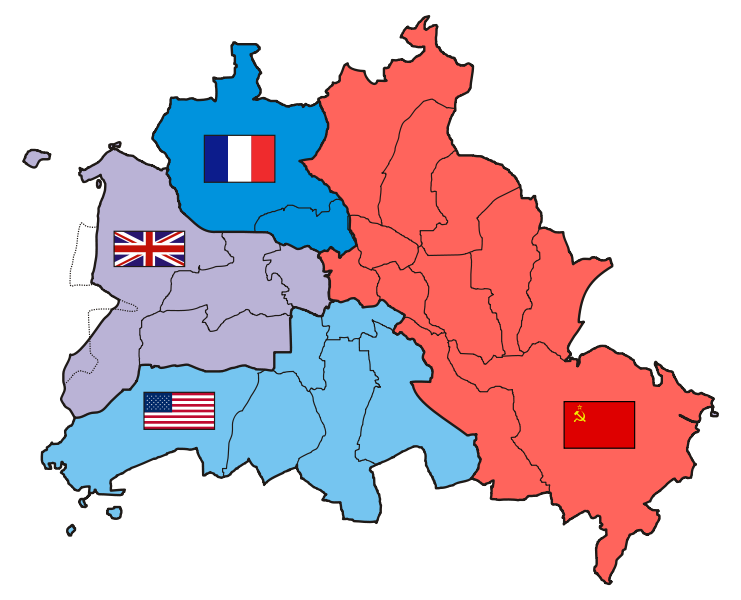
After World War 2 (1945 to 1948), Germany was divided into four zones, occupied by the allies: the USA, UK, France and the USSR. Berlin was also divided into four zones
After that, we have spoken about the division of Germany between 1949 to 1991, when the disputes between the Western allies and the USSR led to the Berlin blockade in 1948. After this crisis, two States were created: the Federal Republic of Germany in the West and the German Democratic Republic in the East. Berlin was also divided into two zones. In 1961, a wall was built inside Berlin, which physically represented the division of the world into two opposed blocks during the Cold War. The Berlin Wall was built by the German Democratic Republic. The Eastern Bloc claimed that the wall was erected to protect its population from fascist elements conspiring to prevent the "will of the people" in building a Socialist State in East Germany. In practise, the Wall served to prevent the massive emigration and defection that marked Germany and the communist Eastern Bloc during the post-World War II period.
After the fall of the Berlin Wall on the 9th November 1989, 28 years after it was built, the reunification process of Germany started. Germany became officially an only State on the 3rd October 1990. We have seen a map which shows Germany as it is today. Germany is formed by different Länder (federal States), which are similar to the autonomous communities in Spain, although they have more power.
Finally, Paqui has shown us some cartoons about a "German Europe". She has said that some experts think that things would go better in Europe if there's an European Germany rather than a German Europe.
We have also seen a cartoon which represents the positions the countries occupied in the EU, being Germany at the top, followed by France and the United Kingdom. Paqui has said that is convenient for the United Kingdom to be in the European Union, so they could veto decisions which could be harmful for it.
Afterwards, we have talked about
Social Darwinism. Paqui included some information about this topic on the blog few days ago, where she explains that Darwin's ideas were distorted by Social Darwinism. She wrote this post to explain us why "white" men thought that they were superior to other people.
Charles Darwin was an English naturalist who established that all species have descended over time from common ancestors and proposed the scientific theory that this branching pattern of evolution resulted from a process that he called natural selection, in which the struggle for existence has a similar effect to the artificial selection involved in selective breeding. But his ideas were distorted by Social Darwinism.
The theory of evolution developed by Darwin explains that the survivors of every species are the best adapted to the environment: the best fitted. Social Darwinism adapted the theory of evolution to explain how societies work. The theorists of this current considered that there were better fitted "races" (the "white" people") and that was the explanation to their superiority and their right to control the inferior "races". Competition between the different "races" would determine the hegemony of the victorious ones and the submission of those considered to be inferior.
Social Darwinism was used to classify people into different "races", depending on the colour of people´s skin or the size of their heads.
Eugen Fischer was a a German and Nazi professor of medicine, anthropology and eugenics. During the Second World War, he was the responsible for studying racial hygiene and for sending Jews to exterminate. He considered bastard and mentally ill people to be faulty. He classified people into “races” based on physical traits such as head size and eye, hair and skin colour. This classification was published in the 1921 and 1923 editions of
Foundations of Human Genetics and Racial Hygiene.
Paqui and some classmates have commented that a Greek footballer, Giorgos Katidis, has been expelled for life from the national team by the Greek Football Federation because he celebrated a goal with the Nazi greeting. The player's insistence that he did not know the meaning of the gesture seems ridiculous. "Katidis is probably not a fascist. But he is certainly an idiot", as has said a British newspaper.
Social Darwinists also defended eugenics. Paqui has explained us what eugenics is. It is a social philosophy which defends the improvement of the genetic inheritance of human beings through different ways (selective breeding, genetic engineering, sterilising first and eliminating later the people who had any physical of psychic flaw, in vitro fertilisation...), that is, improve human hereditary traits through the promotion of higher reproduction of more desired people and traits, and reduced reproduction of less desired people and traits, in order to get "pure" individuals.
Historically, eugenics has been used as an justification for coercive discrimination and violations of human rights promoted by the State, such as forced sterilisation of people with genetic defects... and, in some cases, the genocide of races and cultures considered to be inferior.
These ideas were used in different countries to sterilise those considered to be inferior (mentally or physically disabled people) and sustained the Nazi extermination policy during World War 2.
We have seen a photo of a brochure of the American Eugenics Society. It shows fit and unfit marriages and it said that as Americans have been careful for the pedigree of the cattle, they can't leave the ancestry of their children to chance. They affirm, as well, that unfit human characteristics, like criminality, insanity, alcoholism and many others can be avoided if all marriages were eugenic.
Paqui has explained that before exterminating the Jews, Nazi people exterminated, first, mental and physically disabled people. They tested with them in a van first, but as doctors couldn't stand people's shouts and laments while they were killed with gas, Nazis started building extermination camps, where they killed people in mass in gas chambers. Some classmates have asked Paqui why they did not executed by firearm the people and she has explained that in some countries, like in Ukraine, they did. But military men didn't like either.
Paqui has said that all these ideas come from an interested interpretation of Darwin´s evolution theory. But Darwin wouldn't have agreed with the social Darwinists: he thought that not only physical features evolved through natural selection, but also moral sentiments and co-operation and altruism would also belong to human evolution. She has shown us a cartoon which shows Darwin expelling eugenicists and ultra-liberals from his house.
Paqui has shown us a Craig Venter's quote, which explains that "Race is a social concept, not a scientific one. There are no bright lines (that would stand out), if we could compare all the sequenced genomes of everyone on the planet. When we try to apply science to try to sort out these social differences, it all falls apart". Craig Venter was the first to decode the human genome.
We have seen the videoclip of a Michael Jackson's song, Black or White, where the singer says that "I'm not gonna spend my life being a colour".
Finally, Paqui has given us the marks of our projects.
The words I have added to the glosary are:
to be burnt at stake: ser quemado en la hoguera
to threaten: amenazar
threat: amenaza
threatened: amenazado
harmful: dañino, perjudicial
tainted: contaminado, manchado
"blind" sentiment: sentimiento ciego
fittest: los mejores adaptados
eugenics: eugenesia
van: furgoneta, camioneta
to decode: descodificar
genome: genoma
conned hood: capirote
flagellants: Flagelantes
flesh: carne, piel
whip: látigo
to whip: azotar, dar una paliza
garment: vestido, prenda
slander: calumnia, difamación
to display: exponer
leap: salto
lot/destiny: suerte, destino.
to dare: atreverse






.jpg)


_%C2%B7_HHWXI26.svg.png)