Showing posts with label USA. Show all posts

Friday, November 18, 2016

Some music videos about the independence of the USA

Here you have some musical videos that explain the USA independence process:

AMERICAN REVOLUTIONARY WAR

- From Schoolhouse Rock, No More King!: 


USA CONSTITUTION

This song explains the Preamble of the Constitution:


Another song about the Preamble, called We The People:


A rap that explains the content of the Constitution:


 AMENDMENTS TO THE CONSTITUTION 


- A school version of Taylor Swift's song Shake it off that explains the Bill of Rights: 


The Bill of Rights in hip hop style:


The Bill of Rights rap:


- Another very funny school project from McAlpine Elementary School in Charlotte Mecklenburg, North Carolina, USA:


This is another song by another crazy history teacher, which explains why the Bill of Rights was included in the Constitution:


The 27 amendments to the USA Constitution.


Monday, November 7, 2016

Some information about the USA political parties and electoral system

Here you have some answers to the questions you asked about the USA political parties and electoral system: 

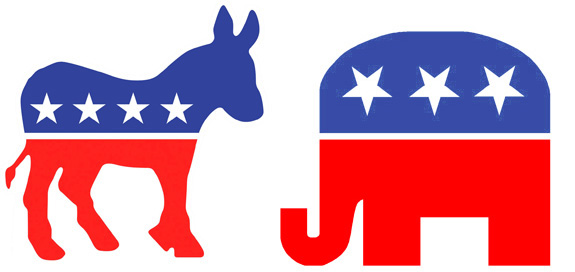
- Here you have the explanation to the symbols of the Democratic and Republican party:

Resultado de imagen de donkey democratic party


The donkey started being used by the Democrats in the 19th century. During the presidential campaign of that year Democrat candidate Andrew JAckson was called a jackass (a donkey) by his opponents and he decided to adopt this animal for his campaign. Later cartoonist Thomas Nast popularized the symbol.

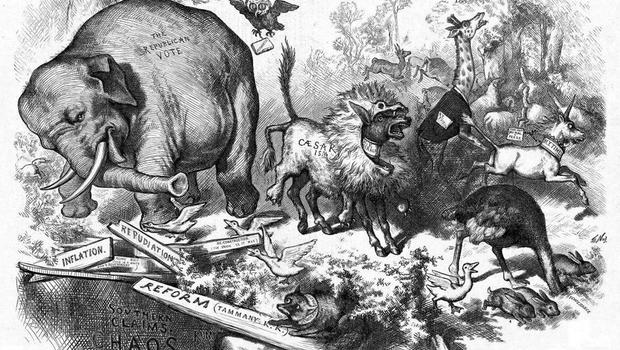
Thomas Nast was also the inventor of the elephant that became the symbol of the Republican Party. In 1874 he drew a cartoon inwhich the Democrats' donkey appeared as clothed in lion's skin, scaring all the other animals. There was an elephant labelled as "The Republican Vote" and from then on the elephant was associated with the Republican Party.

Here you have Nast's cartoon in Harper's Weekly:

Resultado de imagen de Harper's Weekly in 1874, Nast drew a donkey clothed in lion's skin


Democrats today say that the donkey is smart and brave, while Republicans say that the elephant is strong and dignified.

Here you have some more information about this topic: 


http://www.factmonster.com/ipka/A0881985.html

- The colours associated to every party date back from year 2000 and it comes from the colours the TV channels used to represent the states every party won. . Red is associated to the Republican Party and blue to the Democratic Party. This is the opposite to the use of these colours in Europe, where red colour is associated to leftist parties and blue colour is associated to the conservative- rightist parties. Curiously, before 2000 several channels used red for the Democrats and blue for the Republicans, as we do in Europe.


- This video explains why they vote on Tuesday. There is a campaign to move the voting day to a holiday, so that more people can vote:


- This is a video that explains the process of primary elections, where the USA citizens elect the candidates of each party:


- This video explains all the process to run for the presidential elections:


 - Here you have some short videos that explain the peculiar electoral system of the USA, with the importance of the electoral college:


Tuesday, October 4, 2016

It's a New World (Horrible Histories

This is the video of the song we have watched today. The quality is not good, but the sound is acceptable.


 Add these are the lyrics, just in case you want to sing:

We're the pilgrim fathers 
You may have heard rather
A lot 'bout our notions
Crossing the ocean
On the good ship Mayflower
But it's true our journey 
Turned into quite a commotion.
People report that we sported these hats
But that's not true, I mean, would you?
Anyway the main thing to say
We began the USA
Our little band of religion fans
From the East Midlands.
We all believed slowly 
That England was becoming less holy
So set off for Holland
'Cos there we had friends 
But in the end seemed the Netherlands 
Would never be the land, we planned.
Couldn't stand to remain on that terrain
So again we rearranged 
To start a new nation with our congregation
A new and calmer life took a farmer and a builder and his wife
And a clerica, to find America.
Oh it's a new world 
It wasn't new to the natives 
Still we thought we'd claim it 
Yeah, it's the new world.
I still remember 9th of November
The year 1620 and we saw plenty of land
We thanked God when we found ground
I kept calm but it didn't go as planned.
Couldn't land on the sand 
A month later though, we made it
New Plymouth man, we claimed it
The natives said not
But ran when we shot.
Moved there it proved yeah
That life would be tough
'Cos we didn't have enough 
Of the right stuff.
Did you know had no seeds we could grow 
Although William Mullins had stacked
126 pairs of shoes in his pack
Now that's whack.
A fishing rod, a plough, 
A pig, or a cow 
Would have been a much better idea
But now there's no food for us to eat
Does this mean that we'll meet with de feet!
No fun in the new world 
I'm glad we've arrived here 
But will we survive here
Yeah, in the new world.
People were staving 
Our numbers halving
And when the winter winds blew
Even fewer live through
It wasn't pretty in our new city
But the natives took pity even though
They didn't have to.
Man called Squanto
Showed us how to grow maize
Catch eel for a meal
Chopped up in the baze
Tribe gave us a feast 
Our starvation ceased
In 1621 what they had done
Turned us back from the dead
To the living and to this day
That's why we have thanks-giving.
In Massachusetts built a colony it's true
They say modern America was founded by our crew 
It's a new world 
But we can't call it England 
Let's call it New England
Yeah, in the world.
My home was in Plymouth
Lets call it New Plymouth
I got an idea let's call this New Hampshire
Wait I'm from Newcastle
Can we call it New Newcastle?
Nah! 
It's a new world.


The song is a parody of Empire State of Mind , by Jay Z and Alicia Keys. This is the link to the original song:


Wednesday, May 25, 2016

Two videos about the other face of prosperity in the USA during the Roaring Twenties

These two videos show some negative aspects of the USA during the Roaring Twenties. The first one is about Prohibition and the development of the mafia and the second one is about the Ku Klux Klan (KKK), a racist organization appeared in the 19th century which reached 4 million members during the 20s: 


Thursday, October 29, 2015

Presentations of Unit 2

These are the two presentations we'll use in this unit. You can use them to have an idea of the contents and start looking for inspiration, just in case you want to participate in the songs' project: 


Friday, May 22, 2015

Friday, 22nd of May 2015

Hello everybody!

Today in class of social sciences we have started the class speaking about the flag that the town hall has placed in the round about at the entrance of the town, that is so big, Lucía said that maybe is as tall as the high school. Paqui has told us that these flags are very expensive and people paid for them like two thousand euros, I think that it´s too much for a flag and maybe that  money will be better spent in other things.

Then we have copied the beginning of the new unit that is: The Interwar period (1919-1939).
And it has this points:
1. The USA: from the Roaring Twenties to the Great Depression.
2. Fascist Italy.
3. Nazi Germany.

And we have started the first point: The USA: from the Roaring Twenties to the Great Depression.
After the WW1 the USA became an industrial power. The USA became also a dream for the thousand immigrants of all over the world. The industrial production grew up and also consumption stimulated by: payment in instalments and banking loans.
But not all the prosperity was good a lot of people were pour like the famous character invented by Charles Chaplin, Charlot.
Then the government prohibited consuming, producing and selling alcohol. So the mafia found a business in these drinks. (In that moment we have started to speak about Al Capone and the alcohol)


http://www.biography.com/people/al-capone-9237536

Slavery was abolished after the Civil War, but many black people continued to be discriminated and they were hounded in several states by the Ku Klux Klan, a racist organization.

http://www.montevideo.com.uy/auc.aspx?266890

And after this Paqui has given us homework, from the page 72 exercises 1 and 2, and on Tuesday we will correct them.

When the class was going to end we have started to speak about the dinner class of 4th of ESO.

In this class we have copied some words of glossary:
to roar: rugir
roaring: rugiente
Roaring twenties: felices años veinte
sentence for life: cadena perpetua
reintegration: reinserción
male chauvinist: machista
male chauvinism: machismo
pound: libra esterlina
Prohibition (1919-1933) selling, buying and producing alcohol was forbidden: ley seca
to blur: nublar


http://www.funnydam.com/picture-5332-have-a-nice-weekend.html


Thursday, May 21, 2015

Presentation about the USA in the interwar period

Hello everybody, 

Here you have the presentation about the interwar period in the USA. It will be useful to answer the exercises I've given you. 


Thursday 21st of May

Hi everybody!

Today in the class of Social Sciences we have started a new unit:

The Interwar Period (1919-1939)
  1. The U.S.A: from the "Roaring Twenties" to the Great Depression
  2. Fascist Italy
  3. Nazi Germany

Before the class started, I have gone to the secretary's office to phone my parents because I have missed my glasses at home. Then, when I have arrived to class, everybody was discussing about the day to take the exam of this unit and finally we have decided to take it on the 9th of June.
After all this, we have started with the first point of the unit.

Today I have learnt that after WW1, the USA became the most important economic power in the world and the most important creditor of the European countries because the USA's productive system was intact after the war. They were the owners of half of the gold reserves and their currency, the dollar, became the predominant one in international trade.

The American way of life became a model. The USA attracted thousands of immigrants under the motto: "USA, land of opportunity" or "There's no way like the American way"


                                         http://allenbwest.com/2014/07/truth-american-way/

Then, Paqui has explained us that consumer society spread a lot thanks to installments and credits, while in Europe they were trying to recover the economy. But all wasn't as perfect as it seems because a lot of people were still living in poverty.

Later Paqui has explained us that between 1919 and 1933 the production sale and consumption of alcohol were forbidden because of the Prohibition. As the members of the parliament were so puritanical they approved the Prohibition, but this only caused the discontent of the citizens and the extraordinary development of the mafia and famous figures like Al Capone.


      Men againt the Prohibition                                                                         Alcapone
  http://www.realbeer.com/blog/?p=86                                                http://forum.joomla.hr/index.php?topic=4062.0


                                                      Women in favour of the Prohibition
                                            http://thecanberran.com/2013/08/16/dry-bars-the-pubs-with-no-beer/
   

After this, we have talked about racism in that period and that even if slavery was forbidden after the Civil War, many black people continued to be discriminated and they were hounded by the Ku Klux Klan, a racist organization related to white supremacism, whose members wore costumes similar to the ones used in Spain to celebrate the Holy Week. Nowadays they continue to exist in the south states of the USA.


                                                         Members of the Ku Klux Klan
                                                      http://ro.wikipedia.org/wiki/Ku_Klux_Klan

To end with the class we have talked about the symptoms of crisis. There was a huge demand for all kind of products, for example: farmers bought more land to increase production. Many people invested in the Stock Market because getting loans was very easy.

  •  Real estate bubble: a lot of houses were built and easily sold, but the prices increased due to the high demand.
  • Stock Market bubble: many people invested money without any knowledge of economics. Stock prices increased a lot due to the high demand
So, the first symptoms of crisis appeared:

  • High debts to keep high levels of production and consumption (Cash-flow problems)
  • When the European started recovering, there was a contraction of the demand for USA products and an overproduction crisis started: products couldn't be sold, stocks started accumulating, farmers couldn't give their loans bank...
  • No correspondence between the real economic situation of the companies and the value of their stocks in the Stock Exchange Market (Stock Exchange bubble)


                                                             Stock Market crash, 1929
                                   http://storiesofusa.com/great-depression-causes-new-deal-1919-1939/

When the bell has rang, Paqui has given us homework: the exercises 1, 2 and 3 of the page 72

That's all for now! See you in class!

Words copied on the glossary:

Roaring: rugiente
To roar: rugir
Roaring Twenties: felices años 20
Interwar: entreguerra
Real estate: inmobiliaria 
Stock Exchange Market: bolsa de valores
Pound: libra
In instalments: a plazos
Banking loans: créditos bancarios
Washing place/site: lavadero
Prohibition: Ley Seca
Speakeasy: bar ilegal
Temperance League: Liga de Abstinencia 
To tax: gravar con un impuesto
To hound: cazar
Hound dog: perro de caza
Foreclosure: desahucio


Monday, February 23, 2015

Glory


I deeply recommend you to watch this video of this year's Oscar Award winning song. It's a really moving song called Glory and it belongs to the film Selma, which tells the story of the fight of the black people for civil rights in the USA, led by Martin Luther King. If you have the opportunity, you should watch the movie too. 

Monday, December 2, 2013

A very good video to understand the division of powers in the USA

As we have studied today, the USA were the first country to write a Constitution and include the division of powers to prevent abuse. On the following video you can learn about the three institutions that hold power in the USA through a rap. Enjoy!


Some interactive maps about the American War of Independence

If you click on the map below, you will have access to a very detailed explanation of the American Revolutionary War. This resource comes from the following website: 

http://www.revolutionarywaranimated.com/PreRevolutionAnimation.html

Monday, June 10, 2013

Breaking news: Big Brother is watching us


When George Orwell wrote 1984, he did it with the intention of criticizing a totalitarian system. Much of the information of the book was based on the USSR under Stalin's rule. But the news show that something similar to what Orwell imagined can happen in the so called best democracy of the world. The recent news from the USA have revealed that the government has a program to watch the citizens and record their e-mails, phone calls and all the information they want. The pretext of terrorism is constantly used to violate the freedom of the citizens. Yesterday, Edward Snowden, an ex-CIA employee explained to the British newspaper The Guardian what the NSA (National Security Agency) does with a sophisticated program called Prism. All this surveillance is made with the collaboration of phone and Internet suppliers. Apparently this doesn't only happen in the USA. Snowden has also pointed the UK. 

If you want to read further information about this scandal, here you have some links: 


Review of other leaks of information in the history of the USA: 


In 1984 the only safe place for the individuals was their inner mind. We should think about it when we use the new media to communicate. 

P.S: Be sure that we are being watched as well.

Sunday, June 2, 2013

Recent news about Coca-Cola formula

As some of you were interested in the story of the formula of Coca-Cola the other day, here you have some   more information and recent news about it: 

Coca-Cola was invented by a pharmacist from Atlanta (Georgia) called John Pemberton in May 1886. The name was suggested to Pemberton by his bookkeeper  Frank Robinson, who also designed the famous logo of the brand, with the flowing letters everybody knows.  Originally Coca-Cola was sold as a medicine. Pemberton claimed that it was good to cure many diseases, such as headache, dyspepsia impotence, nerasthenia and morphine addiction. In 1887 another pharmacist, called Asa Candler, bought the formula to Pemberton and they started producing the beverageon large scale.  At the beginnig Coca-Cola was sold at soda fountains. Later it started being bottled and this way production and distribution could increase and expand to other parts of the country and the rest of the world. 


File:Coca cola Bottle.png

The original Coca- Cola bottle

Coca-Cola includes extracts of cocaine (from coca leaves) and kola nut, which contains caffeine. This composition caused some problems with the Food and Drug Administration in the past and the company had to prove that the quantities didn't create addiction. The current ingredients are carbonated water, sugar (sucrose or high -fructose corn syrup, depending on the countries), caffeine, phosphoric acid, caramel colour and natural flavourings. In 1985 Coca-Cola company launched a new formula, known as New Coke, but the public rejected it and the company had to come back to the classic coke. The original formula of Coca-Cola is placed in an air-conditioned vault at the World of Coca-Cola interactive exhibit in Atlanta, Georgia. 


File:Newworldofcocacola.jpg

World of Coca-Cola building

The legend says that only two executives of the company have access to the formula at the same time, but in fact there are other people who know all the production process. 

There have been some recent news about the secret formula of Coca-Cola: 

- A historian called Mark Pendergrast has recently published a book, where he states that Frank Robinson's family gave him the secret formula. The book's name is For God, Country and Coca-Cola: The Definitive History of the Great American Soft Drink and the Company That Makes It and tells the story of the origins of the company. 

At the same time, an antiques dealer from Georgia called Cliff Kluge has tried to sell  another formula on E-Bay. He started the auction with 5 million dollars and wanted to sell it for 15 million dollars, but no one bid for the formula. 

Here you have the complete story: 

http://www.independent.co.uk/news/world/americas/the-real-thing-historian-publishes-cocacolas-secret-formula-8619076.html

- And here you have the experiment The Independent made with Mark Pendergrast's formula. They tried to concoct Coca-Cola following the recipe included in his book and this was the result: 

http://www.independent.co.uk/news/world/americas/not-quite-the-real-thing-cocacolas-secret-formula-is-out-of-the-bottle--but-can-the-famous-flavour-be-recreated-at-home-8621636.html

Monday, May 27, 2013

Presentations for Unit 8

I don't know if we'll be able to finish this unit before the school year ends, but here you have the two presentations we are going to use to learn these interesting contents: 


Sunday, April 14, 2013

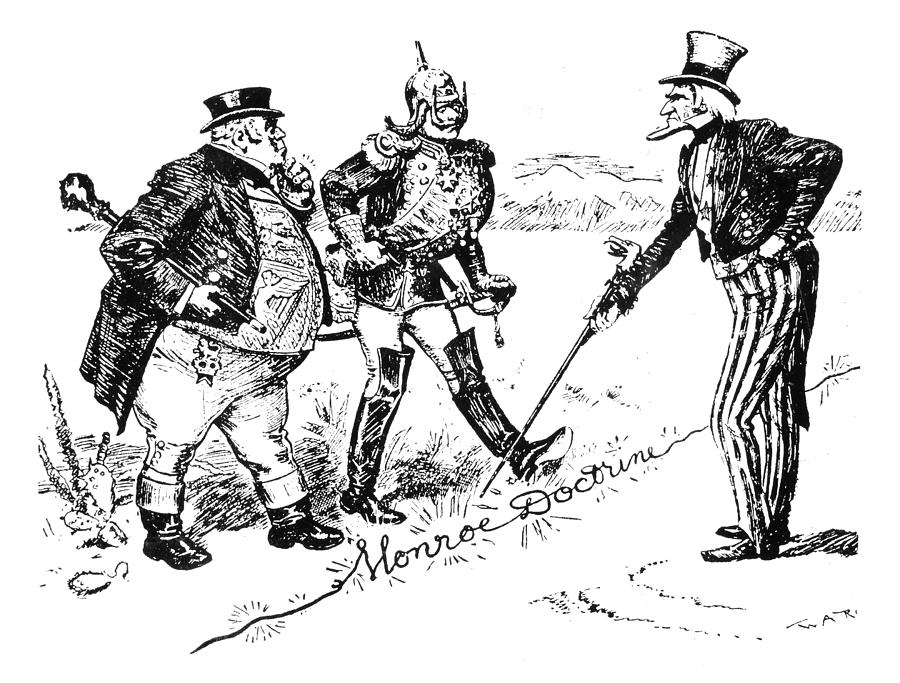
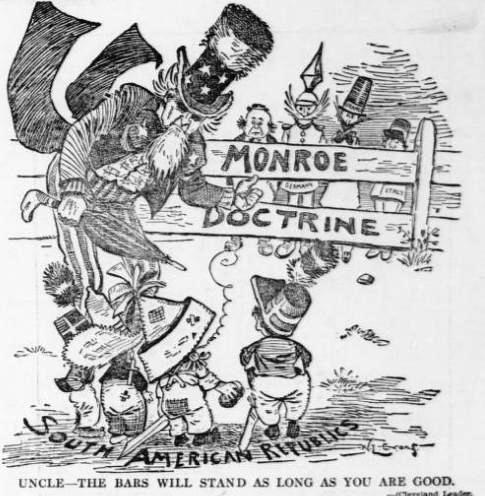
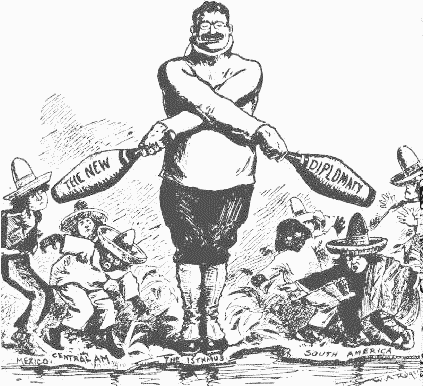
Some cartoons about the Monroe Doctrine and Roosevelt Corollary

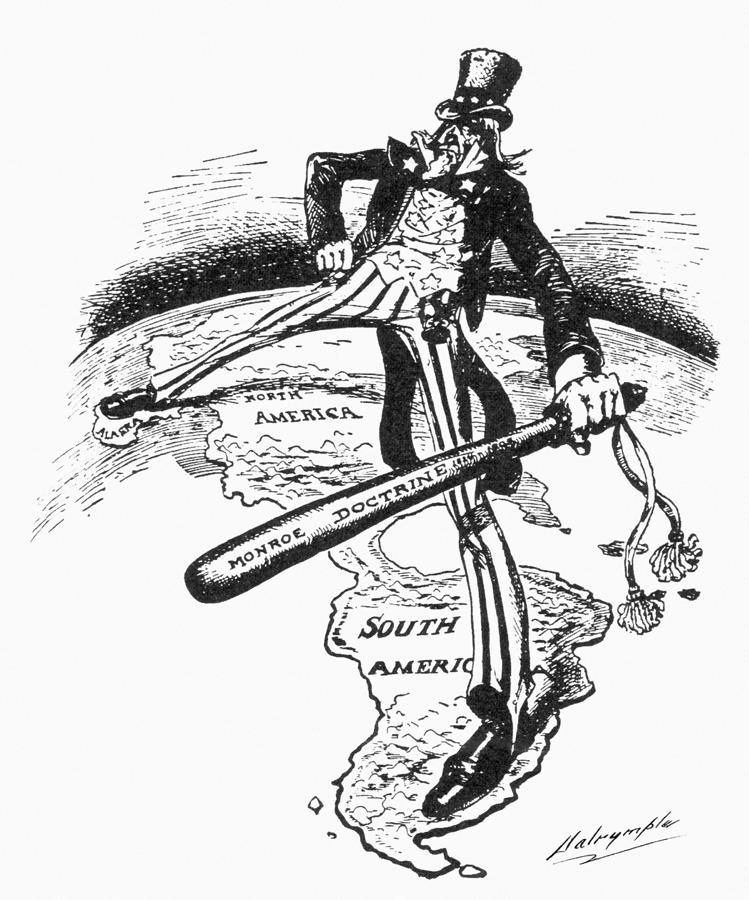
These are some cartoons about Monroe Doctrine (America for the Americans). The USA are personified as Uncle Sam


And the following ones are about Theodore Roosevelt's Corollary and his Big Stick Policy, which defended the intervention of the USA if the interest of the country (rather the USA companies) were in danger. In most of the cartoons President Roosevelt is represented with a big stick 


Thursday, April 11, 2013

Expansion and the beginning of the USA imperialism

The following are some interesting  resources to learn more about the expansion of the USA to the Pacific, following the Manifest Destiny policy, that we' ll study tomorrow. The different governments of the USA promoted the expansion of the country to the Pacific (Westward expansion) and used different methods to annex terrirories: 

- Expulsion or extermination of the native inhabitants (Indian tribes). Here you have more information: 

- Purchase of land to other nations:  Louisiana territory was bought to France by 15 million dollars in 1803.  Florida was ceded by Spain in 1819 in exchange for 5 million dollars not paid, because they were used to pay USA citizens' claims against the Spanish authorities. The South of present states of Nevada and New Mexico was bought to Mexico by 5 million dollars in 1853 (Gadsden Purchase). And Alaska was bought to Russia by 7.2 million dollars in 1867. 

- Wars against other countries, the United Kingdom (1812-1815), Mexico (1845-1848) and Spain (1898) mainly 

And these are some interactive maps to learn the process of expansion of the USA in a visual way. The second and the third maps also include narration. Click on the images to play them: 


Here you have two more interactive maps about the same topic: 

http://mappinghistory.uoregon.edu/english/US/US09-01.html

http://www.the-map-as-history.com/demos/tome07/02d-westward_trails-oregon_demo.php

And this is a map of the USA territorial expansion to the Pacific Ocean and the Caribbean Sea: 


An interactive map of the Spanish- American War in 1898. Click on the image to play the map: 


And finally, a good link to go in depth into the USA  imperialism: 

Sunday, November 11, 2012

Amendments to the USA Constitution


As we studied last Friday, the USA Constitution written in 1787 continues to be in force. This is an important difference between Spain, where we´ve had seven different Constitutions and two more projects along history. But this doesn´t mean that the USA Constitution hasn´t been modified several times. This is what we call "amendments". Twenty-seven amendments have been included in the USA Constitution since 1787. The first ten amendments formed the Bill of Rights, which recognizes rights such as freedom of speech, religion, press, assembly and petition, the right to keep and bear weapons, the right to have a fair trial and not to declare if this could incriminate oneself. Other transcendental amendments were. 

- the 13th Amendment (1865), which abolished slavery and servitude 

- the 15th Amendment (1870), which gave the right to vote to non-white people 

- the 18th Amendment (1919), which established Prohibition of producing, buying and selling alcohol. This one was abolished with the 21st Amendment in 1933

- the 19th Amendment (1920), which gave women the right to vote

- the 26th Amendment established the right to vote for those aged 18 or more.

Many of these amendments referred to suffrage, because the USA don´t have a national electoral law. Every State has different laws for elections and that´s why they had to include general rules that have to be applied everywhere. 

Since 1787 more than 9,000 amendments to the Constitution have been proposed, but only 27 have been accepted. The last one (the 27th) was made in 1992.

Here you have a complete list of the 27 amendments: 


This is the process to amend the Constitution: 


And here you have another link to the proposed amendments that haven´t been ratified for different reasons: 


Finally, here you have two videos made to learn the amendments: 

- the first one was made by two boys who create songs about different school topics. They are called Smart Songs and this is their video about the Bill of Rights: 


- And this one was made by a student called Mike Simmons. You can read the lyrics below the video on Youtube: 


Would you dare to do something similar about a different topic?

The checks and balances system in the USA Constitution


Here you have some additional information to learn more about the system of checks and balances designed in the USA Constitution to prevent abuse of power. This short video explains how every branch of power controls the other ones and how there is also a balance between the power of the Federal Government and the power of the States: 


Symbology of dollar banknotes


There is a lot of controversy about the different symbols that appear in USA banknotes. The lovers of conspiracy theories have explained many of the symbols as related to Freemasonry and the Illuminati sect (the same one of the famous Da Vinci Code). In fact, many of the symbols of USA dollars refer to the origin of the country: number 13 appears in different places: 13 vertical stripes, 13 olive leaves, 13 arrows, all related to the 13 colonies which rebelled against Great Britain. If you want to learn more about the symbols on USA dollars banknotes, visit the following links: 

http://www.creditsesame.com/blog/dollar-symbols-05192011/

http://money.howstuffworks.com/question518.htm

Thursday, November 8, 2012

Common sense


Prior to the Declaration of Independence of the 13 colonies of North America, there was another influential document written by Thomas Paine in January 1776. This document was a 47 page pamphlet called Common Sense and had a huge success, because it explained in an easily understandable language some of the political ideas spread by the enlightened philosophers and used those ideas to support the demand for independence many North American colonists agreed upon. Common Sense talked about the social contract between the people and the government, the need for a representative government (elected as a result of general will), criticized monarchy and considered Parliamentary Monarchy a contradiction due to its origin (limiting the powers of the king, but preserving an institution based on inequality) and proposed to write a document (he called it "charter") to include the rights of the citizens (freedom, property and religious tolerance). Paine also gave different arguments to justify the independence from Great Britain. Paine´s pamphlet had an important distribution in the colonies and contributed to increase the desire for independence. When the Second Continental Congress met in Philadelphia in June 1776, the environment to break ties with Great Britain was much more favorable. 

Here you have a short summary of the pamphlet: 


And this is the complete text: