Showing posts with label colonialism. Show all posts
Showing posts with label colonialism. Show all posts
Tuesday, April 18, 2017


Wednesday, April 13, 2016
Some videos about the foreign intervention in China
These are two videos where you can learn more about the Opium Wars, caused because the British introduced opium in China to open this country to trade.
And here you have some more videos about the Boxer Rebellion:
Tuesday, April 5, 2016
Two images and one song
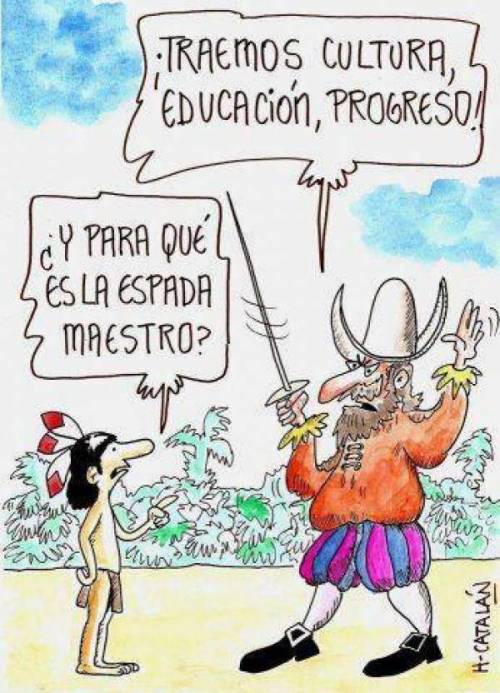
Lucía and Irene have done a really good work about our debate today. I just want to add two meaningful images and dedicate a song to all those who have got rid of the idea that "races" exist.


Monday, April 4, 2016
Tuesday, March 24, 2015
19th March 2015, Thursday
Hi! This is Cristina writing. This is last thursday's journal.


Lucía was supposed to write the journal today, but, as she had to take the exam, here I am.
Today in Social Sciences we have corrected the activities Paqui gave to us last day: 9 and 10 on page 41 and one she invented.
The one invented by Paqui was: "Write the names of the colonies included in every empire." The answer was:
- The British Empire owned colonies from North to South America, Egypt, Sudan, Kenya, Uganda, Rhodesia, Cape Colony, Nigeria, New Zeland, Canada and Guyana.
- The German Empire owned Cameroon, Namibia, Rwanda, Burundi and Tanzania.
- The French Empire owned Algeria, Tunisia, Western Africa, Equatorial Africa, Madagascar, Vietnam, Laos, Cambodia and the French Guyana.
- The Portuguese Empire owned Angola, Mozambique and some islands in the Pacific and the Atlantic.
- The Spanish Empire owned the Gold River (Sahara) and Equatorial Guinea.
- The Italian Empire owned Libya.
-The Dutch Empire owned Indonesia.
-The Belgian Empire owned Congo.
After correcting this, Paqui has showed a map to us with every colony, and she has showed it to us when we have corrected the other exercises, as well.
The question number 9 said: "What were the areas of expansion of the USA and Japan?" I have answered it: the USA expanded to the Pacific (in Hawaii and the Philippines) and the Caribbean (in Cuba, Puerto Rico and a strip of land in Panama). Japan expanded to the Eastern coasts of Asia: Kuril Islands, Korea and Formosa.
The last activity was "What was the Chinese reaction against the foreign intervention in its territory?": as China was coveted by many countries which wanted to control it and there were a lot of wars and revolts, the Chinese were obliged to open their country to the foreigners.
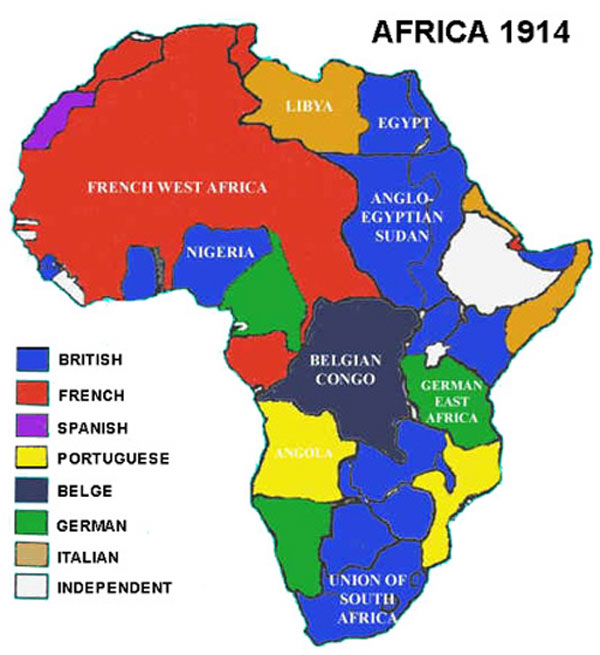
Here you have a picture showing the partition of Africa among the different colonist empires and another one including the colonies which belonged to every empire in the world.
Here you have a picture showing the partition of Africa among the different colonist empires and another one including the colonies which belonged to every empire in the world.
I think it has been a very boring lesson, because I don't like much all this geography and maps thing.
Bye!


Wednesday, February 25, 2015
Presentation for Unit 5
Here you have the presentation we are going to use for Unit 5. It includes the following contents:
- The unifications of Italy and Germany
- The Age of Empires and colonialism
- The unifications of Italy and Germany
- The Age of Empires and colonialism
Sunday, October 12, 2014
Presentation of the Indies and something else
This is the presentation for this part of the unit. As you know, today is the 12th of October, the day Christopher Columbus and his crew arrived in the Bahama Islands and were the first Europeans to communicate their "discovery". This was the beginning of the occupation and exploitation of the Indies. Here you have a small text by Uruguayan writer Eduardo Galeano to think about the "discovery" of America:
Did Christopher Columbus discover America in 1492? Or was it the Vikings before him? And before the Vikings, what about the people who lived there? Didn’t they exist?
Official history relates that Vasco Núñez of Balboa was the first man who saw both oceans, standing on a peak in Panama. Were the inhabitants of that area blind?
Who gave maize and potatoes and tomatoes and chocolate and the rivers and mountains of America their names? Hernán Cortés? Francisco Pizarro? Were the people who were already living there mute?
We have been told, and still are, that it was the pilgrims of the Mayflower that populated America. Had it been empty before?
Because Columbus didn’t understand what the Indians were saying, he concluded that they didn’t know how to speak. Because they wore no clothes, were gentle, and gave away everything they had, he concluded they lacked the capacity for reason. And because he was certain of having discovered the Orient by the back door, he believed they were Indians from India.
Afterwards, during the second voyage, the admiral promulgated an act establishing that Cuba was part of Asia. The document of June 14, 1494, stated as evidence that the crew of the three ships recognized it as such. Whoever said otherwise was given thirty lashes, fined 10,000 maravedíes, and had his tongue cut out.
The notary, Hernán Pérez de Luna, attested, and the sailors who could write signed at the bottom.
The conquistadors demanded that America be something it wasn’t. And they treated the Americans as if they were what they imagined the pagans of the Orient to be.
Christopher Columbus said he saw on the shores of Cuba sirens with men’s faces and chicken feathers, and supposed that not far from there men and women had tails.
In Guyana, according to Sir Walter Raleigh, there were people with eyes in their shoulders and mouths in their chests.
In Venezuela, according to Pedro Simon, there were Indians with ears so long they dragged on the ground.
In the Amazon, according to Christopher of Acuña, the natives’ feet were shaped backwards, heels forward and toes behind, and according to Pedro Martín de Anglería, women mutilated one breast to be able to fire their arrows better.
Anglería, who wrote the first history of America, though he never set foot there, also affirmed that in the New World there were people with tails, and these tails were so long the natives could sit only in chairs with holes.
The Black Code prohibited the torture of slaves in the French colonies. But it wasn’t to torture them but to educate them that slaves’ masters whipped their backs and cut their tendons when they fled.
The Laws of the Indians, which protected those in the Spanish colonies, were quite moving. But the gallows and pillory set up in the center of every Main Square were even more affecting.
The reading of the Request for Obedience was very convincing. This occurred on the eve of the assault on each village. It explained to the Indians that God had come to the world and left St. Peter in his place, and that the successor of St. Peter was the Holy Father, and that the Holy Father has shown favor on the Queen of Castilla, who rules all this land. For this reason, they should go from here or pay tribute in gold, and if they don’t or if they stay, war would be declared on them, and they would be made slaves along with their wives and children. But the Request was read in the middle of the night from the mountain in Spanish and without an interpreter, in the presence of the notary but no Indians, as they were asleep, miles away, and hadn’t the faintest idea what was awaiting them.
Until not long ago, October 12 was Race Day.
But does such a thing even exist? What is race but a useful lie to exploit and exterminate one’s neighbor?
When the U.S. entered the Second World War, the American Red Cross decided that the blood of black people would not be accepted in its blood banks. Has anyone seen, by chance, black blood?
Afterward, Race Day became the Day of Encounter.
Were colonial invasions encounters, whether those of yesterday or those of today? Shouldn’t they be called rapes or violations instead?
Perhaps the most revealing episode in the history of the Americas occurred in 1563 in Chile. Indians besieged the fortress of Arauco, depriving the Spanish of food and water, yet Captain Bernal refused to surrender.
From the stockade he screamed out, “There will be more and more of us!”
“With what women will you make them?” the Indian chief asked.
“With yours. We will make them bear children who will be your masters.”
The invaders called the original Americans idolaters because they believed that nature is sacred and that we are the brothers and sisters of all those with feet, paws, wings, or roots.
And they called them savages. But they were not wrong about this. The Indians were such savages that they ignored the fact that they had to obtain a visa, a certificate of good behavior, and a work permit from Columbus, Cabral, Cortés, Alvarado, Pizarro, and the pilgrims of the Mayflower.
Here you have the text in Spanish:

Thursday, April 11, 2013
The origins of Liberia
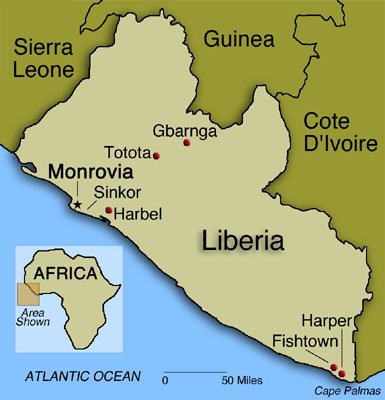
Liberia was one of the few African territories to remain free of the European imperialism after Berlin Conference. The name of the country means "land of the free" and it was founded by freed African slaves from the USA in 1820. The promoters of the resettlement of former slaves in Africa were the members of the American Colonization Society, an organization of white clergymen, abolitionists and slave owners. The name of its capital city, Monrovia, comes from James Monroe, the president of the USA in the early 1820s, when the resettlement of freed slaves started.
 |
| Liberia's coat of arms Source: http://en.wikipedia.org/wiki/File:Coat_of_arms_of_Liberia.svg |

In 1847 Liberia proclaimed its independence and became a republic. By the end of the American Civil War (1861-1865) around10,000 former slaves had settled down in Liberia. But the former slaves. But the former slaves took advantage of the situation to submit the indigenous Africans, black like them, but considered to be inferior. For example, the indigenous Africans who lived in Liberia were excluded from citizenship until 1904 and were also exploited by the Americo-Liberian elite, who monopolized political and economic power and restricted the indigenuos people´s rigth to vote.
The Liberian political system drew inspiration from the USA Constitution, but there was one only party, the True Whig Party, founded in 1869. This party held power until 1980, when a coup d' État removed them from power. A period of ethnic tensions and wars started: two civil wars (1990-1996 and 1999-2003) with around 250,000 people killed. and one million refugees. In 2005 Ellen Johnson-Sirleaf was elected Africa's first female president and started the difficult reconstruction of the country.
If you want to learn more about Liberia, here you have some extra links:
http://www.bbc.co.uk/news/world-africa-13729504
Monday, April 8, 2013
Khartoum, an example of colonialism in Africa
I´ve found the film we´ve talked about on Youtube, just in case anyone wants to have a look on it. It's about an episode of the British domination of Sudan: the Sudanese Arabs, headed by Muhammmad Ahmad, know as the Mahdi, revolted againts the British rule and started fighting for their independence. The British government sent an army commanded by General Charles Gordon to defend the city of Khartoum. The film shows the Western version of the story: Gordon is represented as a hero and the Mahdi and his supporters are depicted as zealots.
Here you have a short review of the film:
Friday, April 5, 2013
Resources to study colonialism
A short definition of imperialism, its causes and consequences:
And these are some interactive maps:
- World colonial empires in 1900:
http://wps.pearsoncustom.com/wps/media/objects/2428/2487068/int_map/imp_0048.html
- The scramble for Africa and the decolonization process:
http://pages.uoregon.edu/maphist/english/AF/AF01-01.html
http://www.brown.edu/Research/AAAH/map.htm
http://wps.prenhall.com/wps/media/objects/716/733716/Int_Maps/map26.1.dcr
http://highered.mcgraw-hill.com/sites/0073406929/student_view0/chapter20/interactive_maps.html#africa
- The British colonial empire in the 19th century and the control of trade routes:
http://www.the-map-as-history.com/demos/tome05/index.php
- Imperialism in Asia:
http://glencoe.mcgraw-hill.com/sites/dl/free/0078750202/195006/map33.html
http://highered.mcgraw-hill.com/sites/0073406929/student_view0/chapter20/interactive_maps.html#asia
Colonialism in 10 minutes: this short video includes the causes of colonialism, the explanation of the "civilizing mission (the justification the Europeans gave to colonialism ) by Noam Chomsky, the scramble for Africa and the tactics used by the Europeans to control territory and the difficulties to reach real independence. The video focuses on the case of Uganda.
The scramble for Africa and Berlin Conference and the consequences of colonialism:
This last documentary is longer, but worth being watched, because it includes the process of independence of some African countries:
And these are some interactive maps:
- World colonial empires in 1900:
http://wps.pearsoncustom.com/wps/media/objects/2428/2487068/int_map/imp_0048.html
- The scramble for Africa and the decolonization process:
http://pages.uoregon.edu/maphist/english/AF/AF01-01.html
http://www.brown.edu/Research/AAAH/map.htm
http://wps.prenhall.com/wps/media/objects/716/733716/Int_Maps/map26.1.dcr
http://highered.mcgraw-hill.com/sites/0073406929/student_view0/chapter20/interactive_maps.html#africa
- The British colonial empire in the 19th century and the control of trade routes:
http://www.the-map-as-history.com/demos/tome05/index.php
- Imperialism in Asia:
http://glencoe.mcgraw-hill.com/sites/dl/free/0078750202/195006/map33.html
http://highered.mcgraw-hill.com/sites/0073406929/student_view0/chapter20/interactive_maps.html#asia
Monday, March 25, 2013
More about Social Darwinism
Social Darwinism was a perversion of Charles Darwin's ideas. The theory of evolution developed by Darwin explains that the survivors of every species are the best adapted to the environment (the best fitted). Darwin´s ideas in Biology extended to Social Sciences. Social Darwinism adapted the theory of evolution to explain how societies work. The theorists of this current considered that there were better fitted "races" (the "white" people") and that was the explanation to their superiority and their right to control the inferior "races". Competition between the different "races" would determine the hegemony of the victorious ones and the submission of those considered to be inferior.
Social Darwinism was used to classify people into different "races", depending on the colour of people´s skin or the size of their heads.

Classification created by Nazi doctor Eugen Fischer in 1921
Social Darwinists also defended eugenics, something similar to selective breeding, in order to get "pure" individuals, by sterilizing first and eliminating later the people who had any physical of psychic flaw. These ideas were used in different countries to sterilize those considered to be inferior (mentally or phisically disabled people, aboriginals) and sustained the Nazi extermination policy during World War 2.
.
.

Brochure of the American Eugenics Society
Social Darwinism has also been used to base the reduction of economic help for the poor. New liberal policies defend that if the poor receive subsidies for food, health or education, they won't do anything to improve their lives


All these ideas come from an interested interpretation of Darwin´s evolution theory. But Darwin wouldn't have agreed with the social Darwinists: he thought that not only physical features evolved through natural selection, but also moral sentiments and co-operation and altruism would also belong to human evolution. The following cartoon shows Darwin expelling eugenists and ultra-liberals from his house.

If you want to read more about all this, here you have a very good link:

Saturday, March 17, 2012
Why do the USA have a naval base in Cuba?

Location of the U.S. Guantánamo Bay Naval Base

The consequences of the Spanish-American War are still evident in some contemporary facts:
- Puerto Rico continues to be under USA control. It´s an associated free State, but the USA decide on many aspects in Puerto Rico, although its citizens can´t vote in the USA presidential elections.
- Although the USA and Cuba don´t have official relations since the Cuban Revolution in 1959, the USA still have a naval base in Cuba: Guantánamo. This is the explanation: after the signature of the Peace of Paris in December 1898, the USA army occupied Cuba. In 1902 Cuba became an independent republic and the Parliament wrote a Constitution. But in 1903 the USA government obliged the Cubans to add an amendment to the Constitution. This is was the Platt Amendment, which gave the USA the right to intervene in Cuba when they considered they had to do it. Also in 1903 the Cuban-American Treaty was signed. This treaty included the creation of a naval base in the southeast of the island. That was the origin of Guantánamo Bay Naval Base, the oldest USA base overseas. President Theodor Roosevelt signed a permanent lease of the base and a yearly rent was established (2,000 gold coins).
When the Cuban Revolution took place in 1959 and Fidel Castro reached power, the Cuban government denounced the lease treaty as illegal and refused to cash the cheques the USA government send every year.
In 2002 Guantánamo Bay Naval Base became famous worldwide, because the USA government created a detention camp (GITMO) for the alleged terrorists and enemies captured in the wars in Afghanistan and Iraq. Several human rights´ organizations have denounced the detention conditions of prisoners, the use of torture and the legal limbo of Guantánamo. President Obama promised to close the detention camp, but he hasn´t done it yet.

Here you have some more information about Guantánamo Bay Base:
Guantánamo Bay Detention Camp:
Inside Guantánamo. Photo report:
Friday, March 16, 2012
The Spanish American War in some cartoons
The loss of the last Spanish colonies in America and Asia was a consequence of the Spanish American War, a conflict which meant the end of an empire (Spain) and the rise of another one (the USA). This war had an important reflection on newspapers. Experts consider the Spanish-American War to be the first "media war". This conflict was widely covered by the USA newspapers. The press barons Joseph Pulitzer and William Randolph Hearst, had an important role in the development of the conflict. The way they presented the news contributed to inflame the public opinion in the USA and created the propitious conditions for war. Their newspapers, The New York World and The New York Journal, competed in sensationalism and are considered to be some of the first examples of yellow journalism.
Here you have some examples:

Joseph Pulitzer and William Randolph Hearst dressed as the Yellow Kid, preparing war:

Cuba as a suffering mother

President McKinley as a coward

President McKinley trying to contain war pressure:

Remember the Maine

The Spanish brute:


Spain out!


Uncle Sam versus the Spanish matador:

The duello

Uncle Sam taking the Spanish bull by the horns

Alphonse of Bourbon, future Alphonse XIII, offering the peace cigarette to Uncle Sam

President McKinley offering Uncle Sam different "dishes"

Uncle Sam Fishing

Uncle Sam balancing his new possessions


The bald eagle extending its wings over the new empire:

Anti-Imperialist cartoon, criticizing the new responsibilities acquired after the war:

Before and after
In Spain the war and its consequences caused a strong impact on the population. The cartoons of that period offer the possibility of knowing the different opinions about the conflict in the country and the evolution of the public opinion: the initial nationalist exaltation of the official dynastic newspapers, the criticism of the opposition parties (the republicans considered the war to be an imperialist conflict and a slaughter for the popular classes), the resignation after the defeat and the search for responsibilities.

General Weyler, in charge of repressing the Cuban insurrection. The republican Catalan magazine
La Campana de Gràcia criticized his incompetence

General Weyler riding a snail. The campaign in Cuba advancing slowly.

The USA sugarcane union feeding the pig of the Cuban insurrection:

Cuba represented as a pig, feeding the rebels:

Cuba is going to get lost, La Campana de Gràcia:
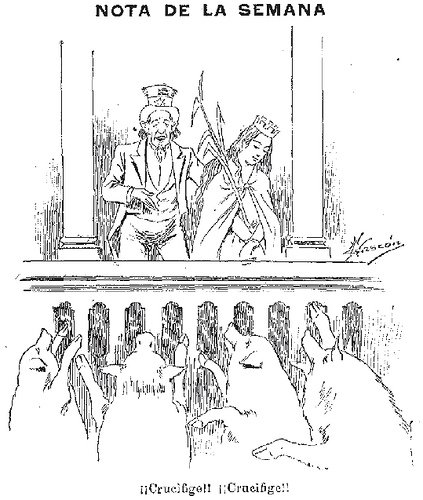
Crucify her!
Uncle Sam-Herod asking the Cuban rebels what to do with Spain-Jesuschrist. This cartoon was published on Madrid Cómico

Uncle Sam´s ambition:


Christopher Columbus complaining about what the Spaniards did with his legacy:

The signature of Peace of Paris, where Spain lost its colonial empire

The cartoon above reflects the missionaries coming back to Spain after the loss of the Philippines. The cartoon shows the contrast between the need for regeneration of the country and the origin of the repatriated (members of the Church and representatives of tradition and backwardness).

Banquet at the County Tennis Court, Cu-cut:
This last cartoon created a strong controversy. It was published on November 1905 in the Catalan satirical magazine Cu-cut! It criticized the role of the Spanish Army in the loss of the colonies. The military considered the cartoon very offensive and a group of them attacked the offices of the Cu-Cut and La Veu de Catalunya, another Catalan newspaper. King Alphonse XIII refused to punish the military men who had attacked the newspapers. As a result of this, Eugenio Montero Ríos, the prime minister, resigned. The new prime minister, Segismundo Moret, promoted the approval of the Law of Jurisdiction, which gave to the Army the power of judging crimes related with the flag, the nation and the honour of the military. This law limited the freedom of the press.
Thursday, February 23, 2012
2011-2012 Challenges. Number 21
This week´s questions will discover you some other sides of colonialism.

Rubber tree (Hevea brasiliensis)
QUESTION 1
Rubber (Hevea brasiliensis) is a tree originary from South America. When its important properties for industry were discovered, rubber became one of the most coveted raw materials in the 2nd half of the 19th century (rubber boom). Until 1885 rubber was only produced in South America and it was forbidden to export seeds or plants to other places, in order to preserve the monopoly and the big profits of its cultivation. How did rubber start being cultivated in other parts of the world?
QUESTION 2
King Leopold II of Belgium exploited the Congo Free State as a private property. The rubber plantations became something similar to hell for the indigenous workers. The subhuman conditions and the extreme abuses workers had to bear served as inspiration for a famous book written by a Polish writer in 1899. What was the title of this novel and who was its author?
QUESTION 3
The atrocities of rubber plantations in Congo were denounced on a report issued in 1904. The author of this report also denounced the abuses over the Putumayo Indians of Peru in 1906. Who was the author of these reports against one of the darkest faces of colonialism?
QUESTION 4
What was the Fashoda incident? How did it end?
QUESTION 5
South Africa became part of the United Kingdom colonial empire, but inside this territory there were two independent republics called Orange and Transvaal until the last decades of the 19th century. What was the origin of these republics and who were their inhabitants? How did these republics finally become part of the British Empire?

QUESTION 6
The origin of modern concentration camps is closely related to colonial conflicts. Colonizers created the structure of modern concentration camps to confine those who opposed their authority. They were used in two different colonial wars which took place at the end of the 19th century, one in the Caribbean Islands and another one in Africa. Where did modern concentration camps appear?
Wednesday, February 22, 2012
Speeches on colonialism

Caricature of Jules Ferry and the consequences of the conquest of Tonkin
Here you have the two texts I have read today in Spanish. They belong to a debate in the French National Assembly, which took place in July 1885. The debate was about the consequences of the French defeat at Tonkin, in Indochina. Jules Ferry was France´s former prime minister and he tried to defend the colonial policy his government had followed. Georges Clemenceau was the head of the Radical Party and he criticized Ferry´s arguments on colonialism
This is what Jules Ferry said:
Gentlemen, it is necessary to speak higher and more truth! it should be said openly that indeed, the higher races have a right with respect to the lower races... I repeat that there is for the higher races a right, because there is a duty for them. They have the duty to civilize the lower races... (...) "
And this is what Georges Clemenceau answered:
The Hindus, an inferior race? The Chinese, an inferior race? (...) Not there is no right of the nations known as higher against the lower nations. There is the struggle for the life which is a fatal need, that as we rise in civilization we must contain within the limits of justice and the right. But let us not try to cover the violence of the hypocritical name of civilization. Let us not speak about right, to have. The conquest that you recommend, it is the pure and simple abuse force which the man gives scientific civilization on rudimentary civilizations to adapt, to torture it, to extract from it all the force which is in him with the profit of alleged civilizing. It is not the right, it is the negation. To speak on this subject about civilization, it is to join to violence hypocrisy.
Wednesday 22th of February 2012
Today in social sciences Bea A. and Carmen have made the exam of last unit. While we have corrected some exercises about colonialism:
-Demographic reasons: high increased of population
-Polithical reasons: control of estrategic places
http://isedphistory.wordpress.com/ww-i/causes-of-ww-i/timeline-causes-of-ww-i/
- Dani has corrected exercise 4 about the main causes of colonialism:
-Demographic reasons: high increased of population
-Polithical reasons: control of estrategic places
- Afterwards Mariluz have corrected exercise 5 about the justification of colonialism: They said they have a responsability of civilizating the last developed territories of the colonies. It was racism. Yolanda R. have said that are people are equal , we have the same gens. In the 19th century Charles Darwin in the theory of evolution said: that survivals were the oné of the most adapted species. This is calles Social Darwinism wich was applied by the nazis to express their superiority against other races. In translation of the theory of species to societies the most educated societies were superior and white people were superior than other people in the colonies.
- Races eugenics: eliminating all the human beings with physical or mental disabilityand sterilized people with this problem.
- Andrea have corrected exercise 6 about axtitudes about colonialism:
-Most of the population didn´t have an actitude towards colonialism
-Most of the politicians were in favour ofd colonialism as Jules Ferry (France) and Benjamin Diesraeli (U.K.)
-Trade unionist and some socialist politicians were against colonialism defending the right of people deciding by themshelves George Clemencau (France) and Lenin were against it.
After that Paqui has read two texts in Spanish one in favour and one against colonialism we have to deduce them.
- Sara has corrected exercise 7 about types of colonialism:
-Colonies of explotation: They totally depend to the metopolis with no goverment
-Colonies of settlement: they have an autonomous goverment but the exterior policy was correspond to the metropolis
-Protectorates: They were independent in theory but really they were someted by the metropolis laws
- I have corrected exercise 9 about the Berlin conference: In 1885 a convention proposed by Otto Von Bismarck was celebrated in Berlinto stablished some rules about coloniasm and avoid some problwms btween european countries. This conference meant a scramble for Africa:
-They created the Congo free state
-Rivers were free for navigation
- The countrie that ocupied the coast could also go to the interior
They give a place in Africa to the king Leopold the II. In this place the king exploid people to take out rubber as if it was a private property and if they didn´t collect the quantity of rubber he said the cut the hands.
The bell has rung and there were no homework
 |
| Source: |
Thursday, February 16, 2012
2011-2012 Challenges.Number 20

Otto Von Bismarck, the "Iron chancellor", had an important role not only in the unification of Germany, but in the history of Europe during the last decades of the 19th century. Here you have some questions to learn something more about his policy in different fields:
QUESTION 1
What was Kulturkampf in Germany?
QUESTION 2
Why is Bismarck considered to be the ruler who put the basis of the Welfare State? What did this policy have to do with Bismarck´s policy against the Socialists?
QUESTION 3
What type of economic foreign policy did Germany follow under Bismarck´s rule? What differences did this policy have with the principles on which Zollverein was based?
QUESTION 4
What was Bismarck´s opinion on colonialism? Why did he change his mind?
QUESTION 5
What colonies did the German Empire seize in the last decades of the 19th century? What international conference was called on by Bismarck to organize the colonization of Africa?
QUESTION 6
What was the main objective of the Bismarckian diplomatic system? Can you remember a similar policy we studied in the Modern Age period?
QUESTION 7
What does this cartoon refer to?

Dropping the pilot, 1890
Subscribe to:
Posts (Atom)