Showing posts with label important figures. Show all posts

Thursday, October 8, 2015

This day in history: the Battle of Lepanto

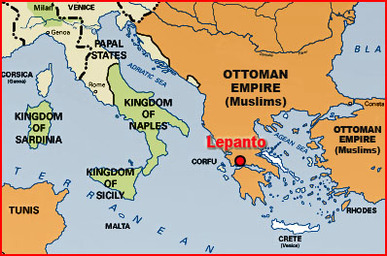
On the 7th October 1571 the Holy League fleet captained by John of Austria defeated Suleyman the Magnificent's fleet in the Gulf of Lepanto, near the coast of Greece. This battle was decissive, because it stopped the Turk threat in the Eastern Mediterranean, 


John of Austria, Philip II's half brother


Here ou have a map of the location of Lepanto, now called Naufpaktos: 


Picture


And on this link you can download a presentation with an animated map of the battle: 


As you know, Miguel de CErvantes participated in the battle and was injured in his left hand. The reason why he participated in the battle was because he had enlisted in the navy in Italy in 1570. We don't know for sure why he was in Italy at the moment, but he might have fled there to avoid being arrested for having participated in a duel and injured his oponent, Cervntes described the Battle of Lepanto as “the highest and most memorable occasion that past and future centuries will ever hope to see”. Hopefully, Cervantes didn't die there and he could write the Quixote. 


Cervates jauregui.jpg


Wednesday, February 22, 2012

Speeches on colonialism


Caricature of  Jules Ferry  and the consequences of the conquest of Tonkin


Here you have the two texts I have read today in Spanish. They belong to a debate in the French National Assembly, which took place in July 1885. The debate was about the consequences of the French defeat at Tonkin, in Indochina. Jules Ferry was France´s former prime minister and he tried to defend the colonial policy his government had followed. Georges Clemenceau was the head of the Radical Party and he criticized Ferry´s arguments on colonialism 


This is what Jules Ferry said: 


Gentlemen, it is necessary to speak higher and more truth! it should be said openly that indeed, the higher races have a right with respect to the lower races... I repeat that there is for the higher races a right, because there is a duty for them. They have the duty to civilize the lower races... (...) "


And this is what Georges Clemenceau answered:

The Hindus, an inferior race? The Chinese, an inferior race? (...) Not there is no right of the nations known as higher against the lower nations. There is the struggle for the life which is a fatal need, that as we rise in civilization we must contain within the limits of justice and the right. But let us not try to cover the violence of the hypocritical name of civilization. Let us not speak about right, to have. The conquest that you recommend, it is the pure and simple abuse force which the man gives scientific civilization on rudimentary civilizations to adapt, to torture it, to extract from it all the force which is in him with the profit of alleged civilizing. It is not the right, it is the negation. To speak on this subject about civilization, it is to join to violence hypocrisy.

Thursday, February 16, 2012

2011-2012 Challenges.Number 20


Otto Von Bismarck, the "Iron chancellor", had an important role not only in the unification of Germany, but in the history of Europe during the last decades of the 19th century. Here you have some questions to learn something more about his policy in different fields: 

QUESTION 1
What was Kulturkampf in Germany?

QUESTION 2
Why is Bismarck considered to be the ruler who put the basis of the Welfare State? What did this policy have to do with Bismarck´s policy against the Socialists?

QUESTION 3
What type of economic foreign policy did Germany follow under Bismarck´s rule? What differences did this policy have with the principles on which Zollverein was based?

QUESTION 4
What was Bismarck´s opinion on colonialism? Why did he change his mind?

QUESTION 5
What colonies did the German Empire seize in the last decades of the 19th century? What international conference was called on by Bismarck to organize the colonization of Africa?

QUESTION 6
What was the main objective of the Bismarckian diplomatic system? Can you remember a similar policy we studied in the Modern Age period?

QUESTION 7
What does this cartoon refer to?


Dropping the pilot, 1890