Monday, March 25, 2013

JOURNAL 25/03/2013


I have come to class on time as usual. But some people have been late as always. And Paqui have said: You're late. And so he got angry and scolded us all. After been told Alice that has failed the term if not participating on the blog, and Alice is angry. Later we are told that some people are going to faild if they not participating on the blog. And I´m not going to faild, because I have participated hehe.

After the class has started. We have continued to item 5.
Today we have studied Age of Empires:

Colonialism is the establishment of colonies in the territory by people from another place (metropolis).

The Age of Empires was an era between the last decades of the 19th century and the first decades of the 20th century in wich the most industrialized countries extended their control and influenced to other territories.

Causes of colonialism:
  • Economic reasons: search for cheap raw materials and workers markets to sell manufactured products and invenst capitals
  • Demographic reasons: emigration was encouraged by the goverments to reduce the excess of population and social conflicts
  • Political reasons: control strategic places or gain international prestige.
Justification to imperialism
The europeans tried to justify their ambitions by saying that tey had the responsibility of civilizing the least developed territories the colinies.
http://library.thinkquest.org/C004367/eh4.shtml social darwinism

This i think some people didn´t copy:
                                       Attitudes towards colinialism
-Most of the population didn´t have any opinion about colonialism
-Most of the politicians were in favour of colonialism. Example: Jule Fery (France) and Benjamin Disraeli (United Kingdom)
-Trade unionists and some socialist politicians were against colinalism and defended the right of the colonized peoples to decided by themselves. Examples: Georges Clemenceau (France) and Lenin (Russia).

And today Paqui speak abaut racism. In my opinion racism don´t exist and it´s bad. The bads person are racist, like the nazis. If a person say: I´m not racist, this person is racist.

This are the vocabulary of today:
-Age of empires: imperialismo
-To depict: representar con imagenes
-strait: estrecho
-to submit: someter
-to encourage: animar
-civilizing mission: misón civilizadora
-burden: carga
-to withe man´s heavy burden: la pesada carga del hombre blanco
-towards: hacia
-humble: humilde
-social darwinism: darwinismo social

I now today muuuuuuuch people are going to comment in my journal becouse how today Paqui has said that if we don´t participated in the blog we are going to fail. See you!! ;)

Sunday, March 24, 2013

JOURNAL 20/03/2013

Today has been the next lesson after the exam. Today is wednesday, so the lesson has started at 8.15 and some people, including me, have arrived some minutes (or seconds) late. So Paqui has told us the same old thing: YOU ARE LATE!!!
                                            http://img.desmotivaciones.es/201105/lazy_2.jpg
As I have said before, on Monday was the day of the exam and we were expecting to now our marks.
At first Paqui has written some questions on the blackboard an then she has told us that we have to read page 33 of the book, the German Unification and to answer to this questions.
While we were doing the questions, Paqui was doing some "strange" things with the exams. It seemed thet she was correcting the another time.
After a long period of time, Paqui has finished with the exams and she has told us that she had commited a mistake in the way of asses the last exercise of the exam and she has had to correct this exercise in all the exams.
Then she has given us all the exams. I think that my mark was good butt as Paqui always says: I think it could be better.
Later we have reviewed the questions of the exam. And then we have give back the exams to Paqui.
After this, we have started with the German Unification:
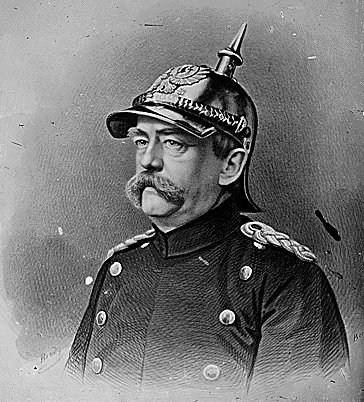
We have spoke about William I and Otto Von Bismark, king and prime minister of Prussia respectively.


 http://www.thelatinlibrary.com/imperialism/images/bismarck.jpg
http://www.pr1898.com/1898/fichas/alemania/images/GuillermoI.png
Then we have talked about why Prussia wanted the war against Austria, the French-Prussian war and the war against Denmark.
After the lesson, we have given the notebooks to Paqui.
This is all for today.
Bye.

Girls´ power

Only the girls have improved their projects. Here you have them in chronological order: 


Saturday, March 23, 2013

Germany from the unification to reunification

This is the answer to Juan´s question about the extension of Germany through history. Here you have some maps, where you can see the evolution of the country from 1871 to present day: 

THE GERMAN EMPIRE (SECOND REICH) FROM 1871 TO 1918

Imperial_Germany.jpg


GERMANY AFTER WORLD WAR 1 UNTIL HITLER´S ARRIVAL TO POWER (1918-1933)

The red colour indicates Germany´s territory during the Weimar Republic. In pink colour, the territories Germany lost as a consequence of the Treaty of Versailles (1919): 


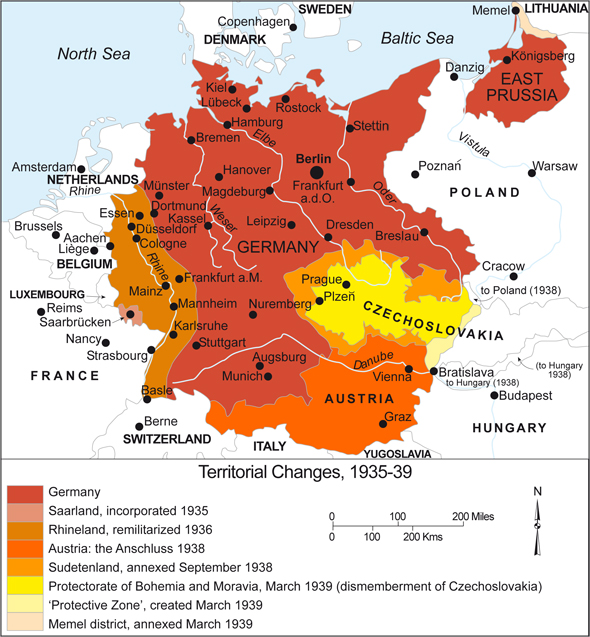
GERMANY DURING THE THIRD REICH (1933-1939)

The different colours indicate the territories seized by Hitler during this period. Most of them were the ones Germany had lost in the Versailles Treaty: 

Germany: Territorial Expansion (1935-1939)


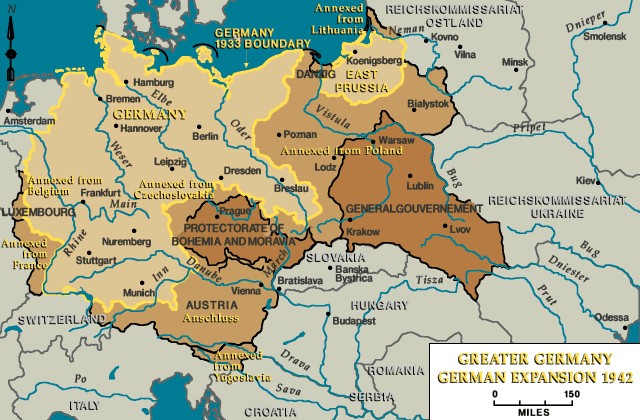
GERMAN EXPANSION DURING WW2

This map shows what the Nazis called the Greater Germany. It included all the territories annexed to Germany until 1942


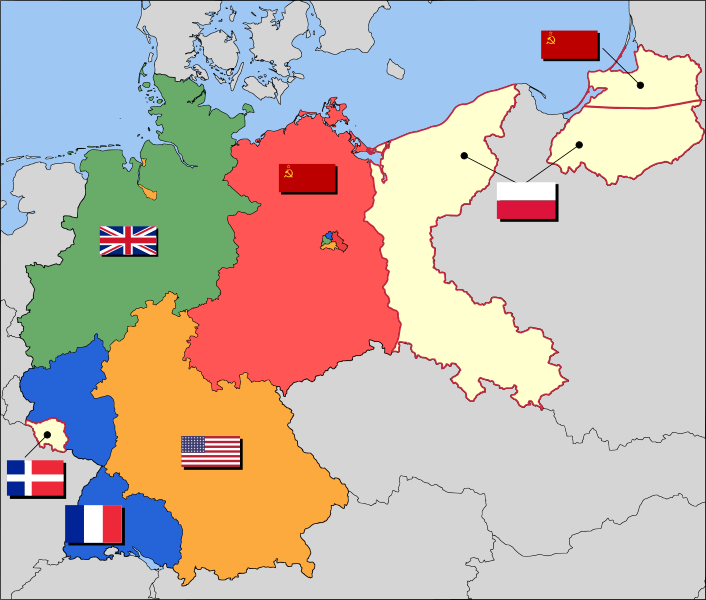
GERMANY AFTER WORLD WAR 2 (1945-1948)

Germany was divided into four zones, occupied by the allies (USA, UK, France and the USSR). Berlin was also divided into four zones. In white, the territories given to Poland and the USSR in the East and the Saar Protectorate in the West (this last territory was administered by France until 1955. Later it reunified with the Federal Republic): 

File:Map-Germany-1945.svg


DIVISION OF GERMANY (1949-1991)

The disputes between the Western allies and the USSR led to the Berlin blockade in 1948. After this crisis, two States were created: the Federal Republic of Germany in the West and the German Democratic Republic in the East. Berlin continued to be divided into two zones. In 1961 a wall was built inside Berlin. It physically represented the division of the world into two opposed blocks during the Cold War: 


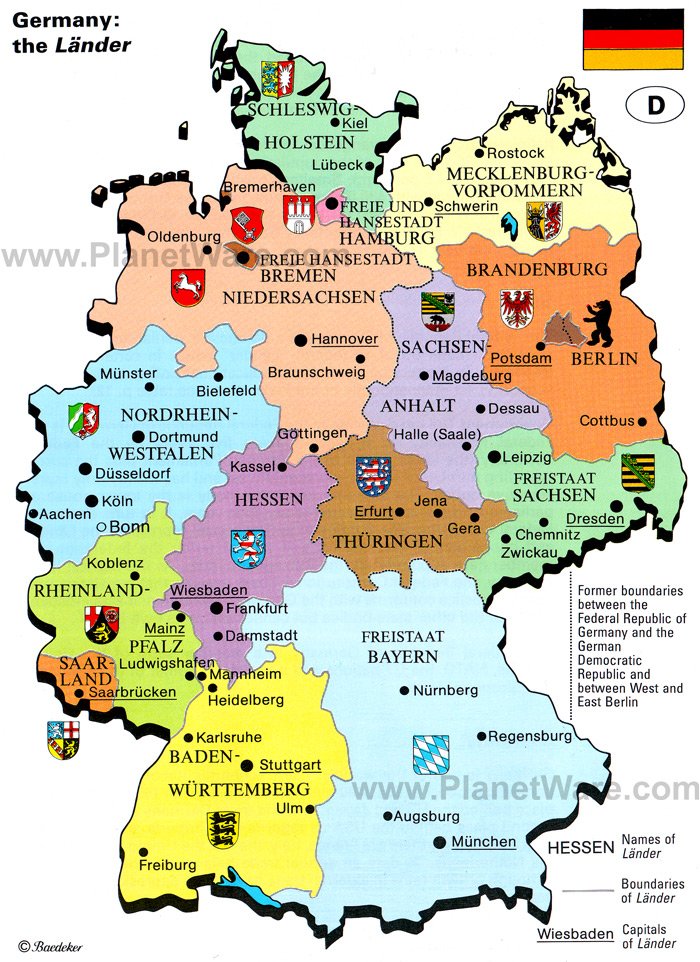
GERMANY  TODAY (1990 to present day)

After the fall of the Berlin Wall in November 1989, the reunification process of Germany started. Germany became officially an only State on the 3rd October 1990. 

This map shows Germany as it is today. You can observe the different Länder (federal States) which form it. The Länder are similar to the autobomous communities in Spain, but they have more power


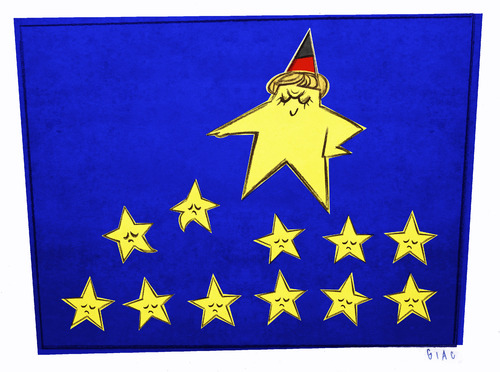
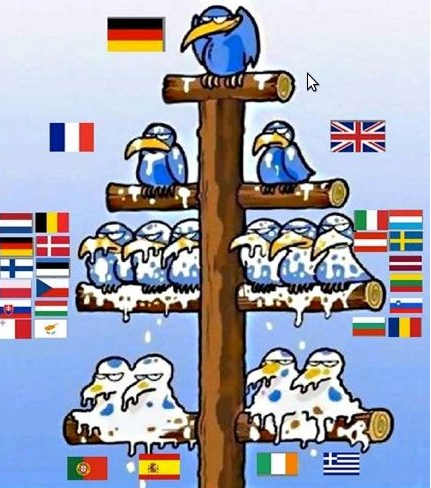
And finally, here you have some cartoons about something called German Europe. Experts say that things go better in Europe if there is a European Germany, rather than a German Europe. 


Friday, March 22, 2013

Friday, 22th of March, 2013


Hello classmates!

Today in the class of Social Sciences Paqui has given us the notebooks back. Paqui has explained us the mistakes that we have done on the notebooks and she has also said that we don’t cheat her; she knows that some people copy all the notebooks the day before give it.

Then Paqui has started the class with a little summary of the contents that we saw the last day. They were:
- German confederation
-  Zollverein.
- Main figures of the Unification of Germany.
- War against Denmark.
- Austro-Prussian War. (1866)

After all this we have started the new contents, Paqui has started explaining the French Prussian War (1870). To make it easy to understand Paqui has explained this period with classmates.
Bismarck (Enrique Perez) knew that he needed a common cause to unite all the German States so he looks for a casus belli against France. He manipulated a dispatch between the Kaiser (Carlos) and the French ambassador (Miguel) at Ems Spa. The conversation about the possible candidacy of Leopold Hohenzollern (Angel Manuel) to the throne of Spain had been friendly but Bismarck manipulated the dispatch, sharpening the language. France had no other option that declaring war to Prussia. All the German States unites against France.

The French army was defeated at the Battle of Sedan and Napoleon III (Fernando) was captured. The consequences were:

- The 2nd Empire disappeared and the 3rd Republic was proclaimed in France.
-  France lost Alsance and Lorraine.
- All the German States became unite and the 2nd German Empire was proclaimed.


Ems Patch. (Source: http://es.slideshare.net/papefons/europe-in-the-second-half-of-the-19th-century-11463409?ref=http://todayinsocialsciences.blogspot.com.es/)

Glossary:
- Duchy: ducado.
- Duke/duchess: duque-duquesa.
- Casus belli: excuse to declare war.
- Dispatch: telegrama.
- To sharpen: endurecer.
- Spa: balneario.


Wednesday, March 20, 2013

On Popes in the 19th century

This post is a little delayed, because I wanted to write it after the Italian unification, but I couldn´t do it before. It´s about the relations between the States and the Popes during the 19th century.In previous units we studied that some monarchs signed concordats with the Holy See to solve the relations of their States with the Catholic Church.

-  Napoleon Bonaparte signed a concordat with Pope Pius VII in 1801. This meant the end of the disputes between the Catholic Church and the State born after the French Revolution. The Concordat recognized that Catholicism was the religion of the great majority of the French, but consecrated religious freedom in France. In addition, the French State would pay the salaries of the clergy and they would have to swear allegiance to the State. This concordat was suppressed in 1905, when the French Third Republic established the definitive separation of the State and the Church (what the French call laïcité). 


Le sacre de Napoleon (Pope Pius on the right)

- The Ecclesiastical confiscation of Mendizábal (1835-1837), one of the most important reforms of the Liberal Revolution in Spain, during Mª Cristina of Bourbon´s Regency, meant the nationalization and sale at auction of the properties of the Church. Pope Gregory XVI decided to excommunicate the members of the government, the Spanish royal family and also all those who bought the properties sold at auction. 

When the moderates came to power, they tried to make peace with the Catholic Church. During the Moderate Decade (1844-1845) they passed a law to return to the Church all the confiscated properties which hadn´t been sold (Ley de Donación de Culto y Clero). Finally, in 1851 the Spanish State signed a Concordat with Pius IX, which stated that Catholicism was the only religion allowed, the right of the Church to have properties (which couldn´t be confiscated in the future) and control education and the obligation of  the State to pay the salaries of the clergy and provide an income to churches and seminaries. Besides, Isabella II was recognized Queen of Spain. This Concordat was in force until 1931, when the government of the Second Republic  rejected it. Dictator General Franco restored the Concordat in 1941 and signed a new one with the Holy See in 1953. 


- Pius IX was also the Pope who confronted the new born Italian monarchy. The Italian troops defeated the Papal troops at the Battle of Castelfidardo in 1860 and occupied all the Papal States except Latium (including Rome). This territory was protected by Napoleon III´s troops until 1870, when they were retired to fight in the French- Prussian War. When this happened King Victor Emmanuel II took the opoportunity and seized Rome in September and converted it into the capital city of Italy. Pope Pius IX refused to accept this and declared himself the "Prisoner of the Vatican". All the Italian royal family was excommunicated (including Amadeus of Savoy, who was king of Spain from 1871 to 1873) and the problem between the Holy See and Italy wasn´t solved until 1929, with the signature of the Lateran Pacts, which created the Vatican City State. 


File:Popepiusix.jpg

Pius IX

Pius IX was also known by other facts: he called the first Vatican Council, which decreed papal infalibility (this means that the Pope is always right). He also defined the dogma of the Immaculate Conception (Mary was conceived without the original sin) and issued the Syllabus Errorum, a list of the errors or mistakes of modern times. The list included 80 propositions condemning all the ideas or thoughts considered to be against the Catholic dogma: freedom of thought, rationalism, science, the separation between the Church and the State, communism, socialism or modern liberalism. Here you have the summary of the complete list:

http://academic.brooklyn.cuny.edu/history/dfg/amrl/syl-err.htm

- Leo XIII was the last Pope of the 19th century. He also considered himself as a prisoner in the Vatican and  his relationships with the Italian monarchy were bad. He recommended the Italian Catholics not to vote in the elections or collaborate with the government. His major contribution to history were the conclusions of his encyclical Rerum Novarum.The Pope wrote it due to his worry about the increasing number of workers who were joining unions and being attracted by Marxism or Anarchism. Although Leo XIII  recognized the workers' rights, he also affirmed the right to private property and tried to reconcile capital and labour. This encyclical is considered to be the beginning of the social doctrine of the Church, the future Catholic unions and Christian democratic .parties.


Leo XIII

Leo XIII

Monday, March 18, 2013

Today in Social Science... 18/03/2013

Hello!
Today in Social Science we have to do the exam of unit 4. There were five questions.
The first question is to match each figure with what he/she did:
-Mijail Bakunin--> One of the main Anarchist thinkers
-Charles Fourier--> French utopian socialist, who proposed the creation of phalanstères
-Count of Saint Simon--> French utopian socialist who proposed the abolition of inheritance
-Henry ford--> Introducer of mass production in car industry
-Jethro Tull--> Inventor of the seed drill
-James Watt--> Inventor of the steam engine
-Robert Fulton--> Inventor of the steamboat
-Antonio Meucci--> Inventor of the telephone

In the second question we have to choose two of the following question and answer:
A) Define Industrial Revolution and explain its main stages and its consequences.
B) Explain the Demographic and the Agricultural revolution.
C) Explain the main inventions and innovations of the First Industrial Revolution and the industries that developed in this period.
I choose A and B.
A: Definition and stages of the Industrial Revolution
A big change in the way of producing which led to important changes in economy and society.
Stages:
- FIRST INDUSTRIAL REVOLUTION: It developed between the last decades of the 18th century and the first half of the 19th century. It started in Great Britain and it spread to continental Europe and North America.
-SECOND INDUSTRIAL REVOLUTION: It developed between the 2nd half of the 19th century and the first decades of the 20th century. Great Britain lost its initial advantage and other countries, such as the USA, Germany and Japan, became big industrial powers.

B: The Demographic and the Agricultural revolution:
-Demographic: From the 18th century there were less wars, hygiene and medicine improved and people were better fed. This led to a reduction of mortality rates, while birth rates continued to be high. This produced a strong population growth. Life expectancy also increased. This population growth created a high demand for all kind of products.
-Agricultural revolution: As there was more demand for agricultural products, prices increased and farmers introduced innovations to produce more:
        - More land was cultivated. Many communal lands (commons) were enclosed in Great Britain (enclosures) and became private.
        - Introduction of the Norfolk four-field system of crop rotation: it was a crop totation system that didn't leave any part fallow. Turnips and fodder crops (clover and ryegrass) rotated with wheat and barley, increased the land fertility (they fixed nitrogen) and contributed to have better fed cattle and more natural fertilizers (manure) for the land.
        - Some inventions made the mechanization of some works possible: the seed drill, invented by Jethro Tull, distributed seeds more efficiently, the Rotherham plough, an iron plough, lighter than the mouldboard plough, the threshing machine and so on.
        - Selective breeding improved stockbreeding.
All these changes led to an increase of production, a richer and more varied diet and a surplus of farmers in the countryside. They had to migrate to cities in search of job.

In the third question we have to explain the main features of industrial capitalism:
- Economy is based on self interest and search of the maximum profit.
- The different interests of the people meet in the market and they interact naturally according to the law of supply and demand.
- The means of production (land, factories, businesses) are private property of a reduced group of people (the ones who own capital, that is, money: capitalists) and the people who don't have properties (proletarians) have to work in exchange for a salary to survive.
- The State doesn't have to intervene in economy. Its only role is to guarantee private property and free interaction between individuals.

In the fourth question we have to explain the main ideas of Scientific Socialism/ Marxism:
- Class struggle and proletarian revolution
- Proletarian impoverishment
- Trust in industrial workers only peasants were considered conservative and counter-revolutionary
- Workers' alienation
- Suplus value
- Workers' organization
Class struggle: History of humanity: continuos fight (struggle) between opressors and oppressed.
19th century: class struggle between the bourgeoisie (oppresors) and the workers (oppressed). The hard working conditions and explotation of workers would lead to a workers' revolution.
Proletarian revolution:
1st stage (dictatorship of the proletariat). Workers would make a revolution and take the State and used it to private property into collective.
2nd stage (communist society). Society without classes, State and private property.
Proletarian impoverishment: the evolution of capitalism would result in a deterioration of the living and working conditions of workers: they would live worse. It seemed that Marx and Engels failed with this prediction, because the labour movement achieved the improvements of the worker's conditions, but now it seems that they were right: the workers conditions all around the world are getting worse and in developed countries workers are losing many of the rights they got.
Organization of workers: 
Marx and Engels considered that workers had to organize themselves, creating parties and unions, to get ready for the revolution, but also top articipate in politics. Differents socialist parties were created following Marxist ideas: Socialdemocratic Party (Germany), SEIO (France) and PSOE (Spain).
Surplus Value
Profit workers produce with their work, but they don't enjoy, because it serves to increase the capitalist's wealth.
Workers' Alienation, according to Marx and Engels:
Monotonous work kills creativity and the worst alienation is the need workers have for selling their work (and part of their lives) in exchange for money.

In the last question we have to define four of the following concepts, including their chronological and geographical context:
Luddism, Anarcho-syndicalism, Mutual benefit societies, Chartism, Propaganda by the deed, International workingmen's association.

The exam is very long for my classmates, but for Gonzalo and me is very short, because we don't study sufficient. See you in the make up exam!!!

BYEEEEEE!!!

Saturday, March 16, 2013

Spaniards through history ;)

Hello Paqui! This is a very funny video about the José Mota's night! :) I hope you like :)


Friday, March 15, 2013

Journal - Friday 15th March


Hello everybody!

Today in Social Sciences' class, we have talked about the Italian unification. First, we have arrived to the class and Paqui has said that we sent our project of the Restoration to El Intermedio. She has said that she sent it last Monday and they haven't answered. Then, Paqui has remembered us that we have to give her the sheet about our opinion about the projects. 

Afterward, Paqui has explained "the four Napoleons". She has said that: 
-Napoleon I was the Emperor of France between 1804 and 1814. 
-Napoleon II was the son of the previous one. He was appointed Emperor after Napoleon I's defeat at the Battle of the Nations in Leipzig, but the coalition that had defeated his father didn't accept this fact and he was obliged to withdraw.
-Napoleon III was Napoleon I's grandnephew. He was the French Emperor who helped the Italian States in their unification.
-Napoleon IV was Napoleon III's son. His early death broke up the hopes of a further Napoleonic restoration in France.

source: http://todayinsocialsciences.blogspot.com.es/

After that, we have continued with the unit. We have corrected the exercise one about the Italian unification. Paqui has showed us a Power Point presentation and some interactive maps about that.

ITALIAN UNIFICATION

1. Before 1859, the Italian peninsula was divided into seven States:
  • Piedmont-Sardinia. It was the most important one. It was a constitutional monarchy and the Italian unification started in this State. The king of this State was Victor Emmanuel II and his prime minister was the Count of Cavour, Camilo Benso.
source: wikipedia.org

source: wikipedia.org
  • Lombardy-Venetia.
  • Papal States.
  • Kingdom of the Two Siciles.
  • Parma.
  • Tuscany.
  • Modena.

Most of them were under the Austro-Hungarian Empire control.

2. 1859. The French Emperor helped the Italians (as we saw last day) against the Austro-Hungarians in exchange for the territories of Savoy and Nice, and Piedmont-Sardinia annexed Lombardy.


3. 1860. Parma, Modena and Tuscany joined Piedmont-Sardinia. In the South the republican Garibaldi conquered Naples and Sicily and he gave these lands to Victor Emmanuel II. Paqui has explained that the republican Garibaldi helped Victor Emmanuel II because he was very popular and because Garibaldi thought that the figure of a king will help to the unification.


source: wikipedia.org

4.1861. In this year, Italy was born.

5.1866. The Austro-Hungarians abandoned Venetia and the Italians occupied this territory.


6. 1870. The French abandoned Rome and the Italians annexed the Papal States and Rome became the capital city of the new State. Paqui has said that in this period, the pope was Pius IX.


(I have forgotten to paint Sardinia in the maps)

7. Italy became a constitutional monarchy ruled by the Savoy dynasty. The Italian Monarchy lasted from 1861 to 1946.

Paqui has explained that the Italian monarchy ended after WW2. She has said that the last king was Victor Emmanuel III. Victor Emmanuel III helped Mussolini, a dictator. Benito Mussolini who headed the National Fascist Party, organized the March on Rome. He didn't have much support but the king appointed him as prime minister in that year, 1922. Once in the government, Mussolini persecuted the opposition. In 1924, he won the elections and started transforming Italy into an authoritarian regime. A socialist deputy called Matteoitti denounced this and he was kidnapped and killed. Mussolini assumed the responsibility of this fact and all the opposition forces retired from the Parliament, so fascists got all the power. This event was called retirement on the Aventine Mount. After the defeat of Mussolini in WW2, the Italians decided in a referendum that they wanted a republic because the king supported the dictatorship.


Paqui has also said that the Vatican City State was created during Mussolini's dictatorship. And she has showed some photos of Mussilini's death. He was hanged by the partisans.

source: ea.com.py

We have listened to the explanation of the unification with an interactive map and later Mónica has done an exercise with the map to review the stages of the Italian unification.

I have put an the source of an interactive map Paqui has shown us. It is very good and I think it's the best one:

Then, Pilar has asked Paqui about the marks of the projects. Pilar has said that she wants to know the mark because she wants to have time to change the mistakes. She has also said that she didn't like to do projects in groups because she prefers to work individually. Many people have supported Pilar. 

Paqui has said that we have to learn to work in groups. I think that we have to learn that when we do a project, we have to be flexible and to make agreements with our classmates. All the people can contribute to improve a project. I think that we have to acquire the habit of working in groups and to learn to reach agreements with other people. I also think that we have to use our knowledge to make things, like this type of projects.


GLOSSARY
  • Ally: aliado.
  • Pius IX: Pío Nono.
  • Demonstration: manifestación (not "demostración").
  • Partisan: partisano.
  • Vatican City State: Ciudad del Vaticano.
  • March on Rome: Marcha sobre Roma.
  • To acquire the habit of: estar acostumbrado a.
That's all for today! Next class we have the exam about the Industrial Revolution and the Labour Movement. Study and good luck!

Have a good weekend! Bye!