Showing posts with label paintings. Show all posts

Tuesday, January 24, 2017

Some videos about Francisco de Goya's paintings

This is a very complete documentary hosted by famous art historian Robert Hughes. You can learn a lot about Goya if you watch it:


 And this short video includes Goya's Black Paintings, some of the most breathtaking images of art 
history:

Friday, November 4, 2016

More Hispanic Baroque paintings

These are some more videos about the paintings the students have explained today:

Christ in the House of Mary and Martha, explained by Cristina:


And two links to learn more about the painting:

http://www.diego-velazquez.org/christ-in-the-house-of-martha-and-mary.jsp

https://www.nationalgallery.org.uk/paintings/diego-velazquez-christ-in-the-house-of-martha-and-mary

 The Waterseller of Seville, which was explained by Ana:


The Surrender of Breda, which was explained by Laura Ortiz:


<

The Meninas, explained by Marcos:


 The Drunks, explained by Natalia:


The Forge of Vulcan, explained by Paula: 


And here you have some links for the rest of the paintings we analyzed:

The Martyrdom of Saint Philip (José de Ribera)


https://www.museodelprado.es/en/the-collection/art-work/the-martyrdom-of-saint-philip/a221ea0e-d38c-4018-be83-af9119458701


The Holy Family with a Little Bird (Murillo):

https://www.museodelprado.es/en/the-collection/art-work/the-holy-family-with-a-little-bird/8008380e-fef5-48b4-8caf-d78b810fb62c

The Martyrdom of Saint Serapion (Zurbarán):

https://www.khanacademy.org/humanities/monarchy-enlightenment/baroque-art1/spain/a/zurbarn-the-martyrdom-of-saint-serapion

Old Woman Cooking Eggs (Velázquez):

http://www.artble.com/artists/diego_velazquez/paintings/an_old_woman_cooking_eggs

The Jester Sebastián de Morra (Velázquez):

https://www.museodelprado.es/en/the-collection/art-work/the-buffoon-el-primo/cc7a8493-e2ff-4d33-a0d0-91d7dc210d5a

https://en.wikipedia.org/wiki/Portrait_of_Sebasti%C3%A1n_de_Morra

Christ on the Cross (Velázquez):  :

https://www.museodelprado.es/en/the-collection/art-work/the-crucified-christ/72cbb57e-f622-4531-9b25-27ff0a9559d7

The Toilet of Venus (Velázquez): :

https://www.nationalgallery.org.uk/paintings/diego-velazquez-the-toilet-of-venus-the-rokeby-venus

Pope Innocent X (Velázquez): :

http://www.artble.com/artists/diego_velazquez/paintings/portrait_of_pope_innocent_x

The Spinners (Velázquez):  :

https://www.museodelprado.es/en/the-collection/art-work/the-spinners-or-the-fable-of-arachne/3d8e510d-2acf-4efb-af0c-8ffd665acd8d

http://www.artble.com/artists/diego_velazquez/paintings/las_hilanderas

Wednesday, October 26, 2016

The Martyrdom of Saint Philip, by José de Ribera

This is a video that explains the main features of the painting Mª Rosa explained yesterday. You can see this painting in El Prado Museum, in Madrid:


And here you have some additional information to learn more about the painting: 


Friday, October 21, 2016

Some of Caravaggio's masterpieces

This video is an overview of Caravaggio's most famous paintings:


On the following video the curator of Italian and Spanish painting of the National Gallery explains Caravaggio's life and talks about the three paintings of this painter they have in the museum:


 And here you have the explanation of some of the paintings we have studied today: 

 - The Conversion of Saint Paul, which includes the two versions of the painting:


 - The Crucifixion of Saint Peter


 - The Death of the Virgin


 - The Supper at Emaus:


Some videos about Rembrandt's masterpieces

The following videoa have been made by Khan Academy and explain some of Rembrandt's most famous paintings: 

The Anatomy Lesson of Doctor Nicolaes Tulp:


:  


 The Shooting Company of Frans Banning Cocq and Willem van Ruytenburch, commonly known as The Night Watch:


 Rembrandt's Self-Portrait:


Saturday, November 16, 2013

The Meninas in 3D

If you click on the painting, you will see a 3D recreation of Velázquez's most famous painting: 

Las Meninas (1656), by Velazquez.jpg

Something more about The Fable of Arachne

File:Velazquez-las hilanderas.jpg


As we've been studying this week, Veláquez liked complex compositions and he used to represent the nain scene in the background and a secondary scene in the foreground. So he did in The Fable of Arachne, also known as The Spinners: the scene in the background refers to Arachne's myth and the scene in the foreground represents a workshop, where some spinners are working, but things are still more complex. Here you have a more detailed explanation of the painting: 

The whole scene appears to happen in the workshop of the Royal Factory of Tapestry of Santa Isabel, where some spinners are working and some others are visiting the factory and observing a tapestry, where the myth of Arachne is represented. But this is what Velázquez painted: 

- The main scene is in the background, where we can see Athena, with her helmet, punishing Arachne. This one was a young girl from Lydia, very skilled in the art of weaving, who defied Athena to a contest. Arachne wove a tapestry representing the rape of the nymph Europa by Zeus, Athena's father. Zeus transformed himself into a bull to possess Europa. Athena became very angry with Arachne's audacity and punished her, transforming her into a spider, and sentencing her to weave forever. On the painting we can see Athena punishing Arachne. The two women are not clients, but the two Lydians who witnessed the moment. The tapestry in the background is a copy of  The Rape of Europa, by Rubens, who had copied it from Titian

El rapto de Europa

The Rape of Europa, by Rubens (1629)


File:Tizian 085.jpg

 The Rape of Europa, by Titian (1562)

- The scene in the foreground also belongs to the myth: it represents the moment of the contest. Athena is the woman who is spinning at the wheel and Arachne is the young lady who is winding the wool. We can observe a pentimento in the head of the young girl to the right. 

Scholars think that with this painting Velázquez wanted to prove the nobility of painting and he also wanted to show how skilled he was, comparing his painting with masters like Titian and Rubens. 

This painting was painted for Pedro de Arce, the royal huntsman, and suffered damage during the fire in the Alcázar in 1734. Some parts were burnt and the painting had to be reduced in height and width. The painting we can admire now is smaller than the original one. 

Tuesday, September 24, 2013

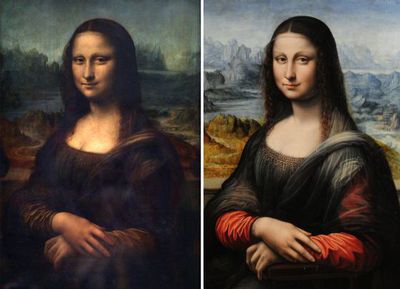
The different Mona Lisa versions

File:The Isleworth Mona Lisa.jpg

Sources: http://elpais.com/elpais/2012/02/02/inenglish/1328163642_850210.html
http://en.wikipedia.org/wiki/Isleworth_Mona_Lisa

Here you have three different versions of Leonardo Da VInci's Mona Lisa: 

- The painting on the left is considered to be the original one and it's located in the Louvre Museum, in Paris (France).

- The work in the center belongs to El Prado Museum. It was stored in the basement of the museum and was discovered and restored in 2012. It is supposed to be a copy made by Salai, Leonardo's pupil, at the same time that Leonardo painted the Mona Lisa. On the following link you can read more about its discovery and restoration: 

http://elpais.com/elpais/2012/02/02/inenglish/1328163642_850210.html

On this video in Spanish you can see the restoration process of this painting: 


- The painting on the right is called Isleworth Mona Lisa. It was discoverd by a British art collector called Hugh Blaker, who bought it and brought it to his studio in Isleworth, London. There are a lot of doubts about its authenticity, but last year the Swiss Federal Institute of Technology said that this painting was made before the Louvre Mona Lisa. Here you have more information about this  painting: 


And this is another article which analyzes Mona Lisa' s similarities with Salai and the theory about the real model for this painting: 


And finally, here you have a link with a small biography of Leonardo Da Vinci that includes data about his sexuality: 

http://www.dailymail.co.uk/news/article-1352915/Mona-Lisa-model-man-Was-Leonardo-da-Vincis-male-apprentice-model.html

Which version you prefer?

Thursday, April 18, 2013

Goya's series of etchings

These are some links with very complete information about Goya's etchings: 

http://www.museodelprado.es/goya-en-el-prado/

http://www.pomona.edu/museum/collections/goya.aspx

http://goya.unizar.es/InfoGoya/Work/Grabado.html

And here you have one of my favourite etchings, from the Caprices' series. It's Caprice Number 37 and was  published for the first time in 1799. Its title is  Will the disciple be wiser?(¿Si sabrá más el discípulo?). 


On it Goya criticized the education of his time. He was influenced by the ideas of Enlightenment and trusted in education as the best way of changing and modernizing society. The notes that accompanied this etching were the following: "Braying is the only think a donkey teacher can teach" ("Un maestro burro no puede enseñar más que a rebuznar"), "Donkey teachers can only get little donkeys" ("Los maestros burros no pueden sacar más que borriquillos"). 

Wednesday, April 17, 2013

Guidelines for your art projects and one example: A bar at the Folies Bergère, by Édouard Manet

Here you have the scheme to prepare your art projects. The text you write will have to include this basic information 

- Title of the painting


- Image and source

- Author

- Chronology

- Material used and dimensions

- Present location of the painting

- Information about the person or institution who commissioned the work of art or bought it.

- Description of the work of art: what is represented, positions of the figures, colours, shapes, use of light, technique (brush-strokes, movement...)

- Meaning of the work of art: symbols used (if there are), purpose of the artist...

- Why it can be considered to be a work of art included in the style it belongs to.

- Additional information: relation with the work of art with other works of the same artist, importance in art history, influence in other artists, curious information

- Why you like this painting

- Sources of information you've used 

Useful advice: 

- First, look for the information in Spanish. You have to make sure that you understand all the information before starting to write your final text. 

- When you have understood the information, check different sources in English and look up for the words you will need to explain what you want to say

- Prepare a previous scheme and be sure that you don´t forget any part. 

- Review the main features of the style and try to find them on your work of art. 

- Don´t copy and paste (I will discover it)

- Don´t use the computer translator (Again, I will discover it)

- Write simple and understandable sentences

- Copy the links of the websites you visit to include them at the end of your explanation and file them on a Word document. This way, you won't lose time looking for the links you've used when you finish your project. 

- The names of the paintings have to be written in Italic font (cursiva) and with all the words in capital letters (nouns and verbs, not prepositions). For example: Saturn Devouring His Son

If you need any help, please contact by e-mail or during the break time in the high school.

Where to find good information: 

- Museums' websites


- About.com: http://arthistory.about.com/

This is an example of what you should do. You don't have to include the titles of every part. I've included them so that you can better understand how to organize the information: 

 A BAR AT THE FOLIES BERGÈRE


TECHNICAL DATA 

The painting I’ve chosen is A Bar at the Folies Bergère, by Édouard Manet. It was painted in 1882 and exhibited in the Paris Salon of the same year. This was Manet’s last important painting. It’s an oil painting on canvas and its dimensions are 96 cm x 130 cam. The painting was bought by Manet’s neighbor, the composer Émmanuel Chabrier, In 1926 the painting was bought by Samuel Courtauld, an art collector who founded the Courtauld Art Institute in London, where the painting is located at the moment. Courtauld paid 22,600 pounds for it. 

DESCRIPTION (explain what you see) 


The painting represents an interior scene at the Folies Bergère, the first Paris music hall, where customers could have a drink and watch a show. The central figure of the painting is a barmaid (identified as a woman could Suzon), who is standing behind a marble bar full of bottles, a glass with a white rose and a plate with oranges. There is a mirror behind her, which shows the audience watching a performance. On the right of the mirror we can also see the image of the barmaid reflected from the back and a man she’s speaking with. On the top left of the mirror we can also see two green feet belonging to a trapeze artist who is performing above the audience. The background reflected on the mirror shows that the Folies Bergère is full of people enjoying the show. 


ANALYSIS (explain what is not evident at first sight) 

Manet represented a real scene of modern life in a real place and a theme considered to be scandalous, because the Folies Bergère was famous as a place where men went to pick up prostitutes. Barmaids sold drinks and also sold themselves. The barmaid of the painting is a real person, known as Suzon, who worked at the Folies-Bergère in the early 1880s. Manet made different preparatory sketches of the painting at the Folies Bergère, but Suzon went to his studio to pose for the painting. The oranges in the foreground indicate that the barmaid is a prostitute, because Manet usually associated oranges with prostitution in his paintings.


Manet's preparatory sketch for the painting

The foreground of the painting is very detailed, while the background is blurrier, painted with an impressionist technique (loose brush-strokes and colour stains). Even the brand of the beer bottles can be identified: the red triangle on the label belonged to Bass Pale Ale, and English beer. The presence of English and not German beer in the foreground has been interpreted as an evidence of anti-German sentiment in France after the Franco-Prussian War. 


The composition using the image reflected on a mirror evokes the influence of Velázquez’ s Meninas. Manet admired Velázquez and used the same play with the images: the main figure of the painting looking directly to the viewer and the image reflected on the mirror as if it was connected with what is happening outside the painting… 


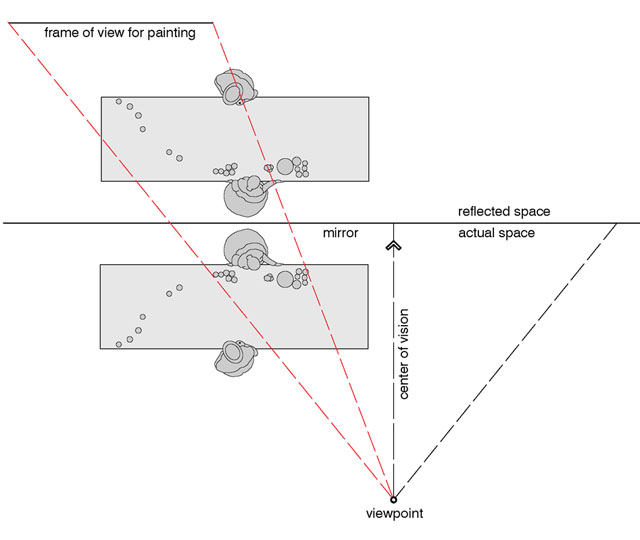
This painting received several critiques for different reasons: the theme, the perspective (considered to be imperfect, because if the girl is supposed to be talking to someone in front of her and the reflection of the man shouldn’t appear on the right of the painting, but to the centre). In 2000 a photograph was taken at the Folies Bergère trying to reproduce what Manet had painted. The photograph allowed the discovery of the point of view Manet had used to paint this scene: he broke up with the traditional way of watching paintings, when the viewer takes a central position to observe the work of art. He represented the scene from a left point of view and this explains that the reflection of the man who is speaking with the barmaid appears on the left and not to the center of the painting. 

bar_diagram_zm

CONNECTION WITH THE STYLE

Édouard Manet is considered to be the precursor of Impressionism, because his paintings broke up with the traditional way of representing scenes as a copy from reality. The themes of his paintings were non conventional as well and many of his works were rejected by the Academy of Painting and the critics. But the impressionist painters considered him as his master. There are impressionist features here, such as the representation of the background with loose, imperfect brush-strokes. The theme (a prostitute as the main figure) was also common in other impressionist and post-impressionist artists, such as Degas and Toulouse-Lautrec. 

WHY I LIKE THIS PAINTING 

I like the play on images with the mirror and all the details that allow us understand the painting better. I also like the contrast between the joy of the customers in the background and Suzon’s sad face. 


Sources: 

http://www.courtauld.ac.uk/gallery/collections/paintings/imppostimp/manet.shtml

http://www.getty.edu/art/exhibitions/manet_bar/

http://www.guardian.co.uk/culture/2000/oct/21/art

http://es.wikipedia.org/wiki/Un_bar_aux_Folies_Berg%C3%A8re

https://www.youtube.com/watch?v=Ye5kbf2_wdI

http://artforus.wordpress.com/2012/12/18/bar-at-the-folies-bergere/

Read the comments' section of this post. You'll find the work of art I've assigned you there. I've tried to respect your choices, but in the cases this hasn't been possible, I've assigned you interesting paintings. 

Monday, April 15, 2013

19th century art presentations

These are the presentations of the contents we are going to study in the next unit. Remember that you have to watch them and choose three works of art (sculptures or paintings) you like or you consider interesting to make a project. You can write a comment with your choices. 

On Wednesday I'll take note of the sculptures or paintings you've chosen and assign one to every student. I'll also write the guidelines for the project and an example to show you how to do it. 


Wednesday, January 30, 2013

Presentation for Unit 4

This is the presentation about the Industrial Revolution and the Labour Movement. As I have told you, one of the images of the cover is the painting called The Fourth Estate, painted by the Italian painter Giuseppe Pellizza da Volpedo in 1901. The name of the painting refers to the proletariat, the new estate appeared after the end of the Ancien Régime, according to the painter.


Friday, June 3, 2011

The Sistine Chapel as if you were there


Here you have an impressive link to visit the Sistine Chapel and enjoy all its details as if you were there. You can use the mouse to move to the different parts of Michelangelo´s frescoes. Use the zoom and and enjoy!

http://www.vatican.va/various/cappelle/sistina_vr/index.html

Challenge number 21

This week´s research will consist in discovering some curiosities about one of the most important Renaissance´s works of art: The last Judgement, painted by Michelangelo Buonarrotti on the altar wall of the Sistine Chapel in theVatican. Michelangelo needed four years to complete this fresco, from 1537 to 1541. 


The Sistine Chapel was restored in the 1980´s and 1990´s. The restorers tried to show Michelangelo´s paintings as he had conceived them, but there are some additions on this fresco Michelangelo didn´t like. Here you have the questions:


QUESTION 1
Why was The last Judgement considered to be a scandalous painting?


QUESTION 2
The following figure is located on the low right side of the painting, in hell´s part. It represents Minos, one of the three judges of the underworld. He´s represented with donkey ears and wrapped in coiled snakes. Michelangelo used a real model to paint this figure. Who was represented as Minos? Why?


QUESTION 3
The following figure represents Saint Bartholomew with a flayed skin. Who did Michelangelo use as model to paint Saint Bartholomew? Whose face is represented in the flayed skin?


QUESTION 4
After the Council of Trent some important alterations were made on The Last Judgement. What changes were made in it and why? What painter was in charge of making these changes? What does his nickname mean?


One last curiosity: Michelangelo also painted two beloved persons on The Last Judgement. On the left side of the picture above the woman below the Virgin is Vittoria Colonna, one of Michelangelo´s best friends. He dedicated her a lot of poems and she was considered to be his Platonic love. Michelangelo also painted Tomasso dei Cavalieri, the man he loved the most. He was probably the model Michelangelo used for the Christ of The Last Judgement and he also painted him behind Saint Bartholomew´s figure. Michelangelo also dedicated Tommaso dei Cavalieri more than 300 hundred poems.


If you want to observe The Last Judgement with more detail, you can use the following link. It belongs to the Vatican Museums. On the left side of the screen you have a magnifying glass that you can use to enlarge the  different parts of the image:


 http://mv.vatican.va/3_EN/pages/x-Schede/CSNs/CSNs_G_Giud.html