Showing posts with label Industrial Revolution. Show all posts
Showing posts with label Industrial Revolution. Show all posts
Wednesday, March 7, 2018


Tuesday, April 18, 2017
Video project about the Industrial Revolution and the Labour Movement
This is the 4th students project about this topic. They chose o explain the contents with some interviews:
Thursday, March 2, 2017
Modern Times
This is Charles Chaplin's full movie Modern Times, a very good film to understand the changes in industrial work as a consequence of mechanization:
Thursday, February 16, 2017
Some short videos about the Industrial Revolution
Here you have a short video that explain the big changes the Industrial Revolution caused:
And this video explains the agricultural revolution:
And this video explains the agricultural revolution:
Thursday, February 18, 2016
Some videos about industrial capitalism
Here you have some videos about Adam Smith's ideas and industrial capitalism. Some of them also include Marx's ideas. We'll study this next week.
On this link you have a short video that explains the concept of capitalism:
http://www.investopedia.com/video/play/capitalism/
- Adam Smith's ideas, from the Political Theory channel:
- Crash course, by John Green
This is a video made by a student and it's really complete, although there are some wrong ideas at the end, when she talks about the accomplishment of Marx's predictions:
- And this is an explanation by David Harvey about crises of capitalism:
Sunday, February 14, 2016
Presentation of Unit 4 and new project suggestion
This is the presentation we are going to use for this unit:


My suggestion for a new project is the following:
Write a small book with the story of a family of workers who live the industrial revolutions, the development of industrial capitalism, the new class-based society and the origins of the labour movement. Here you have some guidelines:
- The members of the family must be at least three: one who lived at the end of the 18th century, one who lived in the first half of the 19th century and one who lived in the 2nd half of the 19th century:
- The first character should live the 1st Industrial Revolution: the demographic and agricultural revolution, migration to cities, the beginning of factory system, the development of the textile and iron and steel industries, the first innovations of transport revolution, the first workers' protests (Luddism, the appearance of class consciousness, mutual benefit societies and the first trade unions).
- The second character should live the changes which led to the 2nd Industrial Revolution and explain the following content: the development of industrial capitalism, the new industries and new ways of organizing work and the new industrial concentrations and the development of the class-based society. As for the labour movement, this character should read about Utopian socialism or participate in New Lanark, New Harmony or the phalanstères and participate in the Chartist movement.
- The third character should tell about the consequences of the industrial revolutions, learn about the Marxist and anarchist ideas, choose one of these alternatives, take active part in the fight of the improvement of workers conditions and explain about International Workingmen's Association and its two stages.
- The story should start in the countryside in Great Britain. Later your characters can travel or settle down in different places, but you have to be careful and keep historical accuracy. Here you have some timelines to keep historical accuracy in what you write:
History of the Trade Unions in the United Kingdom: a very complete website. If you click on the different parts of the timeline, you will get a lot of information about strilkes, campaigns, workers' demands...:
http://www.unionhistory.info/timeline/timeline.php
Timeline on Labour: it includes information of both the United Kingdom and the USA:
http://timelines.ws/subjects/Labor.HTML
A beginners' guide to the history of the British trade union and working class movements: It includes a summary of the most important keystones of the British labour movement:
http://www.grahamstevenson.me.uk/index.php?option=com_content&view=article&id=690&Itemid=52
History of the socialist movement in the United Kingdom: an article from the British Wikipedia
https://en.wikipedia.org/wiki/History_of_the_socialist_movement_in_the_United_Kingdom
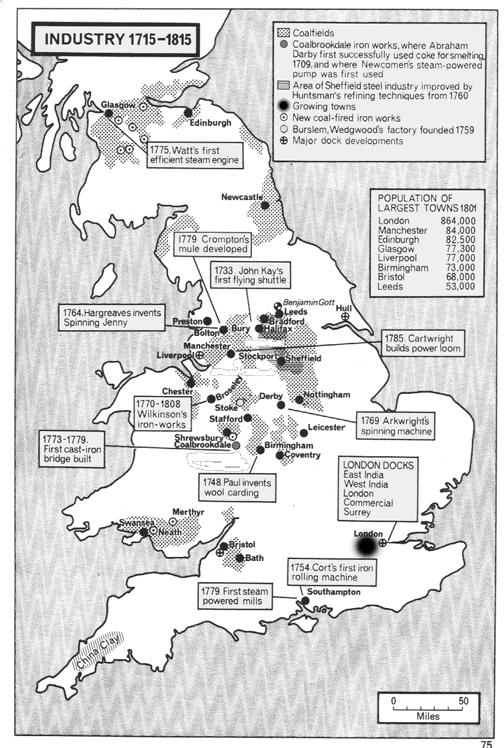
- As the story has to take place in the United Kingdom, here you have some maps to locate your story:
Source: http://websupport1.citytech.cuny.edu/faculty/pcatapano/WC2/wc2maps/16e_Map_19.02.jpg
As a suggestion, your first character could emigrate from the countryside to Manchester, to work in a textile factory, or Sheffield, to work in an iron and steel factory. Your third character could work in a metalworking factory in Sheffield or emigrate to Liverpool and work in the shipyards.
As a suggestion, your first character could emigrate from the countryside to Manchester, to work in a textile factory, or Sheffield, to work in an iron and steel factory. Your third character could work in a metalworking factory in Sheffield or emigrate to Liverpool and work in the shipyards.
- As the story will have to be written on a family book during the 19th century, remember that the sheets of your book should look old. Here you have a video that explains how to age the paper:
- And here you have some videos about how to make a book:
- The project should include drawings or pictures of what you are explaining. Drawings are more original, but as photography was invented in the 19th century, you can include some pictures in the last part of the story.
The deadline for this project will be the 7th of March. Those who fail the project or prefer to take the exam will do it during that week.
Wednesday, February 10, 2016
Some short documentaries about the Industrial Revolution
Here you have some short documentaries about the new unit we are going to study: the Industrial Revolution.
- This one is a quick overview about the Industrial Revolution, including its consequences;
- These videos are an explanation made by a teacher called Mr.Byrd:
Thursday, February 19, 2015
19th February 2015 (Thursday)
Hello, I am
Cristina.
I have really enjoyed today in social sciences’ lesson, because we have been only 5 people and Paqui! That’s way I have enjoyed, because we were very relaxed. The rest of the people have been to a school trip to Almadén.
I have really enjoyed today in social sciences’ lesson, because we have been only 5 people and Paqui! That’s way I have enjoyed, because we were very relaxed. The rest of the people have been to a school trip to Almadén.
The first
we have done during today’s lesson is observing a graphic about Bussiness Cycle,
with Kondratiev waves. Paqui has explained it to us: every business has got crisis
from time to time. As the graphic shows, a Kondratiev wave indicates four
different periods in business:
1) A prosperity period: when the wave’s
line goes up until it reaches its top.
2) A recession period: when it starts
going down from its highest point.
3) A depression period: when it goes
down until its lowest point.
4) An improvement: when the line goes
up from the lowest point, meaning, from the depression.


Paqui has told us that experts say
that the next big crisis will take place in 2018. Are you scared about it?
Afterwards, we have learnt the
difference in society between the one during the Industrial Revolution and the
one there was before. During the Industrial Revolution, instead of a
estate-based society, there was a CLASS-BASED SOCIETY: all the people are equal
before the law but there are differences related to each citizen’s wealth.
There were two main social classes: the Bourgeoisie, whose members owned the
means of production; and the Proletariat (or workers), who were obliged to work
to survive.
Then, the lesson has suffered a
little interruption because Rodrigo was showing us a drawing by Inés Rodríguez.
On this drawing we could see strange signs and drawings from the fiction saga “The Mortal Instruments”
(Cazadores de sombras, in Spanish). There have
been a funny moment when, to explain her drawing, Inés has used the word “tongue”. Paqui hasn’t heard it and she has understood “topless”.
Then, to put an end to this interruption, they have said that I have, genetically, a “widow’s
peak” (pico de viuda) in my hair, but I don’t mind, because I love my hair and
it’s cool. Some famous people have it too, such as Alyson Hannigan (the actress
who plays the role of Lily in ‘How I met your mother’)


Going on with the lesson, Paqui has showed
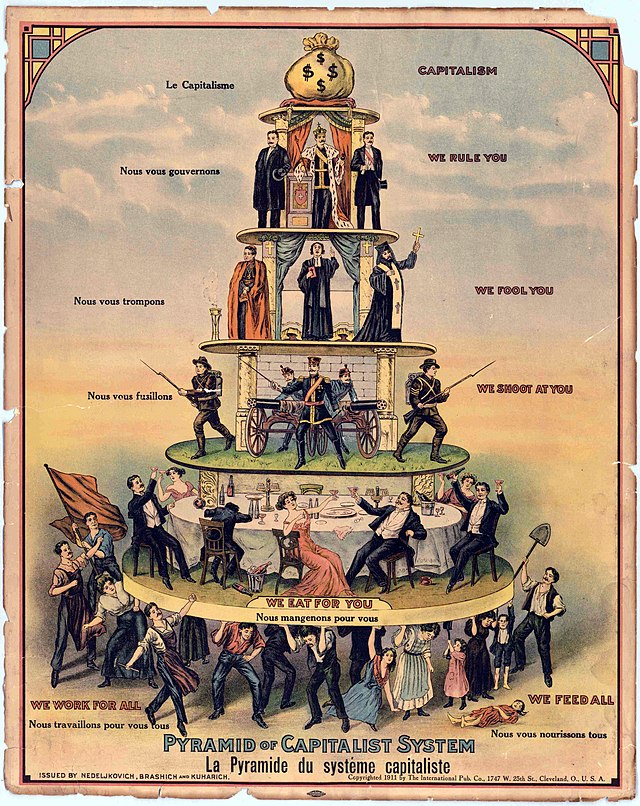
us a nice cartoon about the difference between labor and capital. It's the same shape at the image on the left and the one on the right, but in the first one we can see a poor man while in the second one there is a bourgeois.


Later, we have been talking about the film
and books of “50 Shades of Grey”. Paqui says that they are promoting gender
violence, because these books and film promote women’s submission to men. She
has described it as a “penny dreadful” (novelucha). Inés Rodríguez and my mum
are going to see the film, so they’ll be able to give us their opinions.
As you can see, we have learnt some terms
we didn’t know in English. We have also learnt the terms WIMP (or WUSS), which
means “calzonazos” in Spanish, and DREADFUL, which means “insoportable” (it’s
even worse than awful). I think Rodrigo has been so dreadful today, because he
has written a lot of stupid things on the blackboard.
It has been a very, very funny and nice
lesson.
So long!
Thursday, February 12, 2015
Thursday,12th February 2015
Hello class!
Today in class of Social Sciences we have done many things.
First Paqui has showed us a post she wrote yesterday about the economic system. This has created a discussion in the class about different questions. For example inequality in the world, as you can see in the post next year 1% of the population with own more wealth than the other 99%. Do you think this is fair? There are also other questions to think about it, for example poverty, privileges... We have dedicated part of the class talking about this, but it has been very interesting and we have learnt a lot.
Afterwards, we have continued with the unit and we have talk about:
-The development of the banks: loans, direct investments, owners of companies shares and facilitation of payments.
-The development of public limited societies to share risk; As companies needed more money and it was difficult to find inventors who could provide with all the capital they needed, public limited appeared to divide the risk between all the stockholders. With that we have finished with the first industrial revolution.
The words we have copied on the glossary are:
-GDP: producto interior bruto
-To be left behind: ser dejado atrás
-Decent: digno
-Eviction: desahucio
-To evict: deshauciar
-Mortgage: hipoteca
-One out of...: uno de cada...
-Burden: carga
-Professor: profesor de universidad
-To owe: deber
-To own: ser dueño de
-Public limited company: Sociedad anónima
-Partner: socio
-Share stock: acción o participar.
Today in class of Social Sciences we have done many things.
First Paqui has showed us a post she wrote yesterday about the economic system. This has created a discussion in the class about different questions. For example inequality in the world, as you can see in the post next year 1% of the population with own more wealth than the other 99%. Do you think this is fair? There are also other questions to think about it, for example poverty, privileges... We have dedicated part of the class talking about this, but it has been very interesting and we have learnt a lot.
Afterwards, we have continued with the unit and we have talk about:
-The development of the banks: loans, direct investments, owners of companies shares and facilitation of payments.
-The development of public limited societies to share risk; As companies needed more money and it was difficult to find inventors who could provide with all the capital they needed, public limited appeared to divide the risk between all the stockholders. With that we have finished with the first industrial revolution.
Capitalism in the industrial revolution
Source: http://en.wikipedia.org/wiki/Capitalism#mediaviewer/File:Anti-capitalism_color.jpg
The words we have copied on the glossary are:
-GDP: producto interior bruto
-To be left behind: ser dejado atrás
-Decent: digno
-Eviction: desahucio
-To evict: deshauciar
-Mortgage: hipoteca
-One out of...: uno de cada...
-Burden: carga
-Professor: profesor de universidad
-To owe: deber
-To own: ser dueño de
-Public limited company: Sociedad anónima
-Partner: socio
-Share stock: acción o participar.
Thursday, February 5, 2015
Thursday 5th of February of 2015
Today was the last lesson before the exam. At the beggining of the lesson, Amalia and other people have asked questions about the tomorrow's exam. After this, we have continued wigh the industrial revolution. We had homework for today: complete the scheme about the changues in production and transport revolution, because we don't had time in Monday's lesson. On this scheme we have completed Different sections. In the industries that developed most (textile industry and iron and steel industry), we have seen on the digitalboard some examples about this. Paqui has explained some inventions that appeared in this time. For example in textile industry the flyiung shuttle, by kye, and the power loom, bye Edmund Cartwright. In the iron and steel industry we have seen the Bessemer converter and the blast finnances. At the middle of the class, we have learnt the consequences of this innovations. In general the production increased and the prices decreased. At the end of the class, Paqui have explained us the transport revolution. We haven't seen all because we haven't had enough time, but we have seen the beggining and the risk of the rise of CO2 in the atmosphere.
-Also we have copied some words of the glossary:
-Cotton fabric: Tejido de algodón
-Fabric: Tela/tejido
-Spinning:Hilado
-Weaving: tejido
-To weave: Tejer
-To spin: Hilar
-Engine: motor
-Power loom: Telar mecánico
-Flying shuttle: lanzadera volante
-Iron and steel industry: Industria de sidelurgia
-Blast finnance: Alto horno
-Bessemer converter: Convertidor Bessemer
-Amelioration: mejora
-Overcrawded: Saturado
Here you have a photo about the industrial revolution and the factories:

-Also we have copied some words of the glossary:
-Cotton fabric: Tejido de algodón
-Fabric: Tela/tejido
-Spinning:Hilado
-Weaving: tejido
-To weave: Tejer
-To spin: Hilar
-Engine: motor
-Power loom: Telar mecánico
-Flying shuttle: lanzadera volante
-Iron and steel industry: Industria de sidelurgia
-Blast finnance: Alto horno
-Bessemer converter: Convertidor Bessemer
-Amelioration: mejora
-Overcrawded: Saturado
Here you have a photo about the industrial revolution and the factories:
Tuesday, January 27, 2015
27th January 2015 (Tuesday)
Hello everybody!
Today we start the class of social sciences copying the contents of the unit four, that is: The Industrial Revolution and the Labour movement.
The first point is the stages and the definition of the industrial revolution. The second point is the first industrial revolution, inside this point we have other three parts: A) Demographic and agricultural revolution. B) Changes in production and the transport revolution. C) Development of industrial capitalism. The third point is the second industrial revolution and consequences. The fourth point is the labour movement, inside this point we also have three parts: A) First attempts of worker's organizations. B) Labour movement ideologies, that have also three parts: a) Utopian socialism. b) Scientific socialism or maxism. c) Anarchism. And the finally part of the fouth point is C) The international workingmen's association and the first and second international.
I think that this unit is very long or thats what seems.
After this we start the unit with the first point and Paqui copy a squeme in the blackboard that we have to complete with the book's information about the definition of the indutrial revolution and its stages.
We also talk about the agriculture of the time the most cultivated were the corn and the potato, the tomatoes were yellow and the name of the oranges became of the name of the royal family of Holland.
And for finally we copied two squemes in the second point about the definition, causes, changes and consequences of the demographic and the agricultural revolution. We complete the first in class but we haven't had time for the second. Here's the first:
Demographic revolution:
-Definition: Deep change in population growth started in the 18th century.
-Causes: Less wars and hygiene and medicine improve, people were better.
-Changes: Mortality decreased, while birth rates continued to be high and harp population increased and life expectancy also increased.
-Consequences: High demand for all type of products cause of the agricultural and industrial revolutions.

Source: http://cmapspublic.ihmc.us/rid=1K31112Q6-25F3G57-1K81/1K2M2JJHXIQN77RTI1KLIimage
Today's glossary words:
Labour movement: movimiento obrero.
To supply the demand: abastecer la demanda.
To overtake: superar, sobrepasar.
Outdated: desfasado.
Dizzy: mareado.
To feed: alimentar.
To be fed up: estar harto.
Farmer-peasant: campesino.
To lead: conducir o llevar.
See you on Thursday!
Today we start the class of social sciences copying the contents of the unit four, that is: The Industrial Revolution and the Labour movement.
The first point is the stages and the definition of the industrial revolution. The second point is the first industrial revolution, inside this point we have other three parts: A) Demographic and agricultural revolution. B) Changes in production and the transport revolution. C) Development of industrial capitalism. The third point is the second industrial revolution and consequences. The fourth point is the labour movement, inside this point we also have three parts: A) First attempts of worker's organizations. B) Labour movement ideologies, that have also three parts: a) Utopian socialism. b) Scientific socialism or maxism. c) Anarchism. And the finally part of the fouth point is C) The international workingmen's association and the first and second international.
I think that this unit is very long or thats what seems.
After this we start the unit with the first point and Paqui copy a squeme in the blackboard that we have to complete with the book's information about the definition of the indutrial revolution and its stages.
We also talk about the agriculture of the time the most cultivated were the corn and the potato, the tomatoes were yellow and the name of the oranges became of the name of the royal family of Holland.
And for finally we copied two squemes in the second point about the definition, causes, changes and consequences of the demographic and the agricultural revolution. We complete the first in class but we haven't had time for the second. Here's the first:
Demographic revolution:
-Definition: Deep change in population growth started in the 18th century.
-Causes: Less wars and hygiene and medicine improve, people were better.
-Changes: Mortality decreased, while birth rates continued to be high and harp population increased and life expectancy also increased.
-Consequences: High demand for all type of products cause of the agricultural and industrial revolutions.
Source: http://cmapspublic.ihmc.us/rid=1K31112Q6-25F3G57-1K81/1K2M2JJHXIQN77RTI1KLIimage
Today's glossary words:
Labour movement: movimiento obrero.
To supply the demand: abastecer la demanda.
To overtake: superar, sobrepasar.
Outdated: desfasado.
Dizzy: mareado.
To feed: alimentar.
To be fed up: estar harto.
Farmer-peasant: campesino.
To lead: conducir o llevar.
See you on Thursday!
Thursday, January 22, 2015
Presentation of Unit 4
This is the presentation of Unit 4, whose contents are the Industrial Revolution and the Labour Movement. As always, use it to complete your notes and activities:
Tuesday, January 20, 2015
Tuesday, 20th January 2015
Hi there!
Today in Social Sciences we've argued about the date of the exam of this unit and finally, Paqui has won the battle. We have it on the 5th of January.
Then we've started the lesson. We have started the new unit: The Intustrial Revovlution and labour movement. Paqui has told us that we had to complete the first point, definition of the industrial revolution and its stages, and the first part of the 2nd point (The demographic and agrarian revolution), so we have done this almost until the end of the lesson. I haven't finished it yet. The definition of Industrial Revolution is that it was a deep charge in the way of producing products due to the increase of the population, and it led to important charges in economy and society. It had two stages: the first and the second industrial revolutions.
Then, we have seen some videos about how to do the project. I like the idea of this project, it seems interesting.
It was an interesting lesson today, but we haven't copied almost any word in our glossaries.
Labour movement: Movimiento obrero
Utopian: utópico.

Today in Social Sciences we've argued about the date of the exam of this unit and finally, Paqui has won the battle. We have it on the 5th of January.
Then we've started the lesson. We have started the new unit: The Intustrial Revovlution and labour movement. Paqui has told us that we had to complete the first point, definition of the industrial revolution and its stages, and the first part of the 2nd point (The demographic and agrarian revolution), so we have done this almost until the end of the lesson. I haven't finished it yet. The definition of Industrial Revolution is that it was a deep charge in the way of producing products due to the increase of the population, and it led to important charges in economy and society. It had two stages: the first and the second industrial revolutions.
Then, we have seen some videos about how to do the project. I like the idea of this project, it seems interesting.
It was an interesting lesson today, but we haven't copied almost any word in our glossaries.
Labour movement: Movimiento obrero
Utopian: utópico.
(source: http://upload.wikimedia.org/wikipedia/commons/4/42/Philipp_Jakob_Loutherbourg_d._J._002.jpg )
Saturday, February 16, 2013
Some videos to summarize the Industrial Revolutions
Here you have them:
- Turning points in history: Industrial Revolution:
- Coal, steam and the Industrial Revolution, from the Crash Course of World History:
- Industrial Revolution Overview, by the United Learning website:
- Why the Industrial Revolution happened here, a BBC documentary:
- Turning points in history: Industrial Revolution:
- Coal, steam and the Industrial Revolution, from the Crash Course of World History:
- Industrial Revolution Overview, by the United Learning website:
- Why the Industrial Revolution happened here, a BBC documentary:
Friday, February 8, 2013
Curious stories about some inventions of the Industrial Revolution
Yesterday I told you the story about the flutes James Watt forged to get the money he needed to for his experiments with the steam engine. You can read the full story here:
http://todayinsocialsciences.blogspot.com.es/2012/01/what-do-flutes-have-to-do-with.html
This is the link to the story about the true inventor of the telephone, who was not Alexander Graham Bell, but Antonio Meucci. Graham Bell is supposed to have copied Meucci´s invention and registered it in his name:
http://todayinsocialsciences.blogspot.com.es/2012/01/antonio-meucci-true-inventor-of.html
The story of electricity is very curious as well. Everybody considers Thomas Alva Edison, the Wizard of Menlo Park, to be one of the biggest inventors ever. He accumulated 2,332 patents worldwide (1,093 in the USA), but he didn´t invent all the products people commonly attribute him. Many of them were improvements of previous inventions and other were developed by his workers in his laboratory in Menlo Park. Edison was more a business man who got the money for his projects. Here you have a complete list of all the inventions patented by Edison:
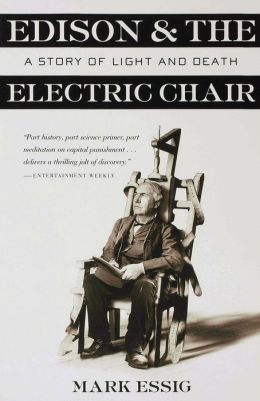
Edison was also involved in the so called War of Currents with Nikola Tesla, a great inventor. Edison defended direct current and Tesla defended alternating current. Tesla received George Westinghouse´s financing and Edison tried to discredit alternating current by all means. He reached the point of inventing the electric chair with an old Westinghouse generator. The first executed criminal was William Kemmler, who died in an awful spectacle. Later Edison executed a circus elephant which had killed three men to show how dangerous alternating current could be. But despite all his efforts, finally Tesla and Westinghouse proved that alternating current was cheaper and more efficient.
If you want to read more about the War of Currents, here you have some links:
Wednesday, January 30, 2013
Presentation for Unit 4
This is the presentation about the Industrial Revolution and the Labour Movement. As I have told you, one of the images of the cover is the painting called The Fourth Estate, painted by the Italian painter Giuseppe Pellizza da Volpedo in 1901. The name of the painting refers to the proletariat, the new estate appeared after the end of the Ancien Régime, according to the painter.
Monday, January 23, 2012
PowerPoint presentation for Unit 4
Here you have the PowerPoint presentation to complete your notes about Unit 4. It includes all the contents about the Demographic and the Agricultural Revolution, the two stages of the Industrial Revolution and their consequences, the new class society, the history of the Labour Movement and the political ideologies that appeared with the objective of improving the workers´conditions. Have a look on the presentation. Cristina will use it in the classroom to check the exercises and show you some interesting things.
Friday, January 20, 2012
2011-2012 Challenges. Number 16
Sorry for the delay. This week´s questions are related to some of the inventions which contributed to the First Industrial Revolution.

James Watt´s first steam engine (1776)
Source: http://library.thinkquest.org/C006011/english/sites/steam_james_watt.php3?f=2&b=50&j=1&fl=1&v=2
QUESTION 1
James Watt is considered to be the inventor of the steam engine. In fact, he improved some pre-existing engines, such as Thomas Savery´s water pump or Thomas Newcomen´s atmospheric engine. In 1606, at the beginning of the 17th century a Navarrese military man, musician and cosmographer patented the first machine to use steam power. He also invented a diving suit, which was tested in the Pisuerga River. Who was this Hispanic inventor?
QUESTION 2
James Watt drew also inspiration from Denis Papin´s inventions. What was the most important contribution of this French inventor?
QUESTION 3
The Spinning Jenny was one of the most important inventions that contributed to the mechanization of textile industry. Who invented it? Why was this machine called Jenny?

Spinning Jenny
QUESTION 4
When and where did the factory system appear?
QUESTION 5
What were the Rainhill Trials? What was the realtion of this event with the history of transport?
Thursday, January 12, 2012
2011-2012 Challenges. Number 15
These are this week´s questions. They are related to the causes of the Industrial Revolution. We´ll study some of the contents of this challenge next week. You should participate.
QUESTION 1
One of the causes of the changes in the way of manufacturing products was population growth. In the 18th century population increased considerably due to different factors, such as medical improvements. What was the most important advance in medicine during the 18th century? What doctor was the responsible for this important discovery?
QUESTION 2
What relation to Question 1´s discovery did the Spanish doctors Francisco Xavier Balmis and José Salvany have? Why are they so important in the history of world medicine?

Doctor Xavier Balmis
QUESTION 3
The picture below shows a turnip. Why was Viscount Charles Thownsend called "Turnip" Thownsend? What was his role in the 18th century British Agricultural Revolution?
What was Joseph Foljambe´s role in the agricultural innovations that contributed to the increase of production?
QUESTION 5
A famous music band of the 70´s got its name from an important 18th-century British agriculturist. Some of their albums are Aqualung and Too Old to Rock´n Roll: Too Young to die. What is the name of this band? What were the main contributions to agriculture of the man who gave name to this group?
QUESTION 6
What was Robert Bakewell and Thomas Coke contribution to stockbreeding?
P.S: I´ll include the source of the first picture when you solve the challenge.
Subscribe to:
Posts (Atom)