Thursday, October 8, 2015

Do you want to help me rebuild the art wall?

As I have told you this morning, I would like to rebuild the art wall we mede in class two years ago. If you have a colour printer and you want to collaborate with me in this task, here you have some instructions about how to do it: 

- Choose one painting you like. In order not to have repeated paintings, I'll make a list of paintings and you can choose the one you prefer. The purpose is that the wall includes some of the most representative paintings of every art style. 

- As the tiles of the class measure 20 x 20 cm, the paintings should be 20 cm wide and not more than 20 cm high. Use the Word ruler to know the measures of the painting you've chosen. It's better that you print the images horizontally, except  Here you have an image where you can see the rule: 


- The title of the painting has to be written with the Calibri font, size 16 and in bold. First we'll write the title in Spanish, a hyphen and finally the name in English. All this has to be written in the same line. The author's name will be written in a second line, below the title. 

If you want to cooperate with this project, please leave a message in the comments' section. Thanks!

Thursday 8Th of October 2015

Today in class of social sciences we have been finishing our projects of the board game. 
In my group we have been finishing the cards and the rules. Our game is called "Duke of Alba's castle".
Image of our project.


The objective of our game is to get more points than the other players and save the princess.
How to play?
You have to follow your path to get the first x that is a custion, then you have to throw the dice and you will have to answer a question depending the number of the dice. If you get a 1 you will have to answer a question of CharlesI, if it's a 2 a question of PhilipII and so on. If you answer correctly the queston you will get a point, if you don't guess it you will have to continue without the point.
When you reach a point of blood you will have to answer a more dificoult question. It follows the previous rules but if you dont guess it you will wait a turn without playing.

We thougt the idea of the idea of the duke of Alba's castle becouse in the past instead of the coco comes they said the duke of alba comes.
Today also we have seen the other groups works. I like Lucia's group's work becouse I think that it is original.


This day in history: the Battle of Lepanto

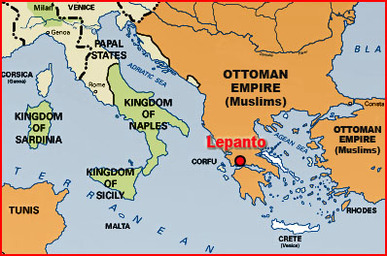
On the 7th October 1571 the Holy League fleet captained by John of Austria defeated Suleyman the Magnificent's fleet in the Gulf of Lepanto, near the coast of Greece. This battle was decissive, because it stopped the Turk threat in the Eastern Mediterranean, 


John of Austria, Philip II's half brother


Here ou have a map of the location of Lepanto, now called Naufpaktos: 


Picture


And on this link you can download a presentation with an animated map of the battle: 


As you know, Miguel de CErvantes participated in the battle and was injured in his left hand. The reason why he participated in the battle was because he had enlisted in the navy in Italy in 1570. We don't know for sure why he was in Italy at the moment, but he might have fled there to avoid being arrested for having participated in a duel and injured his oponent, Cervntes described the Battle of Lepanto as “the highest and most memorable occasion that past and future centuries will ever hope to see”. Hopefully, Cervantes didn't die there and he could write the Quixote. 


Cervates jauregui.jpg


Tuesday, October 6, 2015

This day in history: Elizabeth of France's death

I'm inaugurating a new section on the blog called "This day in history". It consists of explaining some historical events happened on a specific date in the past. You can contribute with your own events, but respecting some rules: the events you elect have to be related to what we' ve studied in class.

On the 6th October 1644 Elizabeth of France, Philip IV's first wife, died in Madrid at the age of 41. She was the daughter of Henry IV of France and Mary of Medicis. She gave birth to 8 children, but when she died only two survived: prince Balthasar Charles, dead two years later when he was 15, and infanta Maria Theresa of Austria, whose marriage with Louis XIV of France was arranged in the Peace of the Pyrenees. 

These are some portraits by Queen Elizabeth painted by Diego de Silva and Velázquez, Philip IV's court painter: 

Isabel de Borbón, by Diego Velázquez.jpg

Source: https://en.wikipedia.org/wiki/Elisabeth_of_France_(1602%E2%80%931644)


Source: https://en.wikipedia.org/wiki/File:Retrato_ecuestre_de_Isabel_de_Borb%C3%B3n,_by_Diego_Vel%C3%A1zquez.jpg

File:Retrato de Isabel de Borbón, by studio of Diego Velázquez.jpg

Source: https://en.wikipedia.org/wiki/File:Retrato_de_Isabel_de_Borb%C3%B3n,_by_studio_of_Diego_Vel%C3%A1zquez.jpg


As prince Balthasar Charles died in 1646, Philip IV needed a new heir to the throne and in 1649 he married his niece Mariana of Austria. They had 5 children. Charles II was the youngest one and the only surviving boy. This was the reason why he became the king of the Hispanic Monarchy.

The French branch of Charles II's family played a significant role when the monarch died. Philip of Anjou, Louis XIV and Maria Theresa of Austria's grandson, was designated by Charles II as the heir to the throne in his last testament. He finally became the king of Spain, after the WAr of Spanish Succession.

6th October 2015


Hi, I'm Carlos!!

Today, in Social Sciences class, we have continued with the board game of the Indies, the 16th and 17th centuries.

My group is formed by: Antonio, Benjamin, Jaime and me. Today in my group we have written the questions on the cards and then Paqui has asked us about what we were doing. At home, we have to finish the questions and we have to do the board, the tokens and the dice.

Our game is going to be like a high school with some rooms. Each room is going to be for a person ( Charles I, Philip II...), so you have to advance to visit all the rooms. When you have finished all the rooms, you have to go to a final room. In this one you will have to answer the final question.

This is a photo of our cards:


NEW VOCABULARY
Dice: dado
Token: ficha
Gameboard: tablero
EVA foam: gomaeva

Bye!


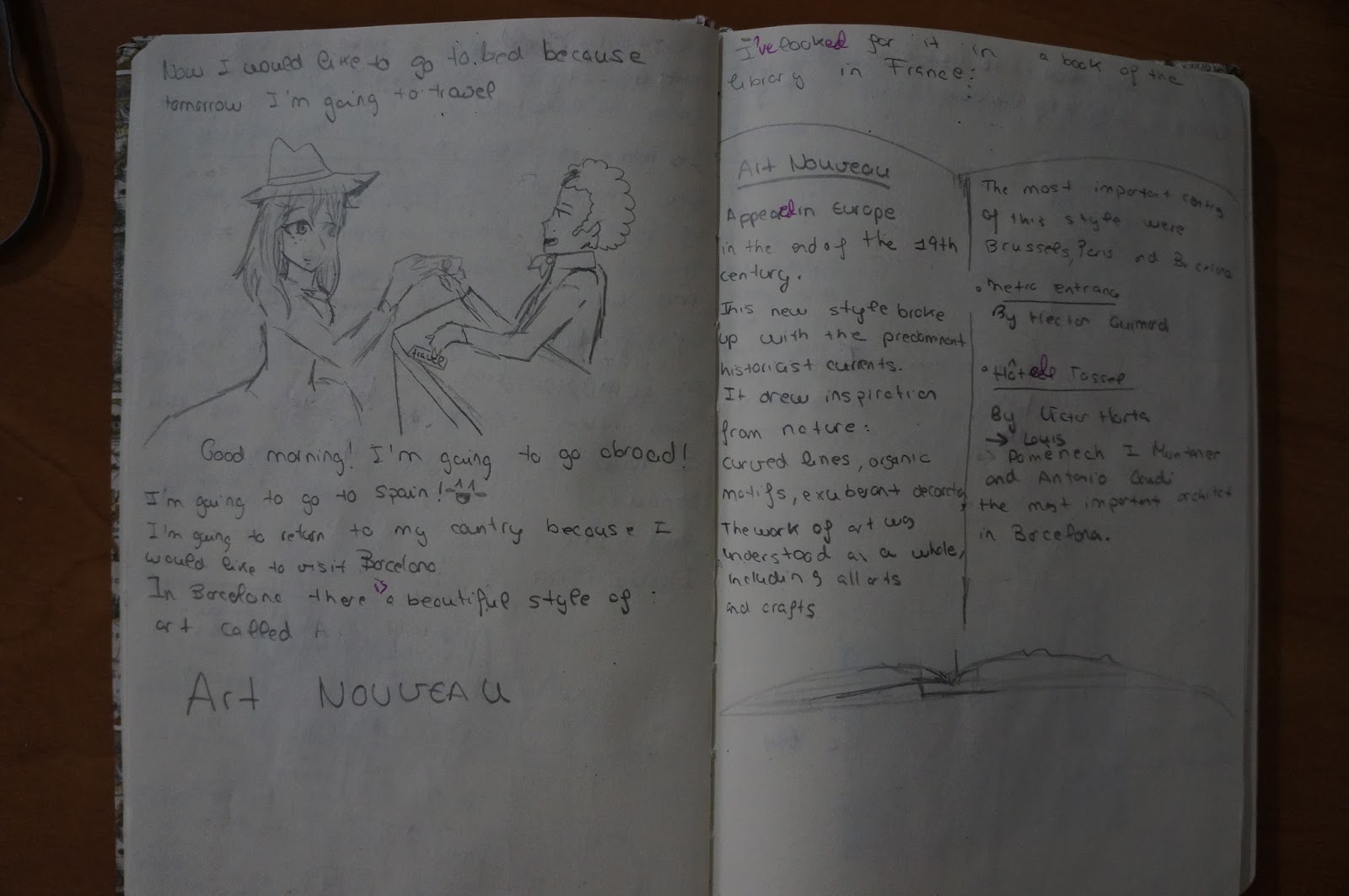
Two presentations for your Baroque art travel journal

Here you have two presentations about Baroque art. You can o¡use them as a reference to learn about the main features and most important art works of every artist: 


Monday, October 5, 2015

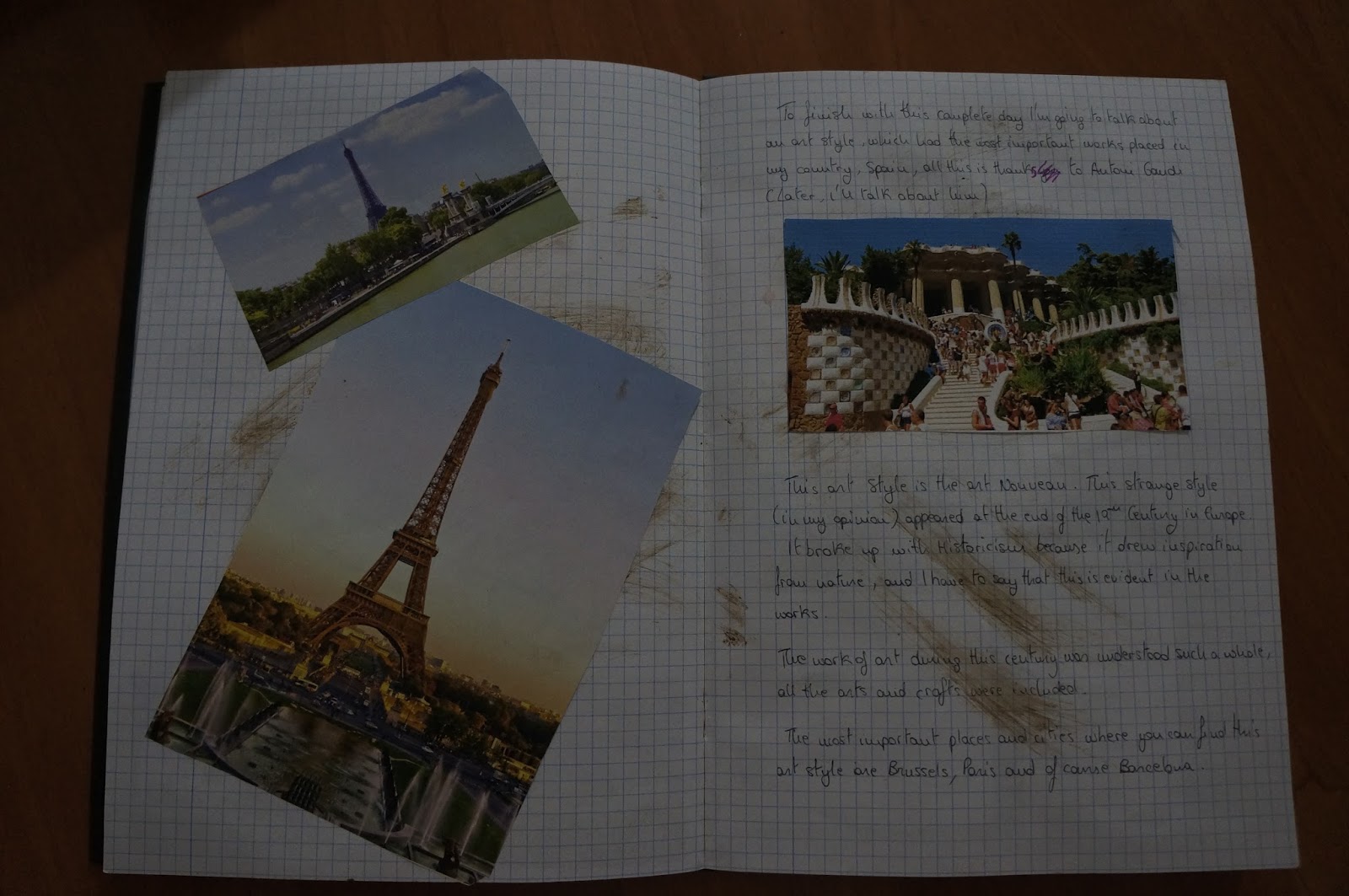
Some examples of travel journals

Here you have some examples of the travel journals the students of 4th ESO made about the art styles of the 18th-19th centuries last year. There were really good projects. I hope yours will be at least as good as they were. 


Monday, 5th October 2015

Today in Social Sciences lesson Paqui has said to us that we had to start doing the project aboutthe 16th and 17th centuries, so we have formed the groups to do doing the project. In my case Fátima, Maria Muñoz and María Perez are my classmates in this project.

We have prepared the questions and drawn what our game is going to be in the reality and some minutes later Paqui has came to us and we have explained her the game and (the same) she has also corrected the questions that we had written before. Then we have continued to work on the project.

In the case of my group we have focused0 the project on a game called Trivial, so we are going to use like a table with different colours and cheeses.

Finally, Paqui said to us that we are going to continue with the project next day. 

Bye!

Art project: travel journal to Baroque art


These are the guidelines for the individual project you are going to do about art  in the 17th century:

Imagine that you are a time traveller and an art lover. Your next trip will be to the 17th century to learn about the art  of this century. Your project will consist of making a travel journal with the following contents:

 - The content of the project is Baroque art in Europe and in the Hispanic Monarchy, including architecture, sculpture and painting.

- Main features, artists and works of Baroque art, narrated as in you were visiting the times and significant places of this period.

- In addition, you will have to choose your favourite art work of  the most important artists of every place, write a short biography of its author, an explanation of the work and your personal opinion about it. For example: in architecture, the most important architect in Italy was Bernini. You should write a short biography of him and choose your favourite architectural work of this artist and why you like it.

- Every stage of your trip will have to include images of the main works and artists. They can be printed images  or drawings you make.


- The format of your travel journal is free: it can be a real journal, bought or made by you with cardboard or another material you prefer, it can also be a video journal, but it has to have the structure of a journal.

The deadline to hand in this project will be the 29th October (Thursday). You have four weeks to do it, so plan your work and don't wait until the last day.

ATTENTION: If your project is superficial or incomplete, you will have to take the exam of these contents.

This afternoon I will upload some pictures of the travel journals last year students did. This way you will have an idea of what you can do if you work hard. 

Here you have some advice about how to make an original travel journal on paper, creating beautiful backgrounds for your pages:

http://rondapalazzari.typepad.com/helpmeronda/2014/06/create-daily-travel-art-journal.html

http://taconescongracia.blogspot.com.es/2013/05/album-del-primer-taller-de-art-journal.html

https://aworkofheart.wordpress.com/tag/art-journal/

Use your imagination and enjoy the trip!

Thursday, October 1, 2015

1st October 2015

Hi, I'm Santiago!!!

Today, in Social Sciences class, we've studied the conquest of the Indies, which lasted only for 50 years. But, why did it last only fot 50 years?? Well, the Castillians had much more militar superiority (they had horses, gunpowder, guns...), they were very ambitious and there were some illnesses that were lethal for Amerindians, like measles or a simple flu.

https://factoriahistorica.wordpress.com/2014/06/24/la-violencia-y-la-guerra-durante-la-conquista/conquista-de-america_siglo-xvi/

The population of Mexico was seriously affected with those illnesses, and the Mexican population decreased a lot. Before this illnesses, they were over 25 million people, but, due to the illnesses, its population was decreased. Some years later, there were only 3 million people in Mexico, and they tried to recover the lost  population with African slaves, and that's why there are a lot of black people in America nowadays.
https://es.wikipedia.org/wiki/Cat%C3%A1strofe_demogr%C3%A1fica_en_Am%C3%A9rica_tras_la_llegada_de_los_europeos#/media/File:Demomex-1518-1623.png

After that, we've started talking about the conquest they made in the Indies. There were 2 important conquests: The one of the Aztec Empire, and the one of the Inca empire.

We've started with the conquest of the Aztec Empire: This conquest was led by Hernán Cortés, and it only lasted for 5 years. The Aztec Empire was placed in the North of what we know now as Mexico. The last Aztec emperor was called Moctezuma, who was captured by Hernan Cortes. He finally conquered the Aztec Empire in 1521.


https://es.wikipedia.org/wiki/Cat%C3%A1strofe_demogr%C3%A1fica_en_Am%C3%A9rica_tras_la_llegada_de_los_europeos#/media/File:Demomex-1518-1623.png

http://www.oocities.org/mx/boletin_cobach/aztecas/aztecas.html


Later, we've talked about the conquest of the Inca Empire. This conquest was led by Francisco Pizarro and Diego de Almagro. They occupied the former capital city, Cuzco, and they captured Atahualpa, who was the last Aztec Emperor. Atahualpa gave them a room full of gold and silver if they set him free. But anyway, he was killed later. They also moved the capital city from Cuzco to Lima. Nowadays, Francisco Pizarro is considered a hero in Spain, but in Perú, he is considered as a monster, because he and his men were very cruel.


https://upload.wikimedia.org/wikipedia/commons/thumb/4/44/Inca_Empire_South_America.png/270px-Inca_Empire_South_America.png

http://a3.files.biography.com/image/upload/c_fill,cs_srgb,dpr_1.0,g_face,h_300,q_80,w_300/MTE4MDAzNDEwNjU4MTY2Mjg2.jpg

Later, Pedro de Valdivia conquered Chile, fighting against the Araucanians

We've also studied about other conquest and discoveries, but they weren't as important as the ones of Hernán Cortes and Francisco Pizarro.

We've talked about Ponce de León, who explored what's known now as Florida. Cabeza de Vaca explored the south of the USA, looking for the fountain of youth. They didn't find it (because it doesn't exist), but they found the Iguazu Falls

http://funmozar.com/wp-content/uploads/2014/12/Iguazu-Falls-03.jpg

Orellana sailed all the Amazon River, and Núñez de Balboa discovered the Pacific Ocean.

They had some common features: They were very ambitious, and they were poor hidalgos.


Then, we've talked about the administration of the Indies. Everything was decided in Castile. They created the Council of the Indies, which made the laws of the Indies and appointed people who had to hold posts in the Indies. They also created a Trading House in Sevilla, which controlled the products that were sent from the Indies or sent to the Indies. If you wanted to send something to the Indies, you had to pay 20% of the product value. There was a lot of contraband, they tried to control it, but it was impossible. And if they caught you, as in many other cases, they killed you.

We've also studied the institutions in the Indies. There were:

  • Two vice-royalties: The vice-royalty of the new Spain, in North America, and the Vice-Royalty in Peru (South America)
  • Cabildos
  • Audiencias


http://redul.wikispaces.com/file/view/2BacHisT08mapa-virreinatos01.png/39030260/2BacHisT08mapa-virreinatos01.png

And, finally, we've talked about the exploitation of the Indies. There were two methods:

  • Encomiendas: Do yo remember how a fief worked? It was basically the same. They gave you a piece of land, and the people who were there worked for you. And the only thing they had to do was to teach religion to the people who lived there.
  • Mita: They obliged natives to work in mines. They were paid, but you could only spend that money on the shops of  the Castilians.
There was a man who denounced the exploitation of the Amerindians. His complaints made that the kings dissolved the encomienda system and forbade indigenous slavery. But black people were still considered as slaves. They considered black people as... things.


NEW VOCABULARY

Gunpowder-Pólvora
Lethal-Mortal
Measles-Sarampión
Smallpox-Viruela
Typhus-Tifus
Scurvy-Escorbuto
Arson-Rescate
Araucanian-Arancano
Trading House-Casa de Contratación
Customs-Aduana

That's all. Bye !!!!