Showing posts with label Stefania Nes. Show all posts

Tuesday, May 26, 2015

Tuesday, 26th May,2015

Hey there! I'm Stefania and this is my last journal of this year.
Today is Social Sciences class we have done many things:
First of all we have corrected three exercises that Paqui gave us the last Thursday. Maria has corrected the first exercise. In this exercise we have to explain the situation of the USA after WW1.

The situation of the USA after WW1 was the following one: the USA became the most important economic power in the world and the most important creditor of the Europeans countries. The American way of life became a model. The USA attracted thousand of immigrants and consumer society spread thanks to the installments and credits. There was a huge demand for all kind of products:
  • Farmers bought lands to increase production
  • Industries asked for credits to expand their business
  • A lot of houses and apartments were built and quickly sold
  • Many people invested in stock exchange markets due to the facilities the banks gave to get a credit.
As there was a huge demand, prices increased constantly, even if there was no correspondence between the price of the stocks and the way companies worked.

The second exercise has consisted of explaining the causes of the 1929 economic crisis in the USA.
The 1929 crisis started when the Europeans countries started recovering,there was a contraction of the demand for USA products and an overproduction crisis started:
  1. Products couldn't be sold
  2. Stocks started accumulating and as everyone wanted to sell their stocks, prices decressed and they lost a lot of money.
  3. Industries couldn't sell their products, so they had to dismiss workers (unemployment rate increased).
  4. Farmers couldn't give their loans back to the banks.
When we have been corrected the second exercise I've asked Paqui who had to do the journal today because I didn't know it, so she has said that it was my turn.

The last exercise consisted of explaining the event that is considered to be the outbreak of the 1929. Marta has corrected this exercise.
Outbreak of 1992's crisis: The public evidence of the crisis came on the 24th October 1929 (Black Friday), when the price of stocks in Wall Street (New York Stock Exchange Market) fell down.
Wall Street

The stockholders panicked and tried to sell their stocks massively. Prices shrunk, many investors got ruined and they couldn't give their loans back. Banks crashed down and economy collapsed. When the USA banks asked the European banks for the money they had lent them before, the crisis spread to Europe and the Great Depression become a world problem.

The picture that is above is representing two men searching for job. Paqui has said us that they had written like a curriculum, because in it that time was very difficult to find a job.
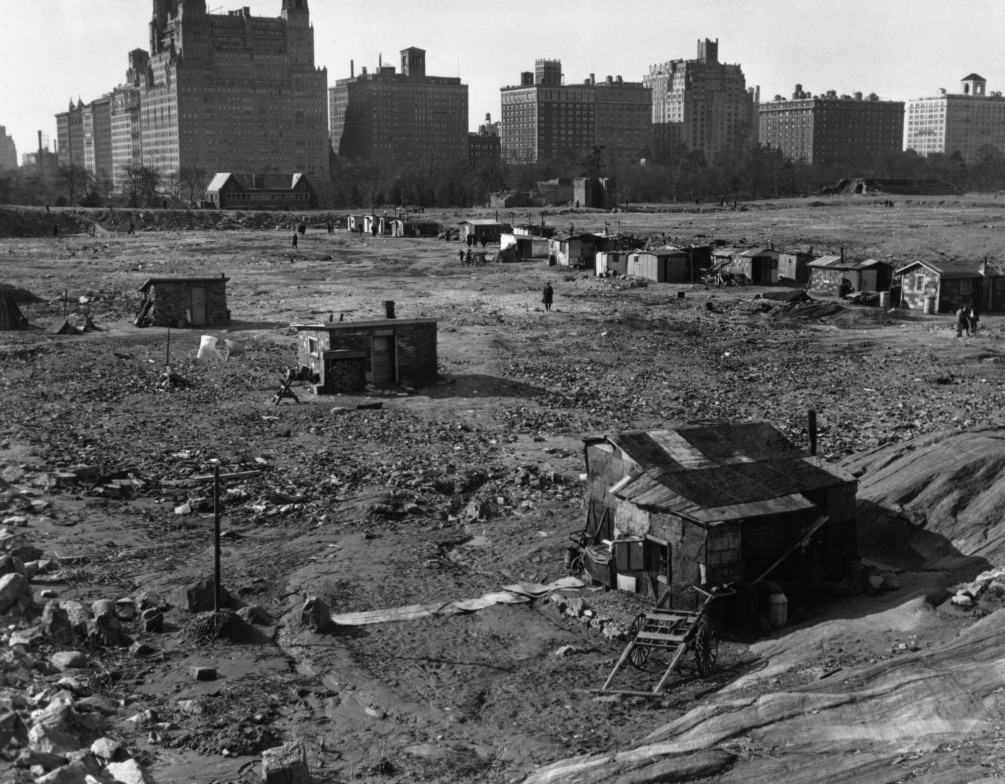
Then we have seen many images and there was one very interesting:
This is the famous Central Park in 1929. It was full of shanties because the people that couldn't pay the loans lost their houses and they started to live there.
Then we have spoken about how the banks work. Paqui has given an example to make me understand why banks collapsed in that period. She has told me that when a person deposits money in a bank, this money doesn't remain there untouchable, that money is given to another people. So this happened in 1929 in the USA the people who didn't invest money in stock they lost their money because the banks couldn't give them their money back.So there were a lot of people queuing to recover their money, like in the next picture.

Then we have seen a graphic about how unemployment rate grow in that period
Paqui has told us that nowatdays Spain has reached the top of unemployment rate.
Then in the last 5 minutes of the class Paqui has started to explain us why the crisis became more serious, but she hasn't finished it, because the bell has rung.
And as always we have copied some words on the glossary:
  • creditor:acreedor
  • interest rate: tasas de interés
  • to going into debts:endeudarse
  • to get ride of something:deshacerse de
  • to go bankrupt: quebrar/ir a la bancarota
  • vicious circle:círculo vicioso
  • shanty :chabola
  • shanty town:poblado chabolista
  • Chemistry:química
And that's all for today! Now I've to go to study Biology! See you on Thursday.


Monday, April 13, 2015

13th April 2015

Hi everyone! I'm Stefania and today it's my turn to write the journal.
Today in Social Sciences after arriving in the class, many classmates have asked Paqui to let them go to speak with our P.E teacher, and Marta has written a quote on the whiteboard . After that we have started our normal lesson.We have learnt many things about the World War I today.
We have started checking the exercise 1 from page 59 (causes of World War I).
 We have learnt that there were many causes(but as Sara has explained it the other day I'm only going to mention them).


  • Rivalry between colonial powers
  • Exacerbation of nationalism 
  • Military alliances
  • Arms race

For today we also has to copy a slide from the presentation called: Growing tension before 1914.We have learnt that there were several crises which increased tension and this was on the brink to provoke war.

Two crises in Morocco,which increased tension between France and Gemany.
  • 1905/1906:It ended with the establishment of a French-Spanish protectorate in Moroco
  • 1911:Germany received part of the French Congo and accepted French protectorate in Moroco.
Two crises in the Balkans:which increased tension between Austria-Hungary and Russia
  • 1908:Bosnia-Herzegovina was annexed to Austria-Hungary
  • 1912/1913: Balkans Wars:Serbia, Montenegro, Greece and Bulgaria joined their force to fight against the Ottoman Empire and later they fought one another to increase their territories.
After these two wars Serbia reached a lot of power.
Then Paqui has started to explain us the Outbreak of the World War One to do it,she has drawn a map of Europe on the blackboard.
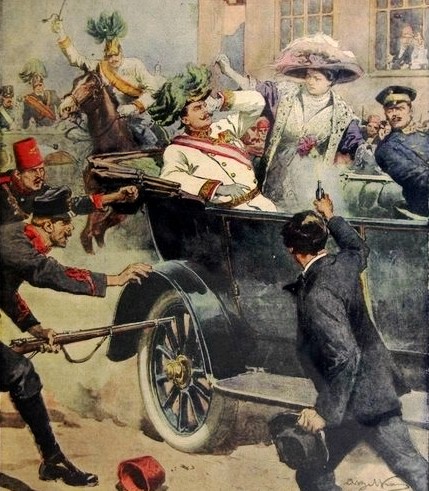
With the map, Paqui has started explaining the trigger for the war. She has told us that the heirs of Austria-Hungary went on holidays in Sarajevo and there a Serbian nationalist, Gavrilo Prinzip, killed them because he wanted the union of the Slaves of the South. So as a reaction to that, the Austro-Hungarian accused the Serbians of being involved in the terrorist attack and they sent an ultimatum in Serbian government with several requirments on the 23th July and gave them 48 hours to carry out their requests but the Serbians didn't accept all their demands and they didn't allow the Austro-Hungarian police to investigate in Serbia, so Austria-Hungary and Serbia broke their relations and got ready for war.

To understand it better Paqui has given us the example of ETA, it was something like if ETA attacks in France and the French police want to investigate in Spain.

Sarajevo murder, by Achille Beltrame 
http://www.italia-resistenza.it/wp-content/uploads/2014/07/DC-1914-27-d-Sarajevo-cropped.jpg
So as Serbia didn't allow the Austro-Hungarian police enter in their country Austria-Hungary declared war to Serbia on the 28th July 1914.
As Russia was an enemy of Austria-Hungary they attacked them on the 30th July.
On the 1st of August Germany declared war on Russia and to France, but to attack France they used the Schlieffen Plan that consisted of attacking France through Belgium.When the United Kingdom saw that Belgium was invaded they declared war on Germany. All the countries that formed alliances intervened except Italy.

The war was called World War One because as the principals countries that intervened in the war were Europeans they had a lot of colonies all around the world and the colonists sent soldiers to the European countries to help them.


We have seen a video that explained about how the Germans tried to attack France.
After that we have studiedthe main features of the WW1:

  • New and deadlier armament
  • Civil population became war target
  • War economy
  • Governments of nationau unity
  • Constant use of propaganda.

Then all most at the end we have seen the new weapons that they invented such as: Machine gun(metralladora), armoured car(carro de combate/tanque), flame thrower (lanzallamas), poison gas(gas tóxico)..
Railway gun(cañón de largo alcance)

And to end with my journal I'm going to write some of the words that we have written in our journal today:

  • rise:ascenso,aumento
  • To such an extent:hasta tal punto
  • Slaves:eslavos
  • Black Hand: la mano negra
  • ultimatum:ultimátum
  • botch:chapuza
  • airships:dirigible
For homework we have to do the exercises 2 and 3 of the page 59.
That's all for today, as Paqui won't came tomorrow to the high school we'll see on Thursday! Bye!
.

Monday, February 23, 2015

Monday, 23rd February 2015


Hello everyone! I'm Stefania and today it's my second time to do the journal this year.
So..let's start!
Today we have had Social Sciences lesson at the 5th period. After arriving in the class we have prepared our things to start the lesson.
We have started correcting the main ideas of the Anarchism:

  • People are born free, but some institutions(schools, Churches...)snatch their freedom and limit their possibility of developing their capabilities.
  • The only way of recovering freedom is destroying everything that limits people's capabilities and led people to decide how to organize their lives.
  • Anarchists also defended collective property.
  • They trusted in the revolutionary capability of both peasants and industrial workers.
Then we have seen the two differents trends:
  • Propaganda by the deed:A minority of the anarchists wanted to solve the problems by violence eliminating representatives of capitalism and they prepared many terrorist attacks:Some examples were the terrorist attacks against the National Assembly, in France,Murder of Cánovas del Castillo(the President of the Spanish Goverment)...
  • Anarcho-Syndicalism:But the majority most of the anarchists preferred to create unions in order to be organized and educate for revolution.(They were pacifists).
 Then Paqui has started explaining us the last point of the unit which is called The First and Second Internationale.
We have studied that the International Working Association (IWA) was a workers' organization created to Marx's initiative in London in 1864, in order to coordinate all the workers' attempts to improve their situation.
There were two Internationals:

  • First Internationale: It included representatives of all trends:Marxists, Anarchists,trade unions, Utopian socialists. It dissolved in 1876 due to the differences between anarchists and Marxists and after the failure of the Paris Commune(1871)

http://www.artofthestate.co.uk/Banksy/banksy-versus-bristol-museum-053-workers-of-the-world-unite.htm

  • Second Internationale: It was created in 1889 and was only formed by Marxists or Socialists. Some of the main symbols of the labour movement were adopted there:anthem,labour day and 8 hours campaign.
http://en.wikipedia.org/wiki/Eight-hour_day#mediaviewer/File:8hoursday_banner_1856.jpg

But there were also disputies between Marxists:
-Some of them wanted to make revolutions to reach power
-Others wanted to participate in the elections(Social-Democrats)
And the Second International dissolved during the World War One (WW1).
Then in class there have started a conversation about Pablo Iglesias(I don't know why) and Paqui has showed us a photo about Pablo Iglesias, and she has said to us that before the Pablo Iglesia that we know now, there were other two Pablo Iglesias. (As I didn't know who that man is, I've asked Marta who is he and what he wanted to do.
Then Paqui and Carla have spoken about how revolutions can be, Paqui has said to Carla that there could be pacific revolutions. 
Later Paqui has said to us that yesterday she saw an article about homework.Then we have spoken a little bit about this, Paqui has said to us that in Finland the childrens go to school for 4 hours per day and the have more break time (after every period they have 15 minutes of rest) and they don't recive any marks until they are 10.
And then we have started the next unit:
Unit 5:Europe in the 2nd halp of the 19th century
The first point of this unit would be included in the exam. This unit is very short:
  1. The Italian and German unification
  2. Imperialismo
And then we have decided on  the date of the exam. The exam would be next week on Thursday 5th of March.
As always we have written some words in the glossary:
  • good deeds:buenas obras
  • deed:hecho/acto
  • IWA:AIT(Asociación Internacional de Trabajadores)
And that's all for today. See you tomorrow classmates.
Bye!

Thursday, January 8, 2015

Thursday, 8th January 2015

Hello everybody!
I'm Stefania!
First of all I want to wish to you a happy New Year!
This is my first journal of this new year.
Today we have got Social Sciences lesson at the first period.
First of all, Paqui has told us about a new whiteboard that is in the class, she has said to us that it is to write quotes that we like and we want to share with all our classmates.
Then, Paqui has started revising quickly all the things that we have studied in this unit.
After that we have started to correct the two points that we have to summarize in Christmas holiday. We had to summarize the Directory(1794-1799) and The Napoleonic Era(1800-18015).

  • The Directory (1794-1799): About the Directory we have learnt many things: The bourgeoise took the control. There were two types of government: The executive power was formed by five members and two legislative chambers formed by  The Council of the Five Hundred and Council of the Ancients.We have also learnt that they had many problems (attacks from the absolutism and attacks from the population, Serious economic and social crisis,the war against the European Monarchies continued...)
  • The end of the Directory arrived when, pretending a threat of Jacobins, Napoleon gave a coup d'État, saying that if the members of the Council of the 500 didn't vote him the people would attack them.
  • The Napoleonic Era(1800-1815): It is divided into two stages: 
  1. Consulate:1800-1802--Three members Consulate                                                                                          1802-1804--Napoleon was elected first and only Consul for life.                               Main decisions: Reestablishment of public order ( he stopped the absolutists and the popular revolts), concordant with the Pope, he made an Administrative reform,the Napoleonic Code(Code of Civil Law) 
  2. Empire: Napoleon crowned himself Emperor in 1804. During the Napoleonic Era France's enemy were Great Britain, Portugal and Russia. Napoleon ordered the Continental Blockade against the Great Britain that consisted of the prohibition to buy or sell products to Great Britain. But Portugal and Russia didn't obey this order, so Napoleon tried the invasion of these two countries that were the beginning of the end of the Napoleonic Era. Paqui has also explained us that Napoleon started his invasion in Russia during the summer ,but when the winter arrived they weren't prepared so many people died because of the low temperature and because the Russians used many tactics, half of the Napoleon's Army died during this invasion.
For homework, we have to complete: Territories included in the French Empire, The allied territories and the end of the Napoleonic Empire.
Today we also have copied some words in our glossary:
  • Coup d'État:golpe de estado
  • Consul for life:cónsul vitalicio
  • Concordat:concordato (That is a treaty signed between a State and the Pope)
  • Scorched-earth tactic: Tácticas de tierra quemada
  • guerilla warfare:guerra de guerrillas
http://es.wikipedia.org/wiki/Napole%C3%B3n_Bonaparte#mediaviewer/File:Jacques-Louis_David,_The_Coronation_of_Napoleon_edit.jpg

This painting represents Napoleon crowning himself.
See you the next day!

Thursday, November 20, 2014

Equestian Statue of Philip IV in Madrid,Pietro Tacca


http://picturetouring.com/wp-content/uploads/Estatua-Felipe-IV-Oriente-palacio-copia.jpg

The Equestrian Statue of Philip IV was made up by the Italian sculptor Pietro Tacca. The king sent to Tacca two sketches to and Italy, he worked in this sculpture for 6 years . Two years later the sculpture was sent to Madrid from the workshop that had Tacca in Florence. In Spain first of all it was situated in gardens of the queen but later it was moved to many places. The statue was commission by Philip IV. It was made in the first part of the 17th century, more or less between 1634 and 1640.

Four gemiuses of that period intervented to make this scuplture:
  • The painter Diego Velázquez , 
  • The scientist Galileo Galilei 
  • The painter Martínez MontañéS 
  • The sculptor Pietro Tucca
This is a very interesting post of the equestrian sculpture of Philip IV , but it explain every thing in Spanish:


http://picturetouring.com/wp-content/uploads/Estatua-Felipe-IV-Oriente-trasera-copia.jpg


High: 4.00m.

Width: 3.5m.

Depth: 2.00m.

The dimensions of the statue required a frame that weighed 9 tones. It was made up with bronze.

Nowadays it is in the center of Plaza de Oriente in Madrid, Spain.

First of all with this sculpture we can see features of Baroque sculpture. It was very difficult to represent it, because it was based on a painting made by Velázquez:


http://es.wikipedia.org/wiki/Felipe_IV_(Vel%C3%A1zquez)#mediaviewer/File:Diego_Vel%C3%A1zquez_053.jpg

The horse had to be represented supported only in its the back legs. This was the most difficult thing, because he had to made this heavy sculpture in a balanced way. He asked for advicee to Galileo Galilei who was a genius of that period, Galileo told him that the better thing that he could do is to let one part of the figure empty . But this advice wasn’t enough.

This sculpture is very realistic: It represents movement thanks to the cloth fold thanks to the horse’s legs.

When Tucca sent to the king a sketch of the sculpture to the king didn’t like the expression of his face, so Velázquez was worried about this. He thought about what was the best thing that he could do. So he asked  Juan Martínez Montañes to do a modelling head of the king. He sent the modeling head to Italy. The equestrian statue was finished the same year in which Pietro Tucca died.

The king is wearing a half framework and in his hand he has a cane.


http://www.memoriademadrid.es/imagen.php?w=1&i=/OTROS/Imp_11998_felipeivplazao2.jpg


The bronze was a material very difficult to work with. Tacca received influences from his teacher.

This was the first equestrian statue of history in which the horse is supported only in its his back legs. Finally he obtained the balance of the figure using the tail of the horse as a support for the figure, it was possible because the distance between the legs and the tail makes a perfect triangle.

The symbols that have this equestrian sculpture has are two marble plaques on the pedestal. It was then that the two bas-relief panels were added at the base of the statue. One shows Philip IV presenting the Cross of Santiago to Velázquez and the other one is an allegorical reference to the monarch's role as a patron of the arts. The ensemble also includes two large shell-shaped fountains, a figure that represents a river and four bronze lions.


http://www.memoriademadrid.es/imagen.php?w=1&i=/OTROS/Imp_11998_felipeivplazao3.jpg
Finally here we have a self portrait of Diego de Velázquez.

Venus at her mirror, Diego Velázquez


It also has different names:

The Toilet of Venus”, “Venus at her Mirror”, “Venus and Cupid”,”Rokeby Venus” or “La Venus del espejo”.


It is  not very clear where he did  the painting, some people say that he did it before his second trip to Italy and others say that he painted it during he’s visit in Italy. It was painted between 1647 and 1651. This painting was not commissioned by anyone .It was just a painting that Velázquez did.

The Venus at her mirror's size is 122,5 x 177 cm. It is painted on oil on canvas. The painting is in the National Gallery, London.

It is a mythological painting. This painting is representing the goddess Venus in a sensual pose lying on a bed and looking into a mirror held by her son, Cupid. The painting describes Venus as she is looking at herself in the mirror, but we can’t see that, what we see is that Venus is looking at us. It is painted in a room. We can see a clear contrast between light and shadow. The warm colors were: pink, white, grey, black and red colors to create a fine illumination of the body. The darkness of the sheets givse to the painting big contrast with Venus skin, making it look lustrous. Velázquez went to Italy and there he painted in a different style, his painting is an influence of Giorgione’s Sleeping Venus and Titian’s Venus of Urbino. As his painting recived the influence of the other paintings, he painted his Venus mixing the postures of the other Venuses made by other painters . His Venus was considerated as a personification of the female beauty.

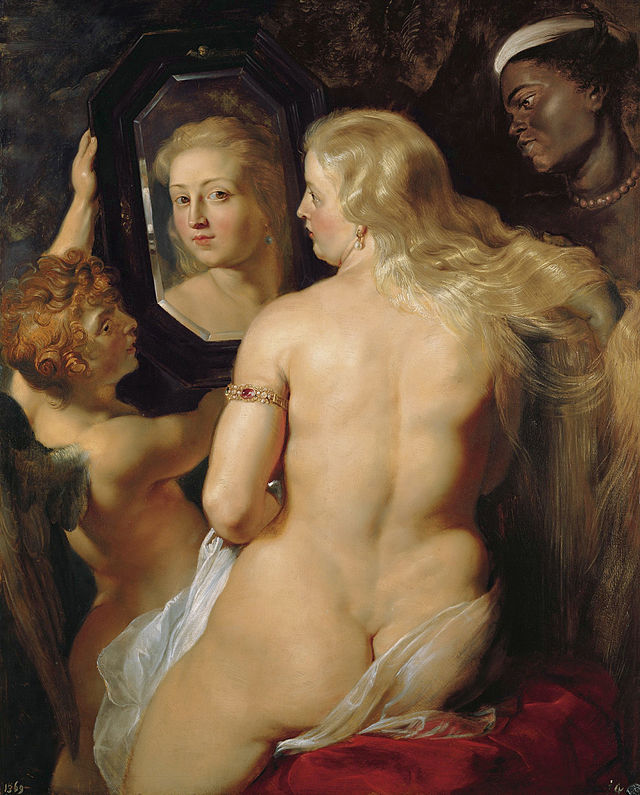
Venus at her mirror, Paul Peter Rubens


In that period the models of the other paintings were representing ideal beauty with wide hips meaingt that they ate well, but Velazquez Venus was fit and this was not common in that period, she also has a modern hairstyle. The only thing that made this woman a goddess is the presence of his children Cupid .

This painting was made in the Baroque because the technique used in this painting is foreshortened and realistic because Venus is not looking directly at the viewer, she is represent with her back , in a foreshortened position.

This is the only surviving nude painting of Velázquez because in the 17th century it was rare to see a nude painting in the Hispanic Monarchy (also because the Inquisiton controlled art and morality).


In 1914 Mary Richardson went to the museum where this painting is located and attacked Velázquez's painting with a cleaver. She left seven marks on the canvas . When they asked her why she has done that she said: "I have tried to destroy the picture of the most beautiful woman in mythological history as a protest against the Government for destroying Mrs. Pankhurst, who is the most beautiful character in modern history."[

Monday, November 10, 2014

Monday,10 th November 2014

Hello everyone!
Today we had Social Science class at the 5th period. We were excited and nervous at the same time, because Paqui has said to us that she have the exams.
We have started the lesson after some jokes that Alfredo has made. We have started watching many paintings of the Baroque period:

  • The Conversion of Saint Paul on the way to Damascus, by Caravaggio.
Paqui has said to us that the painting present first of all big contrast of light and colours(chiaroscuro).
She also has said that it's not like the painting of the Renaissance art. The central character of the painting is not a Saint Paul, but the horse.
  • The Crucifixion of Saint Peter, by Caravaggio
We have seen that it represent movement, Its composition is  made as an X, The people who are in the painting are breaking the ground with this the painter wanted to create a sensation of background(perspective)


We have seen other paintings and Paqui has explained some characteristics of each one.
  • The Entombment of Christ, by Caravaggio
  • The calling of Saint Mattew, by Caravaggio
  • Death of the Virgin,by Caravaggio (This painting is a contradiction, because the woman as model was a prostitute, and she look younger than The Virgin)
  • The Descent from the cross, by Rubens
  • Anatomy lesson of Dr. Nicolaes Tulp, by Rubens
  • Girl reading a letter at an open window, Vermeer
  • Girl with a pearl earring, by Vermeer
:
One curiosity
 Caravaggio's paintings have 
the same structure( the light enter from the 
upper part) because he always was worked
in a basement.

Then we have spoken about The Three Graces, by Rubens. Paqui has told us that it represent the ideal of beauty of that period. Women like these ones, with wide hips, meant that they ate well, and as these three women didn't have the skin suntannedd ,this means that they didn't work(Working in that period was shameful and dishonest).This information in brackets refers only to the Hispanic Monarchy. The reason why this type of women was the ideal one was because they related health with not working and being able to have children. 
Paqui has said to us that the 17th century was the Golden Age of Paintingsin the Hispanic Monarchy, and there were many good painters in this period.


Then Paqui has written the scheme that we have to complete for tomorrow on the blackboard, it is about the Baroque Art in the Hispanic Monarchy.
We also have added some words to the glossary: 
Foreshortened figure:figura en escorzo
Basement:sótano
Ox:buey
Clack:capa
Golden Fleece:Toisón de Oro
At the end of the lesson Paqui has given us the exams, and I'm happy with my mark.
See you tomorrow!