Today, in Social Sciences’ lesson, Paqui has collected the 3rd and 4th ESO books, until those who were late have come to class. She has written on the blackboard that those who had failed have to keep the Social Sciences book until the September exam. She has also written on the blackboard that she would like to speak with those students who were going to study the Bachillerato de Humanidades or Ciencias Sociales and were not going to join the Bachillerato de Excelencia today or tomorrow in the breaktime.
We have continued seeing the documentary about the concentration camp in Mauthausen, from the moment we left it the other day.
A girl asked Antonio Roig, the man who was explaining his experience to some students, if he could imagine that he would leave the concentration camp any day. Antonio Roig answered that he didn’t know when he could die, but that he always had hope, to be able to resist there. Another man who survived the camp, Francisco Comellas, explained that, when the bell rung in the morning and they opened the windows, they always saw some people who had thrown themselves to the electric fences, because they couldn’t resist the horrors of the camp. Joan de Diego also explained that the nazis blinded some prisoners, and they entertained themselves pushing the prisoners to the fences. It was really sad hearing Joan de Diego say that, although he wasn’t a believer, he asked God that those prisoners stopped suffering.
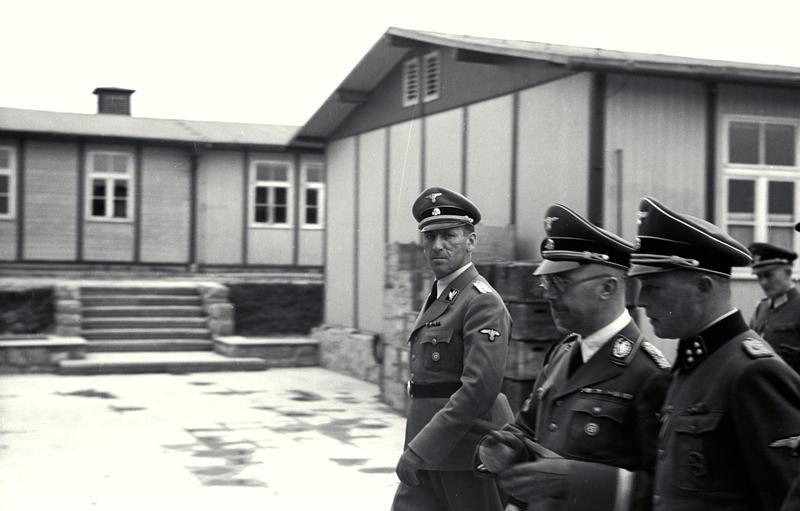
Himmler, the head of the SS (Schutz Staffel-Security Sections) and later both Chief of German Police and Minister of the Interior, including the command of the
GESTAPO (Gegeime Staatspolizei-Secret Police). went to the Mauthausen camp. Francisco Batiste explained that, when Himmler knew that there were Spanish republicans in Mauthausen, he ordered a rise of repression against them.
There was another camp, dependent from Mauthausen: Gusen. Gusen was a Kommando, a fast extermination camp, where those who were weak, those who couldn’t work were sent. The reporter explained that, in one only day, 70 Spanish people died in Gusen and 3,000 more republicans in 3 months. Smilewski was the man in charge of Gusen and he was a really cruel: it’s said that he was the responsible for the frozen showers.
Dr. Krebsbach was the man in charge of the “infirmary”. These “doctors” injected Benzene to some of the prisoners of Mauthausen.
Joan de Diego worked in the office of Mauthausen: he had to do the death certificate of men who were still alive, because there were many planned deaths in the camp. He explained that the most common way of killing were the gas chambers and that most of them were carried out at the
Hartheim castle.
Josep Egea explained that entering the crematorium was forbidden, but that, one day, he went there, because he was cold and that he saw something terrible: there were a lot of piled-up corpses
A student asked if they tried to escape from Mauthausen. They explained that it was very difficult to escape Mauthausen, because they didn’t know how to speak properly and didn’t have where to eat or sleep. Besides, if a prisoner was missing, the Nazis started looking for them and the civilians had to inform the Gestapo about any anomaly. They explained that there was a man, who worked in the carpentry, who escaped. This man built a box and when the lorry brought him out of the camp, he went out of it and he escaped. But the Nazis caught him and they punished the prisoner in front of the others. To mock of them, the Nazis started playing “J’attendrai ton return” (I will wait your comeback).
On the 21st June 1941, Hitler’s troops invaded the USSR. That day, in Mauthausen, all the prisoners were brought together. The Nazis pretended a disinfection. The Spaniards took advantage of this and they created the
Comité Español de Resistencia. They helped themselves in order to achieve that, at least, one Spaniard could survive and tell the horrors they lived there. For that, they had to sacrifice themselves: they could give their food to those who were weaker. Manuel Alfonso explained that there was a time in which he was very weak, and two Spaniards, who were working at the service of the SS, helped him and gave him some food. I think that what they did it's really moving and these acts show that there were good people in a place where horrors were seen everyday and where humanity seems not to be. I think that that solidarity gave strength to those prisoners who were there.
Mariano Constante was appointed office boy of the
SS. Sometimes he had the “privilege” of cleaning Frank Ziereis’ house, the general in charge of Mauthausen. Constante explained that entering Ziereis’ house was even worse, because his wife and children were heartless.
As Mariano Constante, there were also some Spaniards who achieved some privileged posts in the camp, like Francisco Boix. Boix was a photographer of the camp and together with other photographers, he showed the living conditions of the Mauthausen’s way of life. The reporter explained that many of the photos showed in the documentary were from the camp’s file.
Boix and Constante worked together in order to hide some photos, so people could see how they lived in Mauthausen. Boix stole some photos and the Spaniards hid them. To take the photos out of the camp, they used the Poschacher’s company: some Spaniards who worked in the company managed to take the photos out of the camp. Anna Pointer, an antifascist Austrian woman, was a heroine, because she helped the Spaniards to hide the photos in her house. Her daughter, Leopoldine, explained that his mother, who had already died, worked near the prisoners and that, sometimes, Anna gave them some food. She was surprised of the fact that the
SS, who were always looking after his mother, didn’t catch her.
Antonio Roig explained the students the most impressive moment he saw in Mauthausen: the execution of 70 people by a firing squad, the families of those who were fighting against Hitler.
But from 1942, the war turned against Hitler and after the Battle of Stalingrad, which lasted from the fall of 1942 until the winter of 1943, prisoners started having hope.
On the 30th April 1945, Hitler committed suicide; on the 5th May, Mauthausen was freed and on the 8th May, the war ended in Europe.
Before leaving Mauthausen, one of the most important tormentors of Mauthausen, Georg Bachmayer, admitted his defeat. Joan de Diego explained that before the camp was freed, Bachmayer held his hand and the general said “Good luck, Spaniard”. Then, Bachmayer went home, he killed his wife and his two children and then, he committed suicide.
And finally, four American soldiers entered and Mauthausen was freed on the 5th May 1945. Five years of torture and suffering ended. The prisoners received the freedom with hugs, happiness and cries and jumps of joy.
Paqui has stopped the documentary when there were five minutes left to finish the lesson. She has said that we could finish the video at home or on Friday in class. She has had a surprise for us: a video that she had made with Carlos' help.
I really like it and I think that it's a great and perfect present of graduation!
And finally, Paqui has sent me an email today telling an idea she has had. Damian has approved Paqui's idea and he told her that there's no problem to put it into practice:
Paqui wanted to organize some cultural trips for the students who are interested in visiting museum, exhibitions, cultural walks, natural environments, cinema in original version... The trips, at the beginning, would be one day (as when we went to Madrid), to close places as Madrid, Toledo..., but later they could be for the weekend and we could go to Granada, Córdoba, Seville, Barcelona... She has also thought about doing a long trip per year, so we could go to Berlin, London, Dublin... But this idea could also be put into force depending on our behaviour and on how many people would be interested in it (so next year we have to behave well). Paqui has also explained me that there are some teachers interested in this idea and that they have offered to help. So, are you interested in participating and be part of this idea?