Saturday, November 7, 2015

This day in history: birth of Francisco Zurbarán and the beginnig of the Revolt of the Comuneros.


Hi, I’m Carlos and it’s my turn to write in the section ‘this day in history’. I am going to explain  you the birth of Francisco Zurbarán and the beginning of the Revolt of the Comuneros.


FIRST EVENT: THE BIRTH OF FRANCISCO ZURBARÁN.

Francisco Zurbarán was born on the 7th November 1598 in ‘Fuente de Cantos’. He was a painter of the Spanish Golden Age. He was a friend of Velázquez and he stood out in religious paintings. He was a representative painter of the Counter-Reformation. At the beginning, he was influenced by Caravaggio. His paintings were characterized by the use of chiaroscuro and the paintings were away from realism. He tried to do simple paintings with simple perspectives.
The most important paintings were: 'Saint Hugo in the refectory' and 'defense of Cádiz against the English'.


https://mireiarteymusica.files.wordpress.com/2013/10/zurbarc3a1n.jpg?w=474


SECOND EVENT: THE BEGINNING OF THE REVOLT OF THE COMUNEROS.   

The Revolt of the Comuneros was a revolt to protest to the way of ruling of the king. The people thought that the king took advantage of his power and he damage the citizens.  The revolt started in Toledo. The rebels controlled the heart of Castile, ruling the cities of Valladolid, Tordesillas and Toledo. The revolt occurred in the wake of political instability in the Crown of Castile after the death of Queen Isabella I in 1504. Joanna the Mad, Isabella's daughter, inherited the throne with her Burgundian husband King Philip I. Philip I died two years later, and their son Charles was only six years old. Due to his youth and Joanna's mental instability, Castile was ruled by the nobles and her father, King Ferdinand II of Aragon. 


https://upload.wikimedia.org/wikipedia/commons/7/72/Comuneros.jpg

Thursday, November 5, 2015

Wednesday,4th, November, 2015

Today in Social Sciences we have continued speaking about the Encyclopedia. Diderot and D'Alembert compiled all the knowledge of their time asking to scientist and philosophers to colaborate with them. Paqui has told us about Rousseau, Montesquieu and Voltaire.
Roussseau was a philosopher and teacher that defended the social contract: the agreement the people and the governors, sign to preserve social order; and the general will, that consists in the power of the people to decides directly by themselves and not by a representative.
Montesquieu defended the division of powers (executive, legislative and judicial) and an independent judicial power.
Voltaire defended that the power of the king has to be limited by the Parliament, that everybody have to pay taxes (universal tax system) and he critized the church because he thought that the church was intolerant.
Then, she has explained the physiocracy and economic liberalism.
Physiocrats considered agriculture to be the most important economic activity of a country and they supported privated property, free trade, free industry, and they were against any intervention of the State in economy. Quesnay was the most important physiocrat and Adam Smith was an economy teacher in a University and he was the advocate of the economic liberalism.
Finally we have talked about the Enlightened despotism. Some monarchs adopted ideas of the Enlightenment and introduced some reforms in their kingdoms, but as they wanted to preserve their absolute power: they did "everything for the people, but without the people". They didn't  touch the structure of power, the privileges of nobles and clergy and also they thought  that the people were like ignorant children or they couldn't think, so the reforms they made were insufficient.
Encyclopedia by Diderot 
                                                    and D'Alembert
Source: http://www.alquiblaweb.com/2012/11/03/la-enciclopedia/

Diderot
Source:http://www.alquiblaweb.com/2012/11/03/la-enciclopedia/

D'Alembert
Source:https://es.wikipedia.org/wiki/Criterio_de_d%27Alembert

Montesquieu
Source:http://uscivilliberties.org/biography/4166-montesquieu-16891755.html

Rousseau
Source:https://es.wikipedia.org/wiki/Jean-Jacques_Rousseau

Voltaire
Source: http://www.biografiasyvidas.com/biografia/v/voltaire.htm

Quesnay
Source:http://www.biography.com/people/fran%C3%A7ois-quesnay-39200

 Adam Smith
Source:http://livingeconomiesforum.org/Adam-Smith

Catherine the Great
Source: https://world-civ-2012-13.wikispaces.com/The+Enlightened+Despots+(1B)
Joseph II of Austria
Source:https://world-civ-2012-13.wikispaces.com/The+Enlightened+Despots+(1B)

Frederick the Great
Source:https://world-civ-2012-13.wikispaces.com/The+Enlightened+Despots+(1B)

Wednesday, November 4, 2015

This day in history: the Revolt of the Germanías (Brotherhoods)

The 4th of November 1519 was the begining of the Revolt of the Brotherhoods.

The Revolt of the Brotherhoods was a revolt by artisan guilds (Germanies) against the government of King Charles I in the Kingdom of Valencia, part of the Crown of Aragon. It took place from 1519–1523, with most of the fighting occurring during 1521. The Valencian revolt inspired a related revolt in the island of Majorca, also part of Aragon, which lasted from 1521–1523.

The revolt was an anti-monarchist, anti-feudal autonomist movement inspired by the Italian republics.


La pau de les Germanies, by Marcelino de Unceta.

The Revolt's failure is often seen as a political catalyst for Valencia's shift to a modern, centralized, and authoritarian state away from a feudal one. The local nobility were weakened, and needed to call upon royal power to defeat the rebels. The conversion of the mudéjars shrank the pool of cheap labor that the noblemen had relied upon. And though the timing may be a coincidence, Germaine's appearance in Valencia helped weaken the old nobility and reinforce royal power in Valencia.

Tuesday, November 3, 2015

Tuesday, 3rd November 2015

Hi, what's up? It's Lucía. Today it's my turn to do the journal. So, let's review the lesson :)
At the beginning of the class, we've reviewed what we did on Monday.
 That's Enlightenment and his features, in 18th century (century of lights):

–They used the Reason to learn and understand the world and improve it. Philosophers said that they wanted to "Eliminate the darkness of the world with the lights of reason". So they rejected all that couldn't been explained (superstitions, traditions, revelations, miracles...)
– They were tolerant of religions. No religion was superior to another. But they thought that religions gave more problems than positive things.– They rejected the authority principle, this means not to do things that always have been done only because it was traditional or someone ordered it.– They considered education the most important thing.– They criticized absolute monarchies and defended freedom of all the human beings.– They considered knowledge as the basis of happiness and they were very optimistic.
 

Salon de Madame Geoffrin.jpg
Source: https://commons.wikimedia.org/wiki/File:Salon_de_Madame_Geoffrin.jpg#/media/File:Salon_de_Madame_Geoffrin.jpg
KANT.
Source:
www.libropatas.com
After that, the class has started straying. We have started to speak about Spain and the similarities between the present/current world and the Enlightenment. We think that education should be free or cheaper, like in France or Denmark, and make the economy a little easier. You can change a kilo of potatoes for a kilo of tomatoes, or maybe another person can repair your piping. in exchange forpainting his house. I don't know, we can do many things better but no one tries to do it. Maybe the way is to pay more taxes (but not stupid taxes), like Paqui hassaid hahaha.
Source: www.quotationof.com
And at the end, Paqui has started explaining the Encyclopedia.Before Enlightenment, books which contradicted Dogma were forbidden because the Church thought they were dangerous. Knowledge "was dangerous". But in 18th century, Denis Diderot and Jean Rond D'Alembert issued the first Encyclopedia in France in 1751 with 35 volumes, asking philosophers and scientists for advice.
Source: www.pinterest.com
NEW VOCABULARY:
ACQUIRE: Adquirir.
AUTHORITY PRINCIPLE: Principio de autoridad.
BIASED: Tendencioso.
GRANT: Beca.
IN INSTALMENTS: A plazos.
PURSUE: Consecución, alcanzar un objetivo.
PRECAUTION: Precaución.
TRUST: Confiar.
TAX FRAUD: Fraude fiscal.
TIME BANK: Banco de tiempo.
WILLING TO: Dispuesto a.


-----------------------------------------------------------------------------------------------------
And here you have a very beautiful picture that I've found looking for images of Enlightenment!

Monday, November 2, 2015

Monday, 2nd November 2015

Hi, mates, I'm Irene, let's see what we' ve studied today in class:

First, we' ve reviewed about what did we studied last day in class, Ancien Régime and we have drawn this pyramid:


It's about the Ancien Régime society and explains the differences between the three estates: Nobility (divided into high and low) had lands and rents and they charged taxes to peasants; Clergy (divided into high: cardinals and bishops, and low: divided into monks and priests) had also land and charged the tithe; and finally the Third Estate (which included peasants, bougeois, servants, manual workers, merchants and craftsmen), formed by 90% of population, they worked to survive, paid taxes, didn't have participation in politics and didn't have rights.


Then, we have continued with the scheme but we have studied Changes in production: peasants continued using fallow technique and that was the reason for low production. Peasants had to pay taxes and the tithe to the privileged people, 10% of their production was destined to clergy. Guilds controlled production.


After that we've seen the Power Pyramid and what the French revolutionaries wanted to obtain:
-representative government, elected by citizens
                              - a society based on equality of all the citizens, without priviledges
                                              -a productive economy, where those who had initiative could make business without limitations


Power Pyramid in Ancien Règime


Finally, we have started with Enlightenment which was an intellectual movement during 18th century in Europe which questioned all Ancien Règime principles and was based on Reason. We have copied this in class about Enlightenment:
     -15th-16th century: HUMANISM-> human being, center of interest and reduction of the influence of religion
    -17th century: SCIENTIFIC REVOLUTION-> Rationalism and Empiricism. It was a reason and experience where the best mean to learn
        -18th century: ENLIGHTENMENT-> use of Reason (intelligence) to learn, understand the world and improve it


Remember, for homework we must do a scheme about Enlightenment in which we have to include definition of Enlightenment and its features.


-Glossary
  Rents-> rentas
  Gallicanism-> Galicanismo
  Fallow-> barbecho
  Drought-> sequía
  Double-> duplicar, doblar
  Claim-> reivindicar
  Culmination-> culminación
  Enlightened-> ilustrado
  Elitist-> elitista

See you tomorrow!

Sunday, November 1, 2015

This day in history: 1st November 2015, CharlesII's death

THIS DAY IN HISTORY...

315 years ago, Charles II of Spain, died.

A bit information about Charles II of Spain

Charles II's (Spain) description.

He was born in Madrid, the 6 of november 1661

His parents were Felipe IV os Spain and Mariana of Austria

People described him as short, lame, epileptic, senile, and completely bald before 35, he was always on the verge of death, but repeatedly baffled Christendom by continuing to live.Charles was physically and mentally disabled and infertile, possibly due to this massive inbreeding. Due to the deaths of his half brothers, he was the last member of the male Spanish Habsburg line.


Charles did not learn to speak until the age of four nor to walk until eight, and was treated as virtually an infant until he was ten years old.


Charles II's (Spain)reign

The years of Charles's reign were difficult for Spain. The economy was stagnant, there was hunger in the land, and the power of the monarchy over the various Spanish provinces was extremely weak. Spain’s finances were perpetually in crisis. Charles' unfitness for rule meant he was often ignored, and power during his reign became the subject of court intrigues and foreign, particularly French and Austrian, influence.


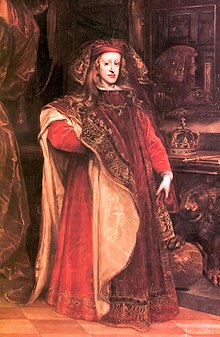
Charles wearing the robes of the Order of the Golden Fleece, in about 167


Now, I'll talk about Charles II's death, that was 315 years ago.
He began to torture with the idea that he was possessed. He had hallucinations and his life became a torment. People also began to think that spell was true.

Toward the end Charles' life, Charles's health deteriorated and he became increasingly hypersensitive and strange, at one point demanding that the bodies of his family be exhumed so he could look upon the corpses.

He officially retired when he had a nervous breakdown caused by the amount of pressure put on him to try to pull Spain out of the economic trouble. He lived a simple life since then, playing games and other activities.His death was slow and painful and ended in Madrid on 1 November 1700, five days before his 39th birthday.He had signed the will in favor of the Elector of Bavaria, but he died before Carlos. Then he signed in favour of Philip of Anjou, grandson of Louis XIV, as the pressures received at his deathbed.


The physician who practiced his autopsy stated that his body "did not contain a single drop of blood; his heart was the size of a peppercorn; his lungs corroded; his intestines rotten and gangrenous; he had a single testicle, black as coal, and his head was full of water.


Resultado de imagen para muerte de carlos ii de españa

And that's all!!!

BYE.

Saturday, October 31, 2015

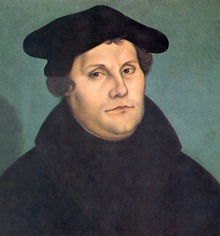
This day in history: Martin Luther and the 95 Wittenberg Theses: beggining of Lutheranism and Protestant Reformation


Hi mates! Do you remember two years ago when we studied Lutheranism and the Protestant Reformation?
Well, today, but 498 years ago, Martin Luther pinned the 95 Theses on the doors of the Wittenberg Church as a protest of what the Dominicans were doing.
One of the things which the Dominicans did to collect money to rebuild St. Peter's Basilica, in Rome, was selling indulgences to the sinners in order to eliminate their sins; the unique incentive of Luther to write the '95 Theses' was to observe how the Dominicans abused of the people.

In the '95 Theses' he rejected the intermediaries between people and God, and expressed his opinion about the equality of the people to God, the unique who could saved or absolve our sins. The Clergy and the court tried to avoid the spreading of the '95 Theses' but they were copied and diffused before it..
In 1521 the Protestant Reformation started when Luther rejected to recant 41 of his thesis


This link will redirect you to Martin Luther's page, where you could found the 95 Theses, and I invite you to watch the film about this,'Luther' it's very interesting and entertaining and you will be able to understand better all this information.

See you!!


https://en.wikipedia.org/wiki/The_Ninety-Five_Theses
A replica of the 95 Theses, in Wittenberg                                                     


Thursday, October 29, 2015

Thursday, 29th October 2015.

Hi, I’m Benjamín, I’m going to explain what we have done today in Social Sciences class.

At the beginning of the class we have handed in the project “My Travel Journal”. Then Paqui has copied the index of the Unit 2; “The 18th century and the crysis of the ancient régime.” on the blackboard.


The main contents of the unit are:
  1. The Ancient Régime.
  2. Enlightenment.
  3. Political changes.
  4. Spain in the 18th century.

Then Paqui has started to explain: THE ANCIENT RÉGIME.

Definition: The Ancient Régime (Old Régime) was a term used by the French revolutionaries to define all they wanted to get rid of. It refers to the features of the European societies during the Modern Age (15th-18th centuries): 

  · Demography: low and slow population growth due to high mortality rates, carried by deficient · hygiene, bad harvest, epidemics…
  · Politics: Absolute Monarchy was the predominant political system; the king held all the power.
  · Society: it was based on inequality and divided into estates; there were two groups of people:
                   -Privileged: they were nobles and clergy.
                   -Underprivileged: they were the bourgeoisie, the workers and the peasants.
  · Economy: the main economic activity was subsistence agriculture.


After the Ancien Régime, Paqui has explained a little bit about the power pyramid and the population pyramid, which I have included below:

pop_pyramid.JPG


Pwr_Pyramid.JPG

Source: Power Pyramid


After that, Paqui has explained to us The Changes in the 18th century:
   -it was a period of relative peace in Europe
   -population grew considerably in Europe
   -the population increased led to a bigger demand for all type of products.

Paqui has also explained that in this unit we could choose between taking the exam of this unit or doing a project. If we choose the project, we will have to write a song about the contents of the unit. 

Vocabulary:
-Angry smurf: pitufo gruñón
-Barefoot: descalzo
-Enlightenment: ilustración
-Estate: estamento
-Get rid of: deshacerse
-Inland trade: comercio interior
-Tithe: diezmo
-Trend: tendencia
-Lice: piojos
-Louse: piojo

Homework:
For homework we have to finish the scheme of the Ancien Régime.

Presentations of Unit 2

These are the two presentations we'll use in this unit. You can use them to have an idea of the contents and start looking for inspiration, just in case you want to participate in the songs' project: 


Wednesday, October 28, 2015

Projects of the Austrias in Spanish

As we don't have a blog in the group of Spanish in 4th ESO, I'm uploading here the board games they made. They were also very interesting and funny projects:

- This game has a very original gameboard with the shape of a shield. The game is similar to parchesi, but you have to come back to the same square you started the game. You have to answer questions and there is also a bad square: the Inquisition Court.  Here you have a picture of the girls who made this project: Lucía Rodríguez, Devisa Pavel, Pilar Moratalla and Lucía Horta. 


- This team used an idea they learned last year in Technology. They made a connect game, with different questions and answers they had to connect with two electric pens. If the answer is correct, the lamp switches on. We had a lot of problems with the design and questions, because the team didn't work coordinately, but finally they corrected all the spelling and grammar mistakes and made me happy. Here you have a picture of the boys with their game "Conecta con los Austrias". They are Rodrigo Orduña, David Ortiz, Soufiane El Karboubi and Manuel Palomino.  


- The last project was made by Marta Pueblas, Patricia Pérez and Eva Mª Pérez. They created a board game using plywood. Their game included two boxes of questions corresponding to Charles I and Philip II reigns, but these boxes also included questions about the other contents (the Indies, and the other monarchs of the House of Austria). This was a little confusing. That's why our suggestion was dividing the squares into the 16th and 17th centuries or into three different types of squares, including another box for the Indies.


And finally, here you have a picture of the whole group. They have insisted to take one: