Tuesday, October 27, 2015

Tuesday, 27th October

Hi, I¨m Carlota.
Today in social science Paqui starting talking about the English Revolutions.
There are two English Revolutions:

The first startaed in 1648:


  • CHARLES I: he tried to rule as an absolute monarchy without the control of the Parliament. He arrested and executed those who opposite him.
Resultado de imagen de charles i of england

  • The consequences of the revolution are because the Parliament rebelled and a civil war started.
  • Charles was decapitated and the Republic was proclaimed.
  • OLIVER CROMWEL was the strongest man of the English Republic. He acted as a dictator. Was appointed Protector Lord. When he died, monarchy was restablish.
Resultado de imagen de oliver cromwell de inglaterra

  • CHARLES II was Charles I's son. He had to accepted the control of the Parliament and the Habeas Corpus that means: "You are innocent until proven the opposite". At his death the Duke of York (his brother) became king. He reigned as James II.
Resultado de imagen de charles ii england

The second Revolution started in 1668:

  • JAMES II: he reigned only for three years. He was a catholic who wanted to restore Catholicims in England. This led him to confrontations with the Parliament. A new revolution against absolutims started.
Resultado de imagen de james ii of england

  • WILLIAM OF ORANGE (1168-1702). He dethrone James II and became the king of England with the condition of limiting his power. In 1689 he swore the BILL OF THE RIGHTS (limited the king's power and put some decitions under the control of the Parliament).
Resultado de imagen de william of orange
  • England was the first country to have a limited monarchy and the powers were separated: executive (king) and the legislative ( Parliament)


We have also been talking about the preferences of each one of us on the republics or monarchies.
 Five of my classmates prefer the republic because they say that being in a democratic country, we must choose who we want. 


Paqui has also spoken about CULTURE: THE SCIENTIFIC REVOLUTION.
Resultado de imagen de galileo galileiI

  • Science and thinking made big progress with the development of the Espiricism and the Rationalism.
  • ESPIRITIMS: It the method of knowledge and research based on experience. Galileo Galilei: he improved the telescope and he defended the heliocentric theory of Nicolas Copernicus ( he explains that the Sun doesn´t turn around the Earth, unlike). He was arrested by the Inquisition an had to lie to save.
Resultado de imagen de teoria heliocentrica
HELIOCENTRIC THEORY

  • RATIONALISM: René Descartes: who defended the use of doubt as a method to know the world and he propose the mathematic language as a model on which to base knowlaedge. His exposed his ideas on the Discourse on the Method.

Resultado de imagen de RENE DESCARTES

  • ACADEMIES: some kings were conscious of the importance of scientific knowledge and they founded academies. 


Resultado de imagen de ROYAL ACADEMIES OF SCIENCE

ROYAL ACADEMIES OF SCIENCE


Resultado de imagen de REAL ACADEMIA DE CIENCIAS EN PARIS

ART AND LANGUAGES IN PARIS.


Resultado de imagen de royal society of london

ROYAL SOCIETY IN LONDON.


Monday, October 26, 2015

The thirty years war

Hello I’m Antonio, today in Social Sciences lesson Paqui has explained us the Thirty Years War. As luckily Benjamin wrote about it yesterday he has said to us a bit of this topic.

The Thirty Years War was a war which started in 1618, in Bohemia and finished in 1648. At first it was a war between Protestans and Catholics but France saw that supporting the Protestants could stop Habburgs hegemony. In this war the Catholics who were the full Hasburg Empire against the north countries with mayority of Protestant people and France.


http://d1royu74ct4jcj.cloudfront.net/wp-content/uploads/2015/03/mapa-de-ambos-bandos-de-la-guerra-de-los-treinta-anos.gif

 Most of the battles took place in the Habbsburg empire. During this war the population decreased, in some places it decreased the fifty per cent. This war finished with the peace of Westphalia in 1648 which were two treaties the peace of Münster and the peace of Osnabrück. As Paqui has said this morning no one wins in wars. The main consequences of this war were the high decrease of population, the independence of the Low Countries (United Provinces of the Netherlands), the end of the Hispanic Hegemony in Europe, France became hegemonic the consolidation of the State-nations and Absolute Monarchy and the end of the religious wars in Europe.

This day in history: Charles V's abdications

Hello I'm María, today I'm going to explain Charles abdications and later life. Today but 450 years ago Charles V abdicated his German possessions and the title of emperor on his brother Ferdinand.


Charles abdicated the parts of his empire piecemeal. First he abdicated the thrones of Sicily and Naples, both fiefs of the Papacy, and the Duchy of Milan to his son Philip in 1554. Upon Charles's abdication of Naples to Philip on 25 July, he was invested with the kingdom (officially "Naples and Sicily") on 2 October by Pope Julius III. The abdication of the throne of Sicily, sometimes dated to 16 January 1556, must have taken place before Joanna's death in 1555. There is a record of Philip being invested with this kingdom (officially "Sicily and Jerusalem") on 18 November 1554 by Julius. These resignations are confirmed in Charles's will from the same year The most famous and public abdication of Charles took place a year later, on 25 October 1555, when he announced to the States General of the Netherlands his abdication of those territories and the county of Charolais and his intention to retire to a monastery. He abdicated from his Spanish Empire in January 1556, with no fanfare, and gave it to Philip.


Charles retired to the monastery of Yuste in Extremadura, but continued to correspond widely and kept an interest in the situation of the empire. He suffered from severe gout. Some scholars think Charles decided to abdicate after a gout attack in 1552 forced him to postpone an attempt to recapture the city of Metz, where he was later defeated. He lived alone in a secluded monastery, with clocks lining every wall, which some historians believe were symbols of his reign and his lack of time. Charles's brother Ferdinand, already in possession of the dynastic Hasburg lands, succeeded as Holy Roman Emperor on Charles's final abdication of that title in 1558, shortly before his death.

Charles died on 21 September 1558 from malaria. Twenty-six years later, his remains were transferred to the Royal Pantheon of the Monastery of San Lorenzo del Escorial.                                                                                                                        


abdication of Charles V


https://sp.yimg.com/xj/thid=OIP.M47b00ab4703dc37992ae84dbb3855e96o0&pid=15.1&P=0&w=300&h=300

Saturday, October 24, 2015

This day in history: Signature of the Peace of Westphalia and end of The Thirty Years' War.

Hello, I'm Benjamín. Today, 24th October, 367 years ago, exactly in 1648, was signed one of the most important peace treaties, the Treaty of Westphalia, which ended the Thirty Years' War. I'll explain in a few sentences how began the Thirty Years' War and how it ended.

The Thirty Years' War.

On October 24th 1648, the Treaty of Westphalia was signed, marking the end of the Thirty Years War, one of the most destructive conflicts in the history of Europe. The Thirty Years' War was a war fought in Central Europe between 1618 and 1648 in which most of the major European powers of the time participated.

The origin of the war was religious, consequence of a confrontation between the supporters of the Reform of the Church supported by Luther (Protestants) and the Catholic Church. However, the conflict spread and changed from being a religious war to a dynastic struggle between the German princes with the intervention of other European powers (especially Sweden and France) interested in controlling the power of the Habsburg family.

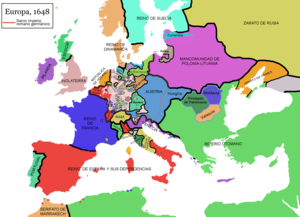
Europe map 1648-es.png


Signature of the Treaty of Westphalia.

The Westphalia area of north-western Germany gave its name to the treaty that ended the Thirty Years War. The Treaty was signed on October 24th in the Hall of Peace of the City of Münster, in the historical region of Westphalia, which ended by the Thirty Years 'War in Germany and the Eighty Years' War between the Hispanic Monarchy and the Netherlands. In this treaty participated the emperor of the Holy Roman Empire (Ferdinand III), the Hispanic Monarchy, France and Sweden, the United Provinces of the Low Countries and their allies among the princes of the Holy Roman Empire.

Westfaelischer Friede in Muenster (Gerard Terborch 1648).jpg


The consequences of the Treaty of Westphalia (1648) were:

  • All the kingdoms accepted the Peace of Augsburg (1555) which established religious freedom of the princes of the Holy Roman Empire, being able to choose either the Catholic or Lutheran confession but without admitting other as the Calvinist. With the Peace of Westphalia of 1648 the religious freedom established in this treaty it was extended and Calvinism became another of the religions allowed.
  • Independence of the Low Countries.
  •  The Hispanic Monarchy lost hegemony in Europe. The kingdom of France became hegemonic.
  • Consolidation of State-nations and Absolute Monarchy.
To understand better what I have written, I leave you a short video in English about the Peace of Westphalia: