The Thirty Years' War.
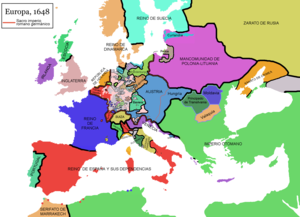
On October 24th 1648, the Treaty
of Westphalia was signed, marking the end of the Thirty Years War, one of the
most destructive conflicts in the history of Europe. The Thirty
Years' War was a war fought in Central Europe between 1618 and 1648 in which most of the major European powers of the time participated.
The origin of the war was
religious, consequence of a confrontation between the supporters of the Reform of
the Church supported by Luther (Protestants) and the Catholic Church. However, the conflict spread and changed from being a religious war to a dynastic struggle
between the German princes with the intervention of other European powers
(especially Sweden and France) interested in controlling the power of the
Habsburg family.
Signature of the Treaty of Westphalia.
The Westphalia area of
north-western Germany gave its name to the treaty that ended the Thirty Years
War. The Treaty was signed on
October 24th in the Hall of Peace of the City of Münster, in the
historical region of Westphalia, which ended by the Thirty Years 'War in
Germany and the Eighty Years' War between the Hispanic Monarchy and the Netherlands. In this treaty participated the
emperor of the Holy Roman Empire (Ferdinand III), the Hispanic Monarchy, France
and Sweden, the United Provinces of the Low Countries and their allies among the princes of the Holy
Roman Empire.

The consequences of the Treaty of Westphalia (1648) were:
- All the kingdoms accepted the Peace of Augsburg (1555) which established religious freedom of the princes of the Holy Roman Empire, being able to choose either the Catholic or Lutheran confession but without admitting other as the Calvinist. With the Peace of Westphalia of 1648 the religious freedom established in this treaty it was extended and Calvinism became another of the religions allowed.
- Independence of the Low Countries.
- The Hispanic Monarchy lost hegemony in Europe. The kingdom of France became hegemonic.
- Consolidation of State-nations and Absolute Monarchy.

