Friday, October 23, 2015

This day in history: Charles I's coronation and the end of the Revolt of the Comuneros


Hey friends! It's Lucía. Today is my turn to explain what happened years and years ago. Yes! This is a new chapter of... THIS DAY IN HISTORY! And as you have seen in the title, today we have double event.

FIRST EVENT: CHARLES I'S CORONATION.
Today but in 1520, Charles was crowned as Emperor in Germany (by the Pope Clement VII). Three years ago, in 1517 he started to be(en) King of the Hispanic Monarchy, but in 1519 he left the Iberian Peninsula to be elected emperor, and because of that the Revolt of the Comuneros started.

                         
                               Source: http://gallery.enciclonet.com/gallery/docs/comun/per/ptitia54.jpg
But Charles I actually was named the heir of Emperor Maximilian when he was 6, when his father Philip the Handsome died. His grandfather died in January 1519 and Charles was elected Emperor by the German electors in July 1519. In Germany there was a tradition: when a new Emperor was elected, they had to celebrate three ceremonies. The first was in the Palatine Chapel of Aachen second one was a coronation to name Charles "The king of Burgundies" and the third one was in Rome. this one didn’t take place until the 23rd February 1530, when Charles V was crowned Emperor by the Pope Clement VII.

Here you have a documentary of his entire life, if you want you can watch it (it's long, and in Spanish).

     
                    Source: https://www.youtube.com/watch?v=3AWhoBtXpA0

This is the link to Charles V's video in English: 
https://www.youtube.com/watch?v=MRYzW3BSj0I 

SECOND EVENT: THE END OF THE REVOLT OF THE COMUNEROS WITH THE SURRENDER OF THE LAST CITY, TOLEDO. (1521)
Joanna the Mad, Isabella's daughter, inherited the throne with her Burgundian husband King Philip I. However, Philip died two years after the beginning of their reign, and their son Charles was only six years old. Due to his youth and Joanna's mental instability, Castile was ruled by the nobles and her father, King Ferdinand II of Aragon, as a regency. After Ferdinand's death in 1516, the sixteen-year-old Charles was proclaimed king of both Castile and Aragon. In 1519, Charles was elected HolyRoman Emperor. He departed to Germany in 1520, leaving the Dutch cardinal Adrian of Utrecht to rule Castile in his absence. Soon, a series of anti-government riots broke out in the cities.


Two men and a priest stand in the center, overseeing the proceedings. A dead body lies on the ground; a man triumphantly lifts up his severed head in the background. A bearded man with hands bound is being brought forward to be executed next.
Source: https://commons.wikimedia.org/wiki/File:Comuneros.jpg#/media/File:Comuneros.jpg

  On 23rd of October 2015, we celebrate when the towns of northern Castile soon succumbed to the king's troops, with all its cities returning their allegiance. Today also Toledo, the last city where the revolt continued, declared surrender.                                     

BatallaDeVillalar.jpg
"BatallaDeVillalar" by The artist is Manuel Picolo López, born in 1851 and died in 1913 (source: https://commons.wikimedia.org/wiki/File:BatallaDeVillalar.jpg#/media/File:BatallaDeVillalar.jpg)
                                           

Thursday, October 22, 2015

22nd October 2015

Hi, i'm Eva L. and i'm going to explain what we have done today in Social Sciences class.

At the beggining of the class Paqui has returned to explain to us what we gave the previous day ; the demography, the economy and the society in the 17th century, the Castilian and Portuguese trade routes and the colonial empires of America in the 17th century.

Then she started to explained : THE TRADE ROUTES IN THE INDIAN OCEAN

She explained this map of the trade routes in the indian ocean.

https://mrbarton-fhs-apwh.wikispaces.com/file/view/Indian_Ocean_trade_route.gif/302657498/604x355/Indian_Ocean_trade_route.gif

Some kingdoms of the Iberian Monopoly was broken in the colonial trade  and England and Holland seized several Portuguese colonies in Asia.

Prior to the seventeenth century , Arabs and other traders had dominated de Indian Ocean. When the Portuguese arrived , Europeans nations entered directed into these trade routes in armed ships. They began the battle for supremacy , projectin European competition into these distant waters and shores.

THE TRIANGULAR TRADE

This is the map of the triangular trade:

http://b68389.medialib.glogster.com/media/68547652f01dc28f00ff8596c69779786126d95260fee37370b2eb80b9baf16a/triangular-trade-1.jpg

From Europe to Africa: manufactor products.
From Africa to America: slaves.
From America to Europe: colonial products (sugar, coffee...)

TRADING COMPANIES

Different companies dedicated to trade, whose shareholders invested money and recived profits in the proportion of their investment. The trading companies got the protection of the States they belonged to.


NEW VOCABULARY:

To be worth: valer la pena
Seize: apartarse de
Dutch: Holandés
Date to: remontarse a
Rum: ron
Shareholders: accionista
Stock exchange market: bolsa
Trading company: compañía comercial
Stock: acción
Savings: ahorros
Trustworthy: digno de confianza
Crow: tripulación


Wednesday, October 21, 2015

This day in history: a decisive marriage

On the 21st October 1496 a decisive marriage took place in the city of Lille, in Burgundy: Joanna of Castille and Aragón, later known as Joanna the Mad, married Philip of Burgundy, later known as Philip the Handsome. This marriage, together with another one between John of Castile of Aragón and Margaret of Austria in 1497, sealed the double alliance between the Catholic Monarchs and the Habsburg dynasty. In 1500 Joanna the Mad and Philip the Handsome had a baby called Charles, who would later become king and emperor: Charles V.


On this link you have some more information about Joanna's trip to Burgundy and the love at first sight Philip and her had the first time they met: 


And here you have a short video from the TV series Isabel with some curiosities about Joanna's trip to meet her future husband and the first time they saw each other: 

Today in History: the Magellan Strait

Hi classmates!

Today in History I'm going to talk about Magellan Strait.


The Strait of Magellan, is a navigable sea route separating mainland South America to the north and Tierra del Fuego to the south. The strait is the most important natural passage between the Atlantic and Pacific oceans but it is considered a difficult route to navigate because of the unpredictable winds and currents and the narrowness of the passage.


Ferdinand Magellan, a Portuguese explorer and navigator in the service of Charles I of Spain, became the first European to navigate the strait in 1520 during his global circumnavigation voyage.


On March 22, 1518, the expedition was organized in Valladolid, naming Magellan captain general of the fleet and governor of all the lands discovered. The fleet would become known as the "Armada de las Molucas" or "Fleet of the Moluccas". It was composed of five ships:

-La Trinidad under the command of Magellan

- La San Antonio under the command of Juan de Cartagena

- La Concepción under the command of Gaspar de Quezada

- La Victoria under the command of Luis de Mendoza

- La Santiago under the command of Juan Rodríguez Serrano

Magellan's ships entered the strait on November 1, 1520, All Saints' Day, and it was initially called Strait of All Saints. Magellan's chronicler, Antonio Pigafetta, called it the Patagonian Strait, and others Victoria Strait, commemorating the first ship entering it. Within seven years it was being called Magellan Strait in honor of Magellan.

Tuesday, October 20, 2015

20th October 2015

Hello! :3 I'm María and I'm going to explain what we have done in Social Sciences class.

At the beggining of the class Paqui has returned to explain how we have to use the blog. She explained us how to write the journals and how put the pictures and the links on it, because some people had problems with that.
After that we talked about the projects of  the board game. We have improve the projects to have a better mark. Paqui said we can correct the wrong answers and the mistakes in the rules or in the game in general.
All the project were really good, but Paqui didn't know if some of us will must do the exam, so Good luck for everyone :S

Then we started the new unit, the unit 2 : THE 17th CENTURY, ABSOLUTE MONARCHY AND THE DECLINE OF THE SPANIC EMPIRE.


The points we learned today was.
    - The Demography: Slow population growth, due to high mortality rates caused by wars, epidemics and       famines.
 
     -The Society:
                                         Drawing of class

     -The Economy:
      Paqui explained us the Trade.
      In the 17th century the merchants had shops, if the workshops were of the same type, they were in the           same street. The workshops were of the guild and there was an apprentice who worked in the                       workshop. The apprentice had to make a difficult exam to be guild and to had his own workshop.

Then we talked about the Manufactories. The guild took on the workers of other workshoop giving them more money.

Differences between workshops, manufactories and factories.
    Workshops→  • By hand.
                             • Few workers.

    Manufactories→  • By hand.
                                   • A lot of workers. 
                                   • Tools and raw materialy.

    Factories→  • Machines.
                          • A lot of workers.


After that we saw a map of the new Castilian and Portuguese routes for the trade.
http://spanishdialects-09c.wikispaces.com/file/view/Spanish_and_Portuguese_trade_routes.jpg/107664971/465x199/Spanish_and_Portuguese_trade_routes.jpg

And the new countries of the colonial empire in America
https://histounahblog.files.wordpress.com/2009/08/6-el-imperio-espac3b1ol-hacia-1800.jpg?w=495&h=218.

For homeworks, Paqui ordered us a summary of the Society and Economy.

NEW VOCABULARY
Famine: Hambruna.
Starve: Morirse de hambre.
Starvation: Muerte por hambre.
Bourgeosie: Burguesía.
Bourgeois: Burgueses.
Workshop: Taller artesano
Manufactory: Manufactoria.
Guild: Gremio.
Glassware: Cristalería.
Crokery: Vajilla.

Presentation of the 17th century

Here you have the presentation to study the 17th century:


Monday, October 19, 2015

Monday, 19th October

Hello classmates!
Today in the class of Social Sciences we've done several things. First, we've started talking about the projects, or the games, whatever you want to name them. We've talked about how are they and all the class we've told our opinions, even if are good or bad opinions. We've respected all of the opinions of every classmate. So:

About Eva, Diana and Andrey's project
All we've thought that the game is very basic and something small. But also we've told that in general is very interesting and that has a lot of work of preparation.

About Benjamin, Jaime, Carlos and Antonio's project
In general we've had all the same conclusion, that is very confusing and long. They have to revise the questions, but also it's a good idea to recicle the board.

About the María P, Fátima, Eva and María M's project
This game haven't had any problem, I think, in my personal opinion, is the best game, i'ts very original  and very complete. So funny! Congratulations!!

About Santiago, Anca, Fernando and María L's project
The classmate's opinion is that the game is very long and the board is very dark and confusing. But also is very complete and it's has a different idea of  play. 

About Lorena, Sara, Lucía and Manal's project
About this project we've told that is very beautiful and creative. The only disadvantage is that you advance so slowly, but they are going to improve it.


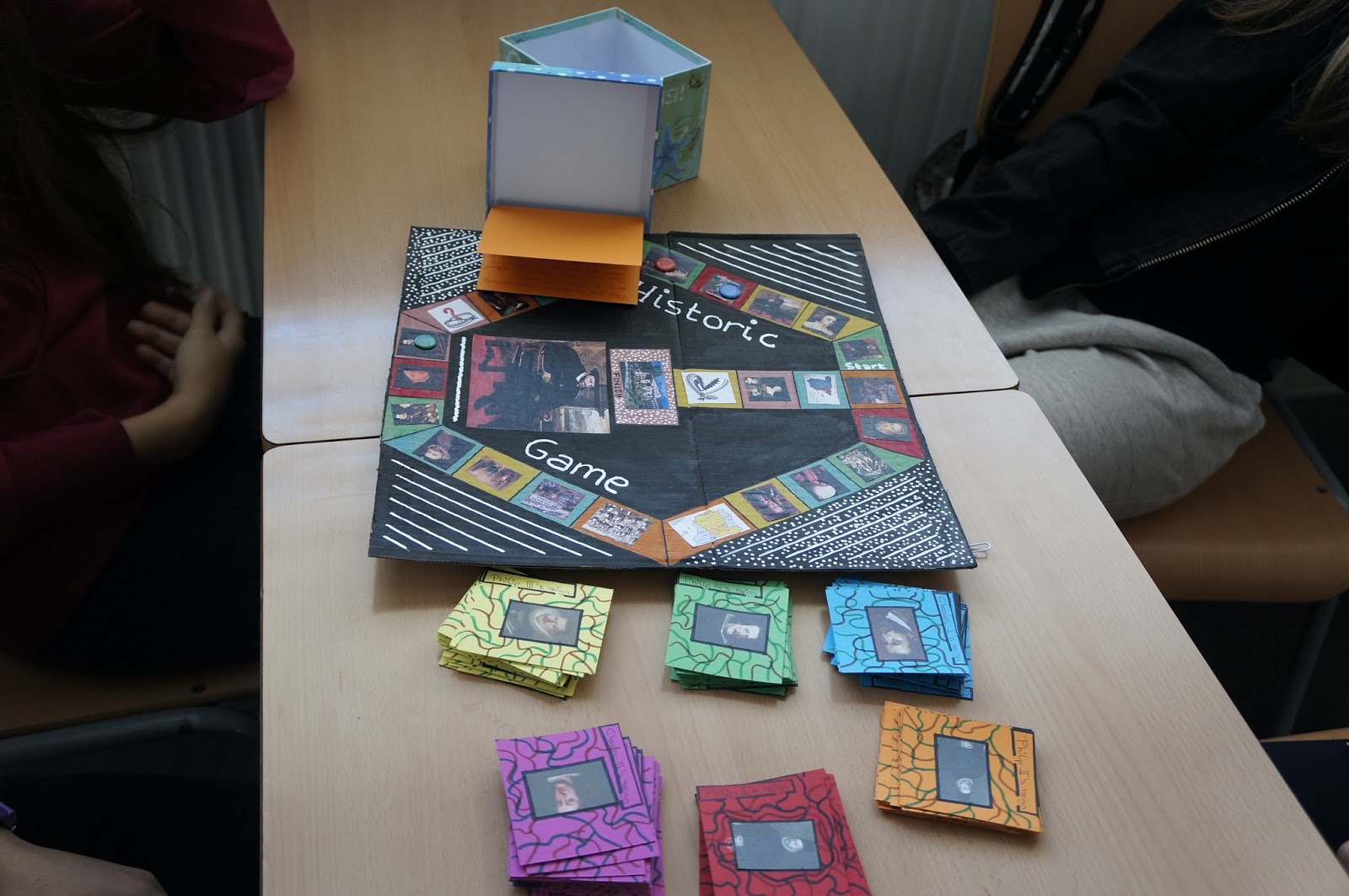
Here you have a picture of our project, made by Carlota, Lidia, Irene and me: 


And this is the box where we packed the board: 


Finnally, at the end of the class, some students of 1st ESO have came to the class to show them the projects (in Spanish) with the theacher Inés, in the subject of Social Sciences. The students have said  that most of the projects are very original and interesting. 
I think that the next class we're going to finish talking about the last project and we're going to continue whith the unit. 
That's all. Bye! See you tomorrow!!

Thursday, October 15, 2015

Thursday, 16th of october

Hello everybody!

Today in Social Sciences we've continued playing with different games.

At the beginning of the class, my group and I have played a game called "Connect with the Austrias ". It was like a trivial. The game consisted of completing a way of 20 squares. Every square had a question and when you arrived at the end of the way you had to answer one question of every section to collect all the dominoes.


Source: https://www.google.es/search?q=trivial&espv=2&biw=1280&bih=699&source=lnms&tbm=isch&sa=X&ved=0CAYQ_AUoAWoVChMI0NSD9tXEyAIVB5INCh3QwgBw#imgrc=Ye5D0cbAv8daO


I liked this game a lot because it's a normal box, but when you open it, a game appears!. I was very surprised. I liked the design and I think it's an original game, but, in my opinion the squares are too small and they haven't space to put the dominoes.

Later, we've played another game called "Duke of Alba's Castle". In this game, you had to advance square by square. There were different sections and you had to throw the die to choose one of them. Every number of the die belonged to a specific section:

- 1 belonged to Charles I section
- 2 belonged to Philip II section
- 3 belonged to Philip III section
- 4 belonged to Philip IV section
- 5 belonged to Charles II section
- 6 belonged to the Indies section

The objective of the game was to rescue the princess of Duke of Alba's Castle, and, for that you had to get right the answer and collect dominoes to rescue her.


Source:https://www.google.es/search?q=duke+of+alba&espv=2&biw=1280&bih=699&source=lnms&tbm=isch&sa=X&ved=0CAYQ_AUoAWoVChMInY-vx9vEyAIVwxoeCh3Q7QZg#tbm=isch&q=Castillo+del+duque+de+alba&imgrc=ZrqdXBqqPK3c4M%3A

This is a real picture of the ruins of Duke of Alba's castle.


I liked this game a lot. I think it's a good idea that each number of the die belong to a different section and I also like the idea of rescue the princess. The problem is that you have to advance square by square and it's very long. In my opinion the design could be better, too, but the dominoes were very original.

We had learnt a lot in a very funny way. I think that my classmates had done a very good work with their projects.  In my opinion this class had been one of the funniest lessons and I would like to repeat it with different contents and projects.


Good bye!

Tuesday, October 13, 2015

This day in history: Pedro de Mena's death

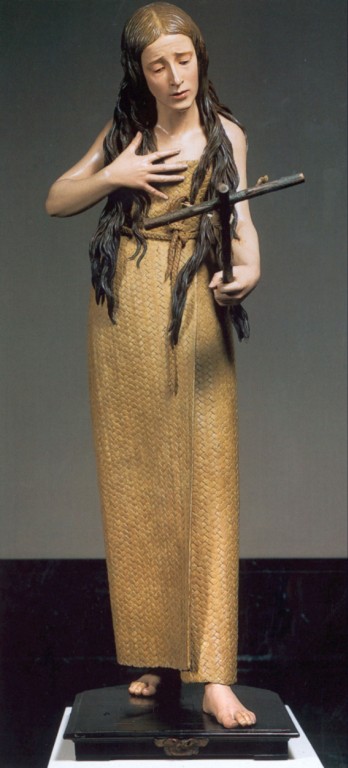
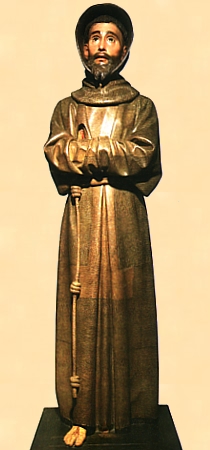
On the 13th October 1688 Pedro de Mena, one of the most important Baroque sculptors, passed away in Málaga. He was one of the most outstanding sculptors of the Baroque Andalusian school. He worked mainly for the Church and sculpted works for the cathedrals of Málaga and Toledo. Here you have some of his main works. You can include some of them on your travel journal: 


Penitent Magdalen


Saint John the Baptist


Ecce Homo


Saint Francis of Assisi

A VERY FUNNY SOCIAL SCIENCES CLASS

Hi classmates!

Once we have finished our projects, today in Social Sciences class, we have put them into practise playing with them all the contents learned in previous lessons. When we have arrived in Social Sciences class, we have formed the same groups of the projects and we have started playing with the games of other partners. We have followed the following steps:

  • One of the classmate who worked in the chosen project has explained us the rules of the game.
  •  As the same time we were playing with the proyects, Paqui has taken photos, asked us our opinion about the other projects (if they were completle, correctly, our favorite ones...) and corrected the mistakes of the games.
 Here I leave you some photos of all of us playing with the projects:


In my opinion we have to continue to work in groups with projects because I think in this way we can learn the contents better and in a funnier way the contents and we can meet our classmates better. I think today has been the funniest and most productive class of Social Sciences.