Showing posts with label international organizations. Show all posts

Tuesday, January 24, 2017

Some short videos about the United Nations

On this short video you will learn how the United Nations work and what their purpose is:


How the United Nations Security Council works:


How effective is the UN?


 How powerful is the UN?


Sunday, May 1, 2011

The last corrected glogs

Here you have the last glogs that have passed the "quality" control. They appear in alphabetical order:


- Yolanda Abad worked on the African Union:


- Beatriz Antequera´s project is about the NATO, the North Atlantic Treaty Organization:


- Laura Bustamante worked on UNASUR:


- Silvia Castiblanque´s project was about the International Criminal Court:


- Carlos Galindo´s work is about the International Monetary Fund:


- Juan Carlos Huertas worked on the Organization of Petroleum Exporting Countries:


- Ana Isabel Lucas´s project was about the World Trade Organization:


- Isabel Naranjo´s work was about the Council of Europe:


- Daniel Pintado worked about the International Organization of Atomic Energy:


-Enrique Vázquez´s work is about the International Labour Organization:


- And last, but not least, Beatriz Yuste´s project was about the League of Arab States:


Judge by yourselves. What´s, in your opinion, the best work?

Thursday, April 28, 2011

A new glog delivery

Here you have two more glogs about our international organizations´project: 

- Ángel Aranda has worked on the Food and Agriculture Organization, a UN specialized agency: 


- Manuel Cruz´s project is about the International Court of Justice, another institution included on the UN system: 


Click on the videos included on the glogs. They are short and interesting. And please, leave your comments. 

Sunday, April 24, 2011

Freshly backed glogs!

Here you have the last finished glogs on the international organizations´ project. As usual, they appear in alphabetical order: 

- Rebeca García´s glog is about the Organization of Economic Cooperation and Development: 


- Laura Muñoz has worked on the European Space Agency:


- And here you have Alejandro Torrillas´s project about ASEAN, the Asociation of Southeast Asian Nations: 


We´re waiting for your opinions. 

More finished glogs

Here you have the second group of glog projects about international organizations:

- Diego López Casero has worked on Interpol, the international police organization: 


- Mari Luz Ortiz  has prepared a glog about the Non Aligned Movement: 


- And Yolanda Rubio´s project is about the World Bank: 


Please, leave your comments about your classmates´ works.

Friday, April 22, 2011

The first glogs about international organizations

These are the first results of the project about international organizations:


- Javier Alberca has prepared a glog about the Organization of the Islamic Conference:


- Ana de la Fuente´s project is about the World Health Organization:


Please, leave your comments and opinions about your classmates´ glogs. And remember  that you have time to finish or improve your projects until next Monday. 

Monday, April 11, 2011

Glogster tutorial in 90 seconds and some advice


Here you have a very short video where you can learn  how to use Glogster Edu and create your own glogs very quickly. 


As for the project, remember to prepare a good scheme on paper to organize your information and a good summary that includes the compulsory sections. Don´t copy and paste. Use your own words to explain about your international organization. And finally, when you have all this, focus on the design and the create your glog. Remember the deadline and ask questions, if you have any doubts. You can use the Glogster Edu platform or the e-mail. Make your best!

Friday, April 8, 2011

Challenge number 15


This week you will have to research on the European Union currency. These are the questions:

QUESTION 1

What was the name of the previous European Union currency? When was the name "euro" officially adopted as the official currency of the European Union?

QUESTION 2

What´s the eurozone? What EU countries are included in the eurozone?

QUESTION 3

What other countries use the euro as official currency?

QUESTION 4

What are the requirements the EU countries have to meet if they want to adopt the euro as currency?

QUESTION 5

What institution is in charge of the eurozone´s monetary policy? Where is its headquarters located?

QUESTION 6

The Eurogroup (the group formed by the finance ministers of the eurozone) has recently approved bailouts to solve the economic problems of the financial systems of three countries whose currency is the euro. Which are these countries? What is the amount of the bailout they have received (or will receive)?

Thursday, February 17, 2011

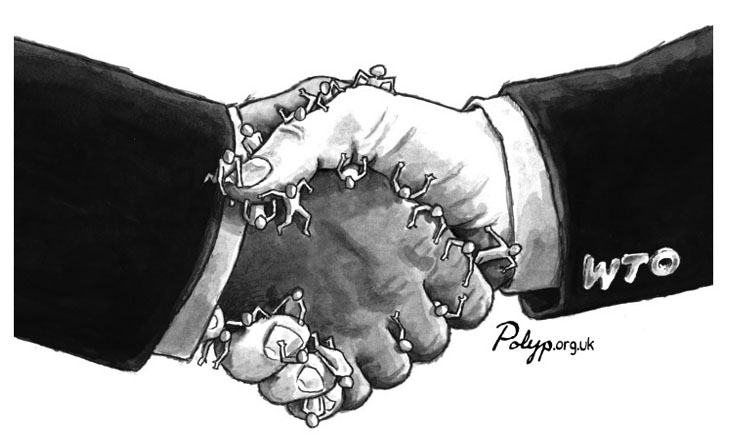
The WTO and free trade in some cartoons

Here you have some cartoons about the role of the WTO in international trade relations. Free trade has benefited the most developed countries and the multinational corporations, but it hasn´t been so good for developing countries and for many workers in the world. 


And the last cartoon reflects another blatant reality: the European free market is closed for the poorer. 


Thursday, November 18, 2010

The guys who make the economic decisions


Answering to Silvia´s demand, I´m going to include some links about the institutions that make a big amount of the economic decisions that influence the life of billions of people in the world

- The G-20 was created in 1999 as a response of the financial crises of the 90s. The countries that belong to this group are the following: France, Germany, Italy, United Kingdom, Russia, Argentina, Brazil, Canada, USA, Mexico, China, India, Indonesia, Japan, Saudi Arabia, Turkey, South Korea, South Africa and Australia. The European Union is also a represented in this group. This is the reason why the representatives of Spain participated in some of the last summits of the G-20. More information on this link:


- The G-8 is formed by the most industrialized countries of the world: the USA, Japan, Canada, Russia, Italy, France, Germany and the United Kingdom. The representatives of the European Union attend the annual meetings as well, but they cannot vote. On the links below you can learn more about the G-8:


- The International Monetary Fund (IMF) was created at the end of World War 2 to supervise the world financial system. Nowadays they defend free market economy and promote measures of liberalization and deregulation of the economies. This policy has received a lot of critics, because of the sacrifices that liberalization entails for many people.


- The World Bank (WB) was also created at the end of World War 2. Its goal was to finance the development of countries, by providing loans at low interest. The policies of the World Bank have been criticised by many NGOs as well:


- The World Economic Forum is a private organization that celebrates an annual meeting in the city of Davos in Switzerland. Every January many influent people go to Davos to discuss and promote initiatives to improve the world. These meetings in Davos have been criticised as well, because of their defense of liberalization and globalization.


- The Federal Reserve is the central bank of the USA. His president, Ben Bernanke, is one of the most powerful men in the world. His decisions of increasing or reducing the value of the dollar can change the lives of millions of people, not only in the USA. Bernanke is an expert in the Great Depression of the 1930s and he has declared that he will avoid a new economic depression, even if he has to print millions of dollars and drop them  from a helicopter over Manhattan Island. This is why he is called “Helicopter Ben”.


- The European Central Bank (ECB) is the central bank of the European Union. It´s presided by Jean Claude Trichet and  has an important role in the economic policy of the European Union. For example, they decide on the interests of mortgages.