Showing posts with label Tourism. Show all posts

Friday, March 11, 2011

Challenge number 11

This week´s challenge will be a "superquestion". The superquestion was the last part of a legendary TV contest, El tiempo es oro (Time is gold). This show was broadcasted between 1987 and 1992 and it was presented by Constantino Romero. In the final part of the show the contestant had to solve three linked questions. The answer to the first question allowed the contestant to go on with the second one and the answer to this one gave the clue to the third and definitive answer. The contestants could use several encyclopedias and dictionaries to solve the questions. You can do the same with your superquestion. As we´re starting a new unit next week, let´s review a little bit!

QUESTION 1

What body of water is this one? Where is it located (continent and country)?


QUESTION 2

One of the countries next to this body of water has five places considered as World Heritage Sites by the UNESCO. Which country is this? What´s its capital city? What of these World Heritage Sites is represented on the following image? Why was this city so important during the Middle Ages?


QUESTION 3

Explain what type of government the country where the body of water and the city of the pictures are located has.

And remember, don´t copy and paste! Write your own answers. You have time until Sunday, 22:00. 

Thursday, March 3, 2011

Challenge number 10

Spain is the second world touristic destination. Many of the tourists that come to Spain choose this country for its mild weather, its beaches and its competitive prices, in comparison with other touristic countries. However, Spain has a wide offer of cultural places and natural landscapes that could attract many visitors. This week´s challenge will consist in discovering some of these interesting places. You will have to identify the pictures, writing their names and where they are located. 

PICTURE 1


PICTURE 2


PICTURE 3


PICTURE 4


PICTURE 5


PICTURE 6

The last question has an open answer. If you had to choose a place to visit in Spain, that is not the typical place tourists usually visit, what would you choose? Explain why. 

P.S: Don´t forget to check your mails on Monday to know what you will have to study for the exam on Friday the 11th. 

Monday, February 28, 2011

The Atlas of the Real World

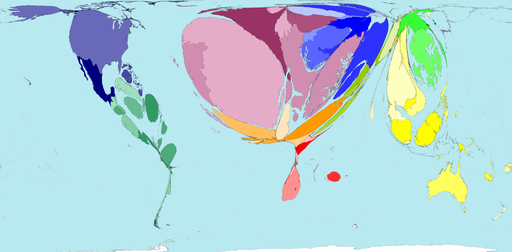
Today we have discovered a new way of representing different facts on world maps. It´s a project called The Atlas of the Real World. The authors represent the countries of the world not by their real size, but by their demographic importance on different subjects. Here you have some examples related to tourism. 

TOURIST ORIGINS


TOURIST DESTINATIONS


TOURISM EXPENDITURE


TOURISM PROFIT

This interesting book is called The Atlas of the Real World: Mapping the way we live, by Daniel Dorling, Mark Newnan and Anna Bartford and it was published byThames and Hudson. 

You can also find these maps on Worldmapper. Every map includes a short explanation and they are very useful to understand many world facts: 


Finally, here is the link to all the world maps about tourist: 

Presentation about tourism

This is the Powerpoint presentation we have used to study tourism. You can review the main world tourist destinations, the most visited countries, the countries that earn more money with tourism and the positive and negative impacts tourism has. 

Saturday, February 26, 2011

25TH FEBRUARY 2011

Today in Social Sciences the first thing we have done has been to check the chart about the different means of transport.
We have to write about uses, infrastructures, advantages and disadvantages.
A curious thing for me has been that all the class was discussing and thinking in the advantages and disadvantages.
I think it will be usefull and I have included the chart. I someone didn't correct it now she/he can do it:


USE
INFRASTRUCTURES
ADVANTAGES
DISADVANTAGES
GROUND
TRANSPORT
ROAD
For small amount of freight and people.
Short distances.
Highways and road tolls
Cheaper than other means of transport.
Price depends on the variation of oil price.
Pollution.
Traffic congestions.
RAILWAY
Freight and people in short, médium and long distance.
Rail tracks
Stations
Electricity
 installation.
Ecological.
Competitive prices.
Fast.
Safer.
No traffic congestions
Inflexibility (passangers have to adapt to lines)
Delays
Strict timetable
Blackouts
MARITIME
TRANSPORT
Big cuantity of freight
Ports and shipyards.
Open spaces for containers.
Big capacity to carry big amount of freight.
Cheap price
Depending on the weather
Slow.
Risk of accidents
Inflexibility
AIR TRANSPORT
Passangers in long distance travels.
Very expensive and light weight goods
Airports (runways, terminals, hangars)
Fast. Security ( the safest mean of transport)
Expensive price.
Air pollution and acoustic pollution near the airports and flight routes.


After that we have read about tourism . This is a very interesting point because tourism is a very important activity in Spain.

Tourism is: The economic activity that consist in organazing trips and stays  for the people in their leisure time.
Tourism appeared in the 19th century but did not become massive until the 2nd middle of the 20th century.
Tourism appeared in Spain in the 60s.