Tuesday, October 21, 2014

Tuesday, 21st of October 2014

Hello class!

I'm Silvia and this is my firts journal because It's my first year with Paqui.

Today in Social Sciences lesson we have started reviewing what we did yesterday and then, she asked where was Sara and Alfredo said that she was in the doctor.

Then we started with the decline of the hispanic empire which were governed by: Philip III, Philip IV and Charles II.


Philip III                                        Philip IV                                             Charles II

 Paqui told us that spanish monarchy loss importance, the population were unhappy with the kings because they were changing the capital of the kingdom when they wanted to buy new territories cheaper. For example: the capital was Madrid and the king wanted to buy territories but there were very expensive so he decided to move the capital to Aragon, buy new territories in Madrid because were cheaper and then moved again the capital to Madrid.

Paqui has explained us who were the validos. They were members of the privileged estates (nobles or members of the clergy) who ruled on behalf of the kings, because they didn't want to work or they were not able to ride.

We have copied a part of the presentation which was compound of the twelve years truce, expulsion of the moorish and the devaluation of currency.

Then, we have asked Paqui how did she learnt english. She told us that she had learn french in school and she has explained to us that her story with the english was very curious because she started learning english with a TV program which was dedicated to teach english to spanish people. Then, she decided to continue learning english and she has said that she learn a lot teaching us.

 For the last we have copied a scheme of the decline of the hispanic empire and we have to complete it at home.

We have copied some important words in Glossary which are:

-Decline: decadencia.
-Valido: valido.
-To mint: acuñar (moneda).
-Copper: cobre.
-Truce: tregua.
-Harmful: dañino, perjudicial.
-Influence peddling: tráfico de influencia.
-Flaw: defecto.
-Flawless: sin defectos.


See you on thursday!

Monday, October 20, 2014

Prezi presentation of the English revolutions


Thanks to Stefania we have this extraordinary resource about the English revolutions. Have a look on it. It's very detailed and you will understand this process better. 

17th October, 2014 (Friday)

Good afternoon to everybody!!

Sorry, I'm late. I thought that I could write my journal today, like we don't have Social Science class. My journal it was written and prepare in another SHEET of paper and now I'm going to tell us the Friday's class.

The lesson started when the teacher put negatives and positives marks while she look at the homeworks that she had commanded on Thursday for Friday.
The homework was about a summary of trade but the following information is the summary of Paqui. I think that is interesting. What about you?

TRADE: long distance trade developed a lot, mainly colonial trade:

- Traditional routes continued to be used:

  • Spice route, controlled by Portugal.
  • Precious metal route, controlled by Castilian.

- England and Low Countries bloke the Iberian monopoly an seized some Portuguese colonies in Asia. The Elglish seized India and the Dutch seized Indonesia.
- New route: triangular trade, linking Europe, Africa and America.

  • Europe sold manufactured products to Africa.
  • Africa sold slaves and gold to America.
  • America sold colonial products to Europe (cotton, sugar, tobaco, cocoa...)

After resolve the dudes about this information we have stopped the class because we have copied in our glossary a new word; rum that means "ron". We have stopped the class because we have tell to Paqui one patetic thing that happened to Jorge.

Then Paqui has continued with her class and she has saw us an animate map. The map was about the triangular trade routes but didn't speak and the teacher explain us where were destined those products.
When we have finished the teacher has put one or two questions about this map. Also she has saw a map in which we can practice.

Paqui has recommended us that we have to see the film "Dances with wolves" that is about the destruction of the aberindian. She says that is very interesting and the music is so beautiful, but I don't like western films... Dances With Wolves is produced by, and starring Kevin Costner.

For finished the lesson we have started the second point of the 17th century: Politics.

The teacher needs 4 blackboards each day hahahaha!

See you on Tuesday!

Lucía.

http://www.nationalarchives.gov.uk/pathways/blackhistory/images/africa/trade_routes.gif

Monday, 20th October, 2014

Good afternoon!

Today in Social Sciences lesson, as every day, we have done a lot of things.
First of all, Paqui has asked Silvia about his ankle, and Paqui has also asked about Sara, because she wasn't in the class. For this reason we have copied the two firsts words of our today's glossary:

- Sprain ankle: esguince en el tobillo.
- ID card: DNI.

Then, Paqui has reviewed our schemes, to see if we had done them. When she has finished, we have started to correct them. 
We have talked a little about the Man in the Iron Mask.
Paqui has explained us the definition of:

Hegemony: it is the first position in something. For example, in Asia is China, in Europe is Germany, in America are the United States...

We have seen a picture of the percentage of population loss in the Empire during the Thirty Years' War. 


We have spoken also about one of the most important battles of the Thirty Years' War:

Capture of Breda: in which Pihlip IV's troops conquered the city of Breda in 1634, but they were defeated at Rocroi in 1643.
We have also seen a photo of the decapitation of Charles I during the 1648 English revolutions, but this decapitation was in 1649.


Decapitation of Charles I
http://www.thegloriousrevolution.org/document.asp?doc=charles1


And we have copied a new word:

- Executioner: verdugo.

Then we have spoken about Oliver Cromwell. In the 1648 English revolutions he was declared Protector Lord, but he was a tyrant. Monarchy was restablished in 1660. But deputies limited the powers of the king with a new concept we have learnt:

HABEAS CORPUS: it was a right people had to defend himself when you were arrested. 
For example, if you were arrested, you could use the habeas corpues right to defend yourself, to ask why had you been arrested and prepare your defense (like a lawyer of the present). And in this way, the king couldn't arrest pepople arbitrarily. So it was an advance.

We have spoken about William of Orange too, who accepted the proposition of some English nobles to dethrone James II and become the king of England. In 1689 he swore the Bill of the rights, which limited the king's power and make decisions without the control of the Parliament.


William of Orange (1650-1702)
http://www.livius.org/bn-bz/bruijn/dutch.html


We have also learnt that during the 1688 English revolutions, England became a limited monarchy, and it was the first country to have one.

And finally, to end the lesson, we have spoken about Charles II. He was hermaphrodite. And he was lame and constantly drooling. He had all these problems because his chromosomes were XXY.


Charles II (1630-1685)
http://www.the-scientist.com/?articles.view/articleNo/35235/title/Did-Inbreeding-Royals-Evolve-/

We have also copied these words:

- Hegemony: hegemonía
- Capture: captura
- Westphalia: Westfalia
- Signature: firma
- Executioner: verdugo
- To cede: ceder
- HABEAS CORPUS: (Tengas cuerpo): the translation is the same in Spanish, but with an accent: Hábeas Corpus
- To swear: jurar
- Hexed: hechizado
- To heal: curar


And this is all for today, I hope you have a good afternoon.
Bye!!

Thursday, October 16, 2014

16 October, 2014 (Thursday)

Hello to everyone!

I'm Inés and this is my first journal of the year.

Today in the class of Social Sciences, we have done a lot of things!

Firstly, Paqui has talk about the photo of the students of this year for the blog and she has told us that it's better to do only one photograph with both groups together.

After this, Cristina Mañez has corrected "Colonial society", which is the last part of the squeme "Conquest, Administration and Colonization of the Indies". Cristina has told us that: There were different social groups living in the Indies, and their position depended on their origin:

  • The peninsulars: economic and political power and they held the main posts in administration.
  • Creoles: descendants of colonists. As time went by they started complaining about their psition.
  • Mestizos: mixture between colonists and American Indians.
  • Black slaves: slaves from Africa. They were sold in the depopulated territories to work in the plantations.
To explain it better, Paqui has drawn a pyramid explaining Colonial society in grades or estates of population.

Then, we have started to talk about Bartolomé de las Casas because he wrote a short account of the destruction of the Indies.

Source: http://www.datum.org.ar/noticias013.html

To understand the situation, Paqui has explained another situation, that all of us understand really well, she has talked about the Spanish Constitution therefore we have konwn that there are a lot of laws that aren't real.

Later, we have studied the products from American origin like tomatoes, corn, pepper, potatoes, coccoa, tobaco, avocado, sunflowers, pumpkin, peanuts... Also, there are products in America with European origin like wheat, barley, oats, donkeys, horses, cows, chicken, rabbits...

Today, we have finished the point 2 of the unit so we have started te point 3 "The 17th century"  part a) "Demography, society and economy".

We have copied from the blackboard a squeme of the part a) and, at the same time, the teacher has explained the slow population growth, due to high mortality rate caused by wars, epidemics and famines; the society sitll into states privileged and underprivileged people. And then, the economy; agriculture continued to be the main activity; most of the production continued to be made by craftsmen in workshops and controlled by the guilds, in some places, merchants created manufactories to escape the control of guilds.

At the end of the lesson, Paqui has given some homework to us, to complete the scheme that we have started in class because we haven't got time to finish it in class.

Today, like always we have copied some vocabulary: 
  • Obey the order, but don't follow it: Obedézcase, pero no se cumpla.
  • Useless: Inútil.
  • Unfair: Injusto.
  • Population growth: Crecimiento de la población.
  • Harvest: Cosecha.
  • Moratlity rate: Tasa de mortalidad.
Source: www.cossio.net/actividades/pinacoteca/p_01_02/las_lanzas.htm

Thursday,16th of October

Hello everyone! I'm Minerva and I'm going to write my first journal of the year.

Today in Social Sciences we have learned a lot of things.

At first, we have reviewed the summary that we had to do for today. It was about demography, economy and society of the 17th century. Marta has read the demography summary that says there was a slow population growth due to high mortality rates caused by wars, epidemics and famines.
Then, Nuria has read the society summary. The society continued to be divided into the privileged and underprivileged estates and there was increasing discontent of the bourgeois because they didn't have political power.
Finally María has read the last part of the homework which was the economy summary. Agriculture continued to be the predominant economic activity and there were some changes in production and trade. Manufactories were created to avoid intermediaries and sell the products directly in the market and to produce more of them.

Gobelins Manufactory, Paris.

After reading this, Paqui has started explaining us the trade in the 17th century with some slides.
Some new countries intervened in long distance trades, apart from the Hispanic Monarchy and Portugal. They were England, France and the Low Countries. We have written down that England and Holland seized some territories from Portugal (Cape Colony and the Spice Islands respectively).

We have also seen that trading companies appeared. They were created to share the risks and expenses of long distance trades. Shareholders invested their money and, if the bussiness didn't fail, they received the corresponding part of the profits. If not, they were not responsible for the losses.

A new trade route linking Europe, Africa and America appeared. The triangular trade. In this website you can see with details all the products Europe, Africa and America sold and bought.
 http://www.eduplace.com/kids/socsci/books/applications/imaps/maps/g5s_u3/index.html

To finish with the lesson, Paqui has explained us the Absolute Monarchy from the Politics in the 17th century scheme. A perfect example of this type of monarchy was Louis XIV of France or also know as "The Sun King".


Louis XIV, King of France, in 1661
The Sun King's emblem

During the lesson we have written down some new words in our glossaries like:
- Famine: hambruna.
- Stock Exchange Market: bolsa
- Partner: socios.
- Public Limited Company: Sociedad Anónima.
- Share/stock: acción.
- Shareholder/stockholder: accionista.
- Profit: beneficio.
- Scholar: sabio, erudito.
And so on. 
For homework we have to complete the scheme which is formed by the Thirty Years War with its causes, consequences and development, the Absolute Monarchy with its main features and examples and English revolutions with the same points as the Thirty Years War.

And that's all! Hope you have a good weekend! See you on Monday.

Tuesday, October 14, 2014

14th October 2014 (Tuesday)

Hello everybody! I'm Fernando
Today in the class of social sciences we have started reading and talking about a text that Paqui published last Sunday. Last Sunday was the 12th of October, it's a importat day because we celebrate the "discovery of América" by Columbus. The text talks about all these things. Also we have seen some photos to think about what, the discovery supposed the indigenous people that live in América.

Columbus with the indegenous people of America.
Source: http://elpais.com/diario/2006/05/14/domingo/1147578759_740215.html

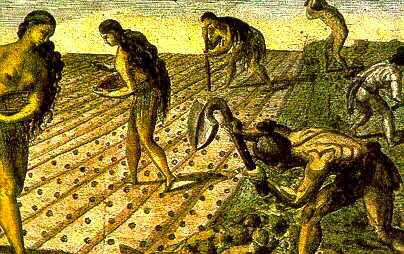
Latter we have started to correct the part of the scheme about the indies (América) that we had to complete at home. First we have corrected the administration of the Indies, Some institutions were created to rule the indies. They created Viceroyalties, Cabildos and Courts of Justice to rule the Indies. Also we have corrected exploitation of the Indies. They had two systems to exploit the indigenous people, the Encomienda system to exploit the lands and the Mita system to exploit the mines. We haven't corrected the colonial society, another part of the scheme.

Indigenous working the land.
Source: http://www.members.tripod.com/~panamahistoria/encomienda.htm
We have added some new words to our glossary:
Viceroy: virrey
Vice-royalty: virreinado
On the outskirts: a las afueras
Royal fifth: quinto real
Load: carga
Customs: aduana
Greed: codicia, avarícia
Greedy: avaricioso
On my side: de mi parte
To enslave: esclavizar

Tuesday, 14th of October 2014

Hello everybody! I 'm Clara Inés and this is my first journal of the year.

Today in Social Sciences we have done a lot of things.

At first Paqui has been talking about the project that we have to do, about the Baroque art.

Later we have started with a new point, the point three: "The 17th century".Fran has started to read on our book the Overview of this point, that said, that in the period of the 17th century was a period of crisis and contrasts, there was an Absolute Monarchy that was the predominant form of the goverment, the English Revolutions took place, and the division between Catholic and Protestant countries caused a new war, and the Baroque was the new art style of this period.

Later we have continued which the point A: "Demography, Society and Economy".

Alfredo has started to read on the book the Demography, which said, that the population grew very slowly, due to the high mortality caused by epidemics (like the Black Death, we also studied this at 2nd ESO)Only in the places where new agricultural techniques were introduced, the population grew.


A man suffering from buboes and splotches
A man with the Black Death


Later Sara has started to read the Society in the 17th century, which said, that it continued to be divided into estates (privileged and underprivileged) but the underprivileged estate grew.

Marta has continued to read the Economy, agriculture continued to be the main economic activity, this was divided into :

-Production: In this part Paqui has done a drawing about the merchants and she has said that the merchants started concentrating workers in big workshops called manufactories. Mechants provided tools and raw materials and workers received a salary in exchange for their work. The products of the merchants, could be sold them directly in markets, they produced: tapestry, crockery and glassware.

-Trade: this part has been read by Minerva, this said that, international trade grew , and sea routes opened by the Portuguese and the Castilians in the 16th century continued to exist. In the 17th century a new trade route appeared the triangular trade which linked Europe,Africa and America. The English , the French and the Dutch broke the Iberian monopoly of colonial trade and formed the trading companies ,their ships received the protaction of their States. Portugal lost its main important colonies of Asia, England saized India, Holand saized Indonesia, but Portugal also kept Goa, Diu and Damao.

Paqui has explained this with some maps of the presentation.

Spanish_and_Portuguese_trade_routes.jpg


Triangular Trade


We have also added some new words to our glossary:

Overview-visión general
Weather-tiempo atmosférico
Precedent-precedente
Tapestry-tapicería
Glassware-cristalería
Crockery-vajilla
Guilds-gremios
Risky-peligroso
And so on.

At the end of the class Paqui hasgiven us the homework that we have to do: a summary about all that we have learnt today: Demography, Society and Economy.

Finally the bell has rung and we have gone to another class.

Bye!

Presentation of the 17th century

As I remembered, I had a different presentation for this part of the unit. Here you have it:


Monday, October 13, 2014

Monday, 13th of October

Hi! I'm Javi, and that's my Social Science journal.
 we have been speaking about the administrations of the Indies, Paquihas spoken about the new vice-royalties that were added to the Spanish empire.:
- they were two at the beginning: New Spain and Perú. In the 18th century the vice-royalty of Perú was divided into two more: Nueva Granada and Río de la Plata. 
In castille new organizations were created
Council of the Indies: had the charge of adviced the king, made teh laws for the Indies and Appointed the people for post there
            
Trading house in Seville: It has the charges of control the trade and collect the royal fifth, that was a old tax in the Spanish empire that consist of collect the 20% of the loot of war, found as a treasure or extracting by mining


                                          (Trading House, Seville )
 Then, we have been speaking about the encomienda system,which consisted of givingevery colonist (received) a plot of land and a number of indigenous to work for him
- The only obligation that the colonist had was teaching the indigenous people  the religion and protect them.
We have also spoken about the Mita, it was a forced work in the mines, but in this case, the colonist paid for their work, but the money that the indigenous won had to be spent in the colonist shops.
Slavery was forbidden, but a lot of colonists abused the indigenous.
 we have also spoken about Bartolomé de las Casas, who was a encomendero, butdenounced the explotation of the indigenous.
Bartolomé de las Casas was appointed the Protector of the Indies.
finally, we have spoken about the population of the Indies:
-Ameridians: they were the indigenous people of the Indies.
-Mestizo: the were the childrens of a Spanish man and an indigenous woman
-Slaves from Africa: The Spanish brought them from Africa to work in America
-Criollo: People who were born in America, but that had European ancestors
-Peninsulars: People from the Iberian Peninsula.
At the end of the lesson,Paqui has give us the mark from the project about the Renaissance art

Too, we have added some new words to our glossary:
Vicerroy- Vicerrey
Vice Royalty- Vicerreinato
Greed- Avaricia
Greedy- Avaricioso
Mining- Minería
Royal fifth- Quinto real

Here you are the link for Puffer's video, learn and have fun time classmates !! https://www.youtube.com/watch?v=zB-nfp-JxHQ

Fco.Javier Martín-Pueblas Pérez-Bustos (Bilingual program)