Wednesday, September 19, 2012

CURIOSITIES ABOUT THE CATHOLIC MONARCHS           


Columbus Letter on the First Voyage

The Catholic Monarchs permitted to Christopher Columbus to realize his expedition to Asia, but he went to the American continent instead of Asian continent, and he brought a letter to King Ferdinand of Spain Describing the First Voyage (1493).

In that letter he spoke about some different things like for example that he has passed from the Canary Islands to the Indies in thirty-three days ( because he thought that he arrived to the Indies instead of America), and the good state of the water, so the majority of which contain gold.

The existence of many spices and great mines of gold and of other metals were other important theme in that letter and he tell also how the people of this island all go naked, men and women, as their mothers bore them, although some of the women cover a single place with the leaf of a plant or with a net of cotton which they make for the purpose, also they don't hold any creed nor are they idolaters; but they all believe that power and good are in the heavens and were very firmly convinced that I, with these ships and men, came from the heavens, and in this belief they everywhere received me after they had mastered their fear.

He also said something about the other islands such as Espanola, has a circumference greater than all Spain.

At the end of the letter he tried to obtain support from the king and he put:

"In conclusion, to speak only of what has been accomplished on this voyage, which was so hasty, their Highnesses can see that I will give them as much gold as they may need, if their Highnesses will render me very slight assistance; presently, I will give them spices and cotton, as much as their Highnesses shall command… and slaves, as many as they shall order, and who will be from the idolaters. I believe also that I have found rhubarb and cinnamon, and I shall find a thousand other things of value, which the people whom I have left there will have discovered".

You can read all the letter and also download it in amhist.ist.unomaha.edu/.../...

Monday, September 17, 2012

First Day of High School!


Hello Everybody!!!

First, welcome to the new year 2012/2013. Today in Social Science, Paqui, the teacher has started calling the roll, then she has been explaining the organization of the notebook, which will include:
   -We have to correct the exercises everyday.
   -We have to have a glossary on the notebook.
   -And we have to do the journal everyday.

After this she has been explaining the assessment criteria for this new school year. The assessment criteria are the following:
    -50% of the mark will correspond to the exam marks
    -50% of the mark will correspond to:
       
             the work in classroom and homework(25%)
             the notebook has to be clean, organised and complete(10%)
             studen's attitude in the classroom, participation, collaboration... etc..(15%)

Then Paqui has been explaining how we are going to organize to write the journal. She has tell that we will do the journal in alphabetical order.


The first part of the unit that we are going to start next day will be a sheet that Paqui has given as is a summary about the Modern Age and it´s an introductory unit before starting the Contemporary Age, because we didn´t finish these contents in 2º.

After this Paqui has been explaining the participation in class. If we do the homework, we check the exercises in class everyday we will have a positive, in contrary we will have a negative.

She also has been explaining the good experience of the blog in the last years, because it had a lot of views, almost 184,000, more or less.
After the teacher has give us a sheet with the fist part of the unit that we will have started next day. After this the bell has rung and we have finished with our fist day os Social Science class.

Bye! :)

New year, new students


Hello everybody, 


Today we´ve started a new school year, with new students in 4th ESO. We´re going to continue learning history with this project. I hope this tool will be profitable for you and  we´ll all learn as much as possible.

In the following days I´ll send you an invitation to join the blog editorial team. Accept it and follow the instructions. On the link below you will find a short video tutorial to learn how to use Blogger: 


At this moment the hit counter reflects 182,833 visits. Your challenge will be increasing the number of readers with good journals, interesting questions and a high participation. Are you ready? Let´s start!

Wednesday, June 20, 2012

So long!


Hello everybody,

This is not a farewell, because I´ll be around and we´ll see each other next year, but I wanted to share some of my thoughts with you. You can call it “advice”, if you prefer. They are just some ideas to make you think about the kind of people you want to become: 

- Don´t stop asking questions: it´s the best way to learn. 

- Be curious, not nosy. 

- Be critical. Don´t believe everything people tell you. Look for the answers to your doubts and come to your own conclusions. 

- Give a hand to the people who need it, cooperate, be supportive. No one can survive alone and the progress of mankind has always been achieved uniting efforts.

- Don´t forget that you are human, not numbers. Don´t let anyone treat you as if you were only figures on a sheet of paper. As for the marks, they´re only figures too. What will remain is what you learnt, not what the administration wrote on your school report. 

- Reason and words are your best weapons. Use them anytime. Violence and revenge never bring anything else but more pain and suffering. Remember that all the wars we studied ended with peace treaties, with people obliged to sit down, talk and reach agreements. 

- Respect the others if you want to earn their respect. 

- Open your mind, judge people for what they do, not for who they are or where they come from. Forget about prejudices. We, citizens of the world, all belong to the same species and share more than we could imagine. Borders, nations and “races” are human inventions to divide us and justify the supremacy of the minorities over the great majority.

- Don´t keep silence before injustice. Listen to the others, but speak out loud when you think you´re right. Following the herd may seem more comfortable sometimes, but you will feel better if you don´t betray your principles. 

- Don´t forget about the past: use it to build a better future. 

- Have a good life and share with others everything you can do to make the world a better place to live in. 

And above all, don´t be another brick in the wall. 

I would like to end with two classical quotes I always bear in mind: 

Dare to know! 

Be the change you want to see in the world!

Mónica´s wishes


    Happy summer holidays to all :)

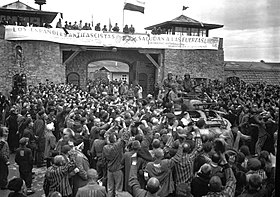
Mauthausen forced labour camp


Today in Social Sciences we have seen our exams about Alphonse XIII, Fascist Italy and Nazi Germany. After that Paqui has said that we have to give her the 4º of ESO book and if we want we can take the 3º ESO book for us. Today some classmates have done the make-up exam because they failed the first one.

After that Paqui has said that she is going to put us a video about 8 spanish survivors that were confined in Mauthausen, a forced labour camp, not an extermination one, in Austria. In this concentration camp there were 140,000 people, 7,000 spanish, and we the camp was destroyed only there were 2,100 survivors.
http://upload.wikimedia.org/wikipedia/commons/thumb/5/51/KZ_Mauthausen.jpg/280px-KZ_Mauthausen.jpg

In this video we could see the experiences in this force labour camp of 8 spanish people ( nowadays only 2 of the 8 men are still alive, they are Manuel Alfonso and Ramón Milá, because the documentary was filmed more or less in 2000). This 8 men told some experiences (good and bad ones) about their time there. Some interesting things that impressed me were the photos, and when one of the men said that he lived near the electric fence, and he could listen to the electricity passing along the fence, and he said “is the death that is passing”. This people received only 1,000 calories and the normal rate for a person during a day is 3,000 calories. They ate for example turnips potatoes, slice of bread, sausage… The people in Mauthausen had to wake up very early and they went to a granite quarry to work there. Some people died there because of their tiredness, and other ones for example were killed by throwing them from a cliff. The people from the video also talk about their clothes. In this clothes they have an special symbol to recognized them, for example the Spanish ones had an S inside a triangle, that means in German “Rot Spanier”, that in English means “Red Spanish”.

http://www.andalan.es/wp-content/uploads/logo_republicanos_espanoles_mauthausen.jpg
Near the Mauthausen camp there was the Gusen, this was a Kommando were they took the people to kill them. In this camp they received only half of food, and they didn’t have any clothes. 
In Hartheim Castle there were the gas chamber, but they use a lot the crematorium.

One thing that had shocked me was that one of these men, Joan de Diego had only 4 fingers in one hand!
All this things were horrible! I like the documentary because you learn a lot, but is too sad and shocking for me… I also like the aria of Puccini's Tosca: E lucevan le stelle, ( one of my favourite) that appeared in this video.

http://www.forumperlamemoria.org/local/cache-vignettes/L220xH280/jpg_Mauthausen_3-b3d8f.jpg
Then the bell rang and Paqui said that if we like this documentary, and she has collected the make-up exams.

We have learned one new word: to broadcast- emitir.

Sorry for the delay, but that's musicians life!

Bye bye

Tuesday, June 19, 2012

Mauthausen, the duty of remembering

As Enrique didn´t write the journal, I´m going to include some information about what we saw in class yesterday. The documentary is called El deber de recordar (The duty of remembering) and it was produced by a La 2 TV program called Línea 900 in 2000. It tells the story of 8 Spanish fighters against Franco and Hitler, who were confined in Mauthausen concentration camp during World War 2. The survivors who appeared in the documentary were Francesc Comellas, Antoni Roig, Joan de Diego, Francisco Batiste, Josep Egea, Mariano Constante, Manuel Alfonso and Ramón Milà. Only Manuel Alfonso and Ramón Milà are still alive. The documentary explains about the hard conditions the prisoners had to put up with, the countless ways of killing the Nazis used and how the survivors managed to remain alive until the camp release on the 5th May 1945. It´s a story of horror and humiliation, but also tells about resistance and solidarity, values no one should forget. 

Here you have the complete documentary:


This is a map of all the forced labour and extermination camps the Nazis created in Germany and the territories they occupied: 


Source: http://www.ushmm.org/wlc/es/media_nm.php?ModuleId=10005196&MediaId=354

And these are some links to learn more about Mauthausen: 

- Information about the structure of the camp and pictures on Remember.org: 

http://www.remember.org/camps/mauthausen/index.html

- Information about Mauthausen in the United States Holocaust Memorial Museum: 

http://www.ushmm.org/wlc/es/article.php?ModuleId=10005196

- Brief story of Mauthausen on the Holocaust Research Project: 

http://www.holocaustresearchproject.org/othercamps/mauthausen.html

- Photographs of the life and death at Mauthausen: 

http://www.jewishvirtuallibrary.org/jsource/Holocaust/mauthpictoc.html

- Mauthausen Concentration Camp official website: 

http://en.mauthausen-memorial.at/

- Report about three of the last Spanish Mauthausen survivors, appeared on El País some weeks ago: 

http://cultura.elpais.com/cultura/2012/05/24/actualidad/1337863342_182744.html

Sunday, June 17, 2012

WW2 animated maps

At Manuel´s request, here you have some links to learn about the different operation theatres of WW2: 

- This is a link to the presentation we saw last week in class. It was made by the Combat Studies Institute, a section of the United States Army Combined Arms Center, located in Fort Leavenworth (Kansas). On this link you can find the battle maps of the European and Pacific Theaters: 


- And this link belongs to the UK National Archives. Every animated map includes an audio explanation of the military operations on each theatre: 


Thursday, June 14, 2012

LAST EXAM OF THE YEAR

Hello everybody!
Today we have taken the exam about The Restoration under Alphonse XIII, The USA crisis and the Great Drepression, Fascist Italy and Nazi Germany.
The structure of the exam was the following:
In the first exercise we had to choose one of the two big crisis of the Restoration under Alphonse XIII. Here we had to choose between explaining the crisis of the "Tragic Week (24th - 2nd August 1909) or the 1917 crisis, the year of the triple protest in Spain (military, opposition politicians and unions' protests). We had to explain the consequences of the crises as well. I have explained the first crisis, the Tragic Week.
The second exercise consisted on choosing four of several concepts that Paqui gave us. I don't remember all of them, but I have chosen Nuremberg Laws, Disaster of Annual, Night of the Broken Glass and Padlock Law. 
The third exercise was about the 1929 crisis in the USA and the Great Depression. Here we had to explain the causes, the development and the decisions made to solve this crisis. I was not sure if I had to explain all the decisions made in the "New Deal" by Franklin D. Roosevelt, and Paqui has told me to explain them. 
The fourth exercise was about Italian Fascism. Paqui has asked us how the Fascists took power, how they imposed their totalitarian dictatorship, and the main features of their totalitarianism. 
And finally, the fifth exercise was about Nazism in Germany. Almost all the students of the class have had problems to understand this exercise. I suppose this is because we were nervous. Paqui has told us not to explain everything!! She says it is not the way to do things. She has told us that we only had to explain the ideology of the NSDAP, how the Nazis took power and what they did to achieve their purposes. I think finally we all have understood it and have done it in the right way. 
As some people have needed more time to finish the exam, we have stayed with Paqui during some minutes of the Math's lesson. It was not a problem because the people of the class were reviewing for the resit exam. 
Paqui has told us that she is sending us our marks this evening so, we'll know our results today! 

P. S. It has been our last European Sections exam... This is very sad :( But that's life. I think we have all learnt a lot this year. Don't you think so?

Wednesday, June 13, 2012

Wednesday, 13th of June.


The symbol of the NSDAP


Today in Social Sciences, today was the last day before the exam of unit 8: The interwar period. So we have dedicated this class principally to correct ours schemes about the Nazi Germany. We have used the PowerPoint presentation of Paqui to correct ours schemes.

We have started saying that the Nazi Germany had similar characteristics to the Fascist Italy. After, Paqui has remembered us that the Nazi party (the NSDAP) had to principal paramilitary groups: the SA or Assault Sections and the SS or Security Sections. Next to this, Paqui has asked for silence, She have said that when She is speaking we have to stay in silence.

The next section of the scheme was how the Nazi party reached power. Before start this section, Paqui has asked for silence again. This section has started with the Beer Hall Putsch, that was a planed Coup d' État in a beer hall in Munich. All the political authorities were celebrating a meeting. The plan failed because the army didn't joint the Nazis. Fourteen Nazis and their principal leaders were arrested. Hitler was sentenced to 5 years in jail, but he only stayed 8 months. In this time, we wrote the "Mein Kampf" (translated: My war), this book is consider the bible of Nazism. Actually, this book is forbidden is Germany. After this, the NSDAP results on the elections were not very good (you can find a summary of the elections on the slide 26 in the PowerPoint presentation of this unit). In January 1933, Hitler was promoted to prime minister. Hitler's first government included 3 Nazis out of 11 minister. Hitler call new elections for the 5th of march of 1933. The Nazis committed arson against the Reichstag (parliament) and they accused the communists. The government declared an emergency decree restricting liberties. Many of the communists were arrested and sent to the concentration camps.

On the 5th of March of 1933, the Nazis won the elections using intimidation and violence against the opposition with the 43% of the votes. They got the absolute majority. Hitler demanded absolute powers in the Reichstag. The Gestapo (secret police) was created and in July the NSDAP was the only legal party. The persecution against the Jews started immediately. On the 10th of March of 1933, the Nazis burnt books considered against Germany: Einstein (Jew), Marx (Jew), Hemingway, Proust, Heinrich and Thomas Mann. The members of the opposition parties started to work in concentration camps, commanded by the SS.

The Night of the long Knives was developed between June and Jule of 1934. Hitler eliminated the opposition inside his party, Ernst Röhm, leader of the SA, and other prominent Nazis were killed.

When President Hindenburg died in August of 1934, Hitler concentrated the post of chancellor and president and the Army swore fealty to him. He was proclaimed "Führer" (guide, leader) of the Germans and proclaimed the 3rd Reich (Empire).

The Nazis excluded the Jews for Germany nationality. In the Night of broken glass (9th November 1938), the Nazis attacked the synagogues and Jewish shops all around Germany. 90 Jews killed and more than 30,000 Jews were arrested to the concentration camps. There were a massive emigration of the Jews to other countries.

In March 1936, they started revising Versailles sanctions of WWI. In this moment, Paqui has said that we are disrespectful because we are speaking when she is also speaking.

Hitler claimed Sudetenland, a Czechoslovakian territory inhabited by 3 millions of German speakers. The main European powers accorded to cede Sudetenland to Germany with the promise that Hitler stop his territorial demands. The European powers saw Hitler as a powerful ally against Stalin. But Hitler didn't keep his promise. The Nazis started to occupied Czechoslovakia and Hitler signed secretly an agreement with the URSS to part Poland in two. Hitler wanted to neutralize the URSS in the invasion of Poland and Stalin wanted to gain time to be ready for the next war against the Nazis.

The 1st of September of 1939, the Nazis started the invasion of Poland using Thunder War: combined attack of artillery and air attacks (Poland was occupied in four weeks). The 3rd of September of 1939, the United Kingdom and France declared war to Germany. And the 17th of September of 1939, the Soviet Union occupied the Eastern part of Poland, Finland, Estonia, Latvia and Lithuania.

Next to this part of the class, Paqui has shown as another PowerPoint presentation with a slides of the expansion of the terriotories that Germany occupied during this period.

In this moment, the bell has rung and Paqui has said to us that study to pass the exam.

Well, this is all we have done is this class. Good luck for tomorrow. Juan Carlos