Wednesday, May 1, 2013

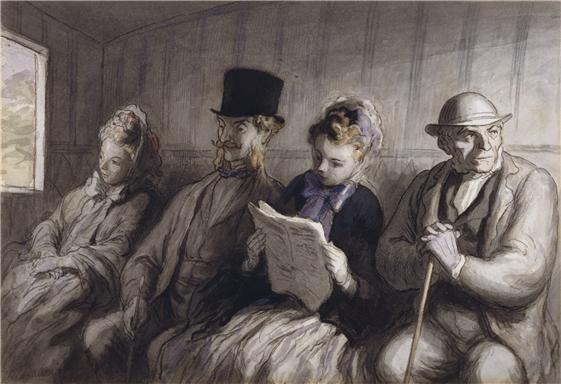
THE THIRD- CLASS WAGON, BY HONORÉ DAUMIER.


THE THIRD-CLASS WAGON, BY HONORÉ DAUMIER.

Source: http://www.friendsofart.net/static/images/art2/honore-daumier-a-wagon-of-the-third-class.jpg


The painting I have chosen is The Third-Class Wagon, by Honoré Daumier. It was painted between 1863 and 1865. At first, people didn’t like it so much because of its ordinary life theme and its technique. It is an oil painting on canvas and its dimensions are 65.4 x 90.2 cm. In 1878 it was bought by Paul Durand-Ruel in Paris (France) and it had different owners. Nowadays, this painting is located at the National Gallery of Canada, which acquired it in 1946. This gallery is located in the capital city of this country, Ottawa.

In the foreground of the painting you can see a family formed by an old woman who has a basket in her hands. On the left there is a younger woman, maybe her daughter, and she is nursing a baby, who maybe can be the brother of the child who is to the left of the old woman. This boy is sleeping and he has a box with him. It seems as if the viewer was sitting in front of the family on the wagon.

Behind the family, in the background there are a lot of people. All them are men. They are painted in a heterogeneous way, so you can distinguish the people very well. We can see nine persons. On the left there are two men who are wearing black clothes and top hats. And there are also more persons who are wearing something on their heads. The painting is very subdued and you can see in everyone’s expressions that they are sad, tired and distraught.

The Third-Class Wagon is also known as The Third-Class Carriage and there are three different versions of the same theme. The one that is finished is located in the National Gallery of Canada and there are other two unfinished versions. 


Metropolitan Museum of New York 

Walters Art Museum of Baltimore 
Source: http://art.thewalters.org/detail/16494/the-third-class-carriage/


This painting belongs to a three-part series which was commissioned by William Thomas Walters. Walters was an American businessman and most known as an art collector. His collection formed the Walters Art Museum. Walters had a big passion for art and he started to collect works from local artists. He and his family went to Paris when the American Civil War started. In Paris he continued collecting art works from local artists such as Jean-Leon Gerome, Antoine-Louis Barye and Daumier. When he returned to America, he invested his money in banking and railroads. And this is why Walters took interest in the life of the passengers who travel in trains. The series he commissioned to Daumier was formed by The First Class Carriage, The Second Class-Carriage and The Third Class Carriage (The Third-Wagon Class).


The First Class Carriage
Source: http://www.artble.com/imgs/f/1/7/314516/the_first_class_carriage.jpg


The Second Class-Carriage
Source: http://www.artble.com/imgs/9/5/f/414525/the_second_class_carriage.jpg


Daumier was a Realist painter and during this period the main purpose of the artists was to represent reality through social themes. Most of them were problems of their society, like the children and women's work, the excessive working hours, the unhealthy housing… and he thought they had to denounce all these things.

On his Third-Class Wagon Daumier represented peasants who are travelling to the city, probably to look for a job. In this way he wanted to denounce the hard life of the popular classes in the big cities. He symbolized the fatigue of the working class in a very good way. A deep silence is noticeable on the painting. We can see that everyone is on their own, they show a big indifference about the persons who are with them and about what is happening on the wagon.  They are looking one another, but they don’t talk. Each figure is individualized and we can see their gestures and expressions of boredom and weariness. The new industrial world was so inhuman.

Daumier dedicated more space to the background than to the foreground, but the figures of the family are bigger, so this means that the family is more important. The family represents three generations: young, middle-age and old people. We can see that the women travel alone, without the presence of a man. The adult woman’s face is sweet, but we can notice the exhaustion in the old woman’s face, maybe because she had a hard life. Undoubtedly her face transmits much affection to the viewer. The boy is sleeping, probably he is tired because he has had to work in a very hard job for a child. Daumier symbolized the isolation and rejection of the family from the rest of society, because we can see the family faced away from the rest of the passengers.

We can see some differences between the three different versions of the painting. For example, in the version of the National Gallery of Canada the colors are cooler and the light is clearer, it’s evident that is daylight. But, as the others are unfinished, we can’t distinguish well. In the two unfinished versions we can see better that there are also women in the background, because their features are clearer. In first painting we can perfectly see a landscape through the windows, but in the other ones we can’t see anything. In the two unfinished paintings there are more people in hats. And the last most evident difference I see is that the boy doesn’t have any box in one of the unfinished versions. But in the three paintings we can see that the lines are very precise and Daumier used black color to enhance the lines, so that we can distinguish all the figures. After preparing the painting with previous drawings, he made the final composition with aquarelle and then he used the grid system to make the painting on the canvas. The light that he used reminds of Rembrandt and the color reminds of Baroque, a style Daumier admired. But the theme of the painting is completely contemporary.

In this period trains had three classes of wagons. Daumier painted the three of them because William Thomas Walters requested a complete series, although he was most interested in the working classes. But Daumier represented the three well. The first-class wagons had better seats, heating and not many passengers in a closed compartment. The second-class wagons were very similar, but with more passengers. And the third-class wagons had wooden benches and they didn’t have heating or compartments. 

Daumier did other similar works about public transport and the working class. This means that he showed affection for the disadvantaged and he was a witty critic with the bourgeoisie. Here you have some of these works:


Voyageurs Appréciant de Moins En Moins Les Wagons de Troisi'eme pendant l'Hiver


Impressions et Compressions de Voyage


Omnibus
Source: http://en.wikipedia.org/wiki/File:HDaumierOmnibus.JPG


Daumier was a prestigious French caricaturist, painter and sculptor. He focused on the society of his time and showed affection for the disadvantaged. When he started losing his sight, he had to leave lithography and he started focusing more on painting. And in the same years he made this painting, he made also The Laundress (1863), which is his most famous painting together with The Third-Class Wagon. Both of them represented the hard lives of workers.


The Laundress


The way he captured people’s expressions and his love by the caricature had influence on the expressionist painters Nolde and Ensor.

I like this painting, because it transmits me very well what is happening on the wagon. When I see it, it seems so real that I’m there with them and I can see their faces and notice their sadness. I like paintings which transmit me something and this is one of them. I also prefer dark and cool colors to clear and warm colors.


Sources:

The Sea of Ice by Friedrich

                                                                  THE SEA OF ICE


The painting I’ve chosen is The Sea of Ice (also known as The Wreck of the Hope or The Polar Sea), by Caspar David Friedrich. It’s an oil painting on canvas and its dimensions are 97 x 127 cm. It was painted between 1823 and 1824; it was exposed in Prague’s Academy and two years later in Berlin. It was very criticized by society because it wasn’t the common landscape painting in those years. It didn’t find any buyer until 1843 (the artist was dead yet). Now, it’s in the Kunsthalle of Hamburg.


The painting represents an accident that took place in the North Pole, an expedition to explore the North-West part of the North Pole. We can see a piece of a shipwreck that has broken the ice into many huge pieces. The sky is almost dark, except for a part, in which we can see a bit of sunlight crossing through the clouds that light up the foreground, leaving the background in the darkness. We can hardly see another shipwreck in the background because of the lack of light. We can also see the details of the ice shadows that give more reality to the painting.

It’s a dramatic image of a shipwreck in the ice. It seems that  there are no life signs inside the ship. The radical nature and subject was greeted in its own day with incomprehension and rejection. The huge pinnacles are the slowly moving icebergs because of the collision. The sky, confused with the disturbing horizon, responds to a use of ranges of grey and blue. The artist placed all the big ice pieces to confer an aspect without falling in the colour monotony. In this painting Friedrich used a triangular composition.

This piece of art can have two meanings: on one side it refers to the political situation in Germany in that period and on the other side, it may refer to the eternity of Nature against the fragile and mortal life of the human beings.

This painting shows the growing pessimism that characterized Friedrich’s life. His work became darker, revealing a fearsome monumentality. This painting is perhaps the one that best represents Friedrich’s ideas, in such a radical way that the painting wasn’t well received.

Friedrich was a romantic painter who tried show his feelings in his paintings, in which the wild nature or the loneliness were usual. He intended his paintings to function as pure aesthetic, so he was thorough with the that the titles given to his work weren’t descriptive or evocative. The titles weren’t given by the artist himself. They were adopted during one of the revivals of interest on Friedrich’s works. He didn’t directly name his paintings, because he thought that everyone has his or her own representation of the painting. So the title was relative.

Friedrich’s paintings aren’t very large-scale paintings, but although they are smaller, they are more humble and detailed works with an ambience that produces a great impact on the viewer. Friedrich’s represent nature, tombs, mist and that special light you only find at dusk and dawn. 

Some of his paintings are:

The Abbey in the Oakwood

Monastery Graveyard in the Snow

Graveyard under Snow 


Later influences
Some Walt Disney’s films drew inspiration from Friedrich’s depictions of nature and they used this inspiration in the movie Bambi.

Also during the 1930s, his works were used as promotion of Nazi ideology, so it took some decades to recover his reputation from this association with Nazism. His reliance on Nazi symbolism contributed to his fall from favour.

Today, Friedrich’s international reputation is well established. He is a national icon in his native Germany and highly recognized across Europe. He is generally viewed as a figure of great psychological complexity. 

I like this painting, because it’s very realistic. I also like the mixture of light and darkness in the background. It perfectly shows the pessimist mind he had in that moment and I have learnt a lot of Friedrich’s life and his complex mind. 

These are the resources that I have used to find information about The Sea of Ice and Caspar David Friedrich:

http://hoocher.com/Caspar_David_Friedrich/Caspar_David_Friedrich.htm

http://en.wikipedia.org/wiki/The_Sea_of_Ice

http://www.artecreha.com/index2.php?option=com_content&do_pdf=1&id=1055

http://www.artehistoria.jcyl.es/v2/obras/6237.htm

http://www.kommunikationsforum.dk/matilde-boye-digmann/blog/kitsch-vs-fine-art-caspar-david-friedrich-walt-disney-and-salvador-dali

http://en.wikipedia.org/wiki/Caspar_David_Friedrich

http://www.artble.com/artists/caspar_david_friedrich

http://temakel.net/artetesisfriedrich.htm

http://www.artehistoria.jcyl.es/v2/personajes/1974.htm

http://www.museothyssen.org/thyssen/ficha_artista/215

http://www.ibiblio.org/wm/paint/auth/friedrich/

http://www.caspardavidfriedrich.org/ http://www.wga.hu/frames-e.html?/html/f/friedric/3/309fried.html

The images are from Google images

The Raft of the Medusa


The Raft of the Medusa  (Le Radeau de la Méduse) 


This painting is The Raft of the Medusa (Le Radeau de la Méduse) by Théodore Géricault. It was painted between 1818 and 1819, when he was 27 years old. Its dimensions are 491 cm x 716 cm and it´s an oil painting on canvas. It provoked fascination in the 1819 Paris Salon and the Louvre Museum bought it. At the moment, The Raft of the Medusa is exhibited in the Painting Department of the Louvre.

On this painting you can see the unfortunate shipwreck of the Méduse, a French ship. The people are in a raft struggling to survive. Some of them are dead and the others are surprised because they have seen a ship in the distance and they are trying to attract its attention. There are some big waves around them and the weather is very bad. The wind is blowing and it moves the sail of the boat. We can also see a person holding a corpse. He is wearing a red fabric over his body and his expression makes us think about the torture of that moment. It´s not a very colorful painting, but it represents the moment very well.

The painting refers to a real shipwreck occurred on the 5th of July 1816 in Mauritania. The French navy frigate ran aground off the coast near Mauritania when they wanted to colonize Senegal. In that ship, there were 400 passengers, including Captain Julien-Désiré Schamltz and his wife Reine Schalmtz. After the collision, the survivors were distributed into six boats, but there was not enough space and 147 persons were piled on a raft. 132 of them died at the sea and only 15 survived. The survivors had to resist hunger, thirst and cannibalism. They endured 13 days at sea until they were rescued on the 18th of July of that year by the Argus, another ship. After that, they were taken to a French hospital. They tried to reform their lives, but some of them couldn´t, due to their consistent fear to life. Théodore Géricault became interested in this history when he read a book about it. The painter started the painting with some sketches and he built a model of the raft in his studio, to make it as real as possible.


Model of The Raft of the Medusa during the crew rescue. 

Source: http://en.wikipedia.org/wiki/File:Raft_of_M%C3%A9duse-Alexandre_Corr%C3%A9ard-IMG_4788-cropped.JPG


This painting was an international scandal, because it reflects the incompetence of the French captain during the restored French Monarchy. The classicists criticized the painting as a “pile of corpses” and they said that it didn´t represent the ideal of beauty of Romanticism. The author looked for the survivors to ask them and to know the color and the texture of their discolored hands (due to the shipwreck). 

The painter made this painting following three lines: the boat, the background and the sea. He drew the boat and the distance ship shortly than the reality. As we can see, the wind blows in the opposite direction with respect to the ship in the distance. Géricault wanted to represent that the boat goes to the death and the survivors are doing the impossible to call the attention of the ship. They form two triangles covering all the space of the raft, which represents the madness and the despair of the survivors. The first triangle is made by most of the people and the sail of the boat and the second one is made by the people who are calling the ship in the distance.


The painter used the perspective in this painting to represent the vastness of the ocean. He represented the boat very small with respect to the ocean where they are. He also made this to represent all the people in the raft without any omission. For this painting, the author used dark colours to represent the dramatic situation they were going through. The contours of the figures are inaccurate.

This painting belongs to the Romantic Movement. Géricault used dramatic scenes and a break of the calm present in the Romantic style. His painting influenced artists such as Eugène Delacroix, J. M. W. Turner, Gustave Courbet and Édouard Manet.

I like this painting because it represents the moment of the rescue very well. It has good colors and figures. It´s a very dramatic scene based on a real history and it´s like a photo taken in the middle of the sea in that moment.


Sources: For more information about the history and the type of painting.

http://artandperception.com/2007/10/gericaults-the-raft-of-the-medusa-by-tree.html
http://www.thompsondunn.com/newsletter2/page16.html
http://www.readwritethink.org/files/resources/lesson_images/lesson1142/RaftRomChat.pdf
http://www.historyhouse.com/in_history/medusa/
http://www.independent.co.uk/arts-entertainment/art/great-works/great-works-the-raft-of-the-medusa-1819-491x716-cm-th233odore-g233ricault-2203558.html
http://www.louvre.fr/en/oeuvre-notices/raft-medusa