Showing posts with label Baroque. Show all posts

Tuesday, October 13, 2015

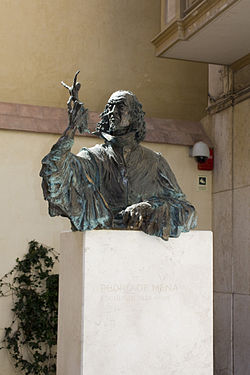
This day in history: Pedro de Mena's death

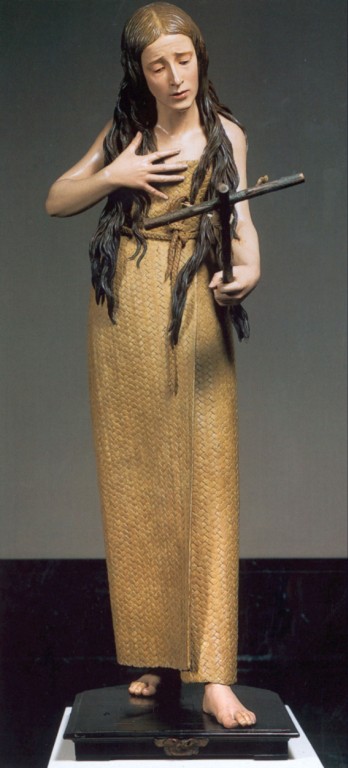
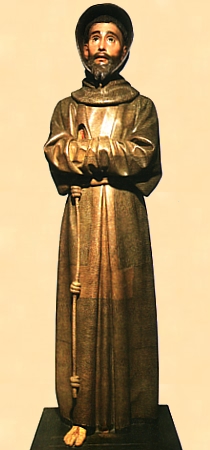
On the 13th October 1688 Pedro de Mena, one of the most important Baroque sculptors, passed away in Málaga. He was one of the most outstanding sculptors of the Baroque Andalusian school. He worked mainly for the Church and sculpted works for the cathedrals of Málaga and Toledo. Here you have some of his main works. You can include some of them on your travel journal: 


Penitent Magdalen


Saint John the Baptist


Ecce Homo


Saint Francis of Assisi

Monday, October 5, 2015

Art project: travel journal to Baroque art


These are the guidelines for the individual project you are going to do about art  in the 17th century:

Imagine that you are a time traveller and an art lover. Your next trip will be to the 17th century to learn about the art  of this century. Your project will consist of making a travel journal with the following contents:

 - The content of the project is Baroque art in Europe and in the Hispanic Monarchy, including architecture, sculpture and painting.

- Main features, artists and works of Baroque art, narrated as in you were visiting the times and significant places of this period.

- In addition, you will have to choose your favourite art work of  the most important artists of every place, write a short biography of its author, an explanation of the work and your personal opinion about it. For example: in architecture, the most important architect in Italy was Bernini. You should write a short biography of him and choose your favourite architectural work of this artist and why you like it.

- Every stage of your trip will have to include images of the main works and artists. They can be printed images  or drawings you make.


- The format of your travel journal is free: it can be a real journal, bought or made by you with cardboard or another material you prefer, it can also be a video journal, but it has to have the structure of a journal.

The deadline to hand in this project will be the 29th October (Thursday). You have four weeks to do it, so plan your work and don't wait until the last day.

ATTENTION: If your project is superficial or incomplete, you will have to take the exam of these contents.

This afternoon I will upload some pictures of the travel journals last year students did. This way you will have an idea of what you can do if you work hard. 

Here you have some advice about how to make an original travel journal on paper, creating beautiful backgrounds for your pages:

http://rondapalazzari.typepad.com/helpmeronda/2014/06/create-daily-travel-art-journal.html

http://taconescongracia.blogspot.com.es/2013/05/album-del-primer-taller-de-art-journal.html

https://aworkofheart.wordpress.com/tag/art-journal/

Use your imagination and enjoy the trip!

Thursday, November 20, 2014

THE NIGHT WATCH, REMBRANDT

The Night Watch

Rembrandt van Rijn

The Night Watch is a painting made by Rembrandt Harmenszoon van Rijn in 1642. It was painted with oil painting on canvas. Its sizes are 363 x 437 cm. Rembrandt  received the commission to paint The Night Watch for the Kloveniersdoelen, the guild hall that housed the Amsterdam civic guard company of musketeers. 

The work shows Captain Frans Banning Cocq and his lieutenant, Willem van Ruytenburgh, surrounded by sixteen of their men, other people were added later.


It is present in the Rijksmuseum, Amsterdam. In 1715 it was cut to make it smaller, we can know its real sizes because there are some copies of the painting. It has also suffered different vandalism attacks but it has been successfully restored. 

Original sizes of the painting
Rembrandt didn’t use a single painting technique, as we can see in The Night Watch, there are elements worked in detail while others seem to be painted quickly. Rembrandt used chiaroscuro’s technique in his paintings with its emphasis on the mysterious, evocative qualities of shadow.

Here we can see some features of this painting:


The Night Watch’s action wasn’t happening during the night and so that wasn’t its original title. When the critics and the public attached that word to the painting, the canvas had become very darkened by dirt and layers of varnish and it seemed to be at night. Its original title was Company of Captain Frans Banning Cocq and Lieutenant Willem van Ruytenhurch.

Sources:

Altarpiece of San Esteban Salamanca (José de Churriguera)

The Altarpiece of San Esteban Salamanca (José de Churriguera) was a grandiose altar made by José 
Benito Churriguer, whose construction required more than four thousand pieces of wood, 
inagurating  the 18th-century Baroque architecture in Spain. It was designed in 1693 a, by Churriguera who had become famous in Salamanca in 1689 with his design of a huge catafalque for the funeral ceremony of Dona 
Doña María Luisa de Borbón,  Charles II's wife. José belonged to a family of Salamanca architects who 
enriched their city with some very fine monuments.

The San Esteban altarpiece is the first example of the so 18th-century  called Baroque style "entallador", which
obtains its effects from the rhythm of the decorated surface, supported by a robust, monumental 
structure.

The work of José de Churriguera, crowning the head of the church, has six large twisted columns, covered with decorative foliage.

In the center there is a tabernacle conceived as a pavilion, flanked by a pair of columns on each side, and between those  two columns at the edges stand niches that harbour the sculptures of St. Dominic of Guzmán and St. Francis of Assis, attributed to the designer of the altarpiece. Centered above there is a painting by Claudio Coello whose theme is the martyrdom of St. Stephen. Everything is covered with gold and richly decorated, resulting in one of the most monumental Spanish Baroque altarpieces.


We can fin it in the Convento de San Esteban is a Dominican monastery situated in the Square of the Council of Trent in the city of Salamanca.

Baroque architecture like to excite and draw the people's attention. These are the main Baroque features in this monument:


                                                                                                                                                                                       - The use of the curved line in both building structures and decoration.                                                                                                                                              -Emphasizes the use of Solomonic columns, which are spiraling, and gives a sense of mobility.                                                                                                      - The use of lighting effects in buildings through concave convex movement                                                                                                                                           - The abundance of decoration and ornaments on the facades and interiors.                                                                                                                                             - Riches of materials, especially in churches, to produce a sense of luxury Baroque architecture like to excite and draw the people's attention.


                                                                                           Source:
                                                     http://en.wikipedia.org/wiki/Convento_de_San_Esteban,_Salamanca

Born in Madrid in 1650. Jose Simon Churriguera  and his sons José Benito, Joaquin and Alberto. were a family of architects and sculptors active in Castile during the 17th and 18th centuries. Churriguera Joseph Simon was born into a family of artists and where his son José Benito Churriguera, the chief sculptor and architect of  the family, to which the name of 

style 'churrigueresco' is due to be born applies to work performed by him and some of his brothers, in which recharging is essentially decorative and dominant over the supporting elements to the point of hiding them in some cases  One of his first works was the altarpiece of the church in the Convent of San Esteban (Salamanca), whose structure would be inherited by the majority of Spanish churches. In 1687, he won the contest for making the catafalque for Queen Marie Louise of Orleans, wife of Charles II. In 1709 he began his most ambitious work, in the municipality of New Baztán in the east of Madrid
commissioned by the banker Juan de  Goyeneche
This urban work included a church, a palace, housing for the 
workers, a factory, offices and an industrial glass oven. He died in Madrid in 1725.                                              

Portrait of José de Churrigera


Sources:


Church of Saint'Ivo alla Sapienza, Borromini

This church was commissioned by the Pope Urban VIII. It was built between 1642 and 1660 in Rome. It's made of gypsum and stucco. 

The church has an hexagonal floor plan in the center of the church. The floor plan was adapted because before it existed a palace before. Borromini built a dome with convex and concave lines.

Source: http://commons.wikimedia.org/wiki/File:SantIvo_Drawing_09.jpg

Souce: https://azukarillo.wordpress.com/2012/03/01/cupula-de-santivo-alla-sapienza-de-borromini/

The facade is totally convex and there is a patio surrounded by columns. In the facade you can see a lot of small windows.

Source: http://www.paradoxplace.com/Perspectives/Rome%20&%20Central%20Italy/Rome/Rome_Churches/SantIvo_alla_Sapienza/Sant_Ivo.htm

We can observe many of the Baroque features in this building: predominance of movement, interest in surprising or moving the audience by provoking feelings in them, use of symbols...

Sources:

Penitent Magdalen, Pedro de Mena. Nuria Iniesta

Penitent Magdalen, Pedro de Mena.

This sculpture was made for the casa profesa of the Jesuits in Madrid during a voyage of Pedro de Mena to Madrid. It was finished in his studio of Malaga in 1664.

Technical data:
  • Size, dimensions: 171 cm x 52 cm x 61 cm
  • Material used: Polychromed wood, carving.
  • Actually, this sculpture of Pedro de Mena is on the National Museum of Sculpture, Valladolid.

The Penitent Magdalen is distinguished for the simplicity of its forms. She looks like a young and Hebrew woman. This sculpture is the living image of penance and repentance. It is made up of polychromed wood. The colors are inside the ocher and brown variety, very appropriated with the theme and spirit that Pedro tried to transmit with this sculpture. This is one of the finest examples of the realistic language of Spanish Baroque sculpture, steeped in emotion and religiosity.


Mary Magdalen contemplates a crucifix she holds in her left hand. Her right hand is on her bosom, indicating her love and devotion to Christ. She feels empathy for Christ's suffering. The movement begun by her left foot represent a dynamic pose. She has a sad look with red eyes, caused by tears and her mouth is slightly open and dry. For the long and flowing hair, Pedro de Mena used several strands of twisted wicker, painted with a chestnut colour. She is wearing a simple long dress, down to his feet and tied around her waist with a rope. X-radiography has revealed that the main body of the figure was created from a column of wood to which Mena attached the separately carved body parts using animal flue and long nails.

The theme of the Penitent Magdalen is a representation of the repentance of the Cristian believers. This sculpture it isn’t very common at the time and in the Andalusian school neither. There aren’t many sculptures of this style during the Baroque period in Spain.
It is a sculpture with a lot of realism that transmits a spiritual value that shows the influence of some Castilians sculptors, like Gregorio Fernández.


In this sculpture we can recognize different features of the Baroque style, like: movement, realism in representations, interest in surprising the audience, capturing fleeting moments,  use of curved lines and cloths folds…

The subject belong to be religious, representing drama and realism, using: wounds, blood, expression of suffering (like the Penitent Magdalen) and pain.

Pedro de Mena

Pedro de Mena was a Spanish sculptor who is considered the most famous representative of Granada during the Baroque period in Spain. He dedicated his life's work to producing sculptures about religious imagery, just as his father had done before him. He shared his workshop with a famous Spanish sculptor and artist, Alonso Cano. As a result, the pair worked together and collaborated in many projects during their lives.


Pedro de Mena has been one of the best sculptors of all time, he was able to create naturalistic iconographic on the Granada school, and he was one of the most influential sacred sculptors in the Spanish religious art during the 17th century until today.

He kept alive the Granada school and he created the focus of sculptors from Malaga. He had influence one hundred and fifty years after his death. 

Sources

Atlas ilustrado de la Historia del Arte, Susaeta.
Historia del Arte, Vicens Vives. J. R. Triadó Tur, M. Pendás García, X. Triadó Subirana.

The Calling of Saint Matthew, Caravaggio

Source: http://biltrix.com/2012/09/21/caravaggio-the-calling-of-saint-matthew/

This painting was commissioned by the cardinal Francesco del Monte. It was painted between 1599 and 1600 for the chapel of San Luigi dei Francesi, Rome. It's an oil on canvas painting with a size of 322x340cm.

Source: http://www.abcroma.com/GalleriaFotografica.asp?Inizio=82

The painting represents Christ calling Matthew, who is sitting in the tax office with other people. On the right we can see Christ pointing at Matthew, and on the left we can see a group of people, among which Matthew is sitting.

Colour is predominant over the drawing and the landscape is secondary. People in the painting are dressed like in the 17th century, but this is a Bible story. Colours are warm and they have textures of velvets and soft fur. The painter has divided into two different parts one on the right in a vertical rectangular way and the other one on the left in a horizontal block way.

The subject is biblical. Caravaggio represented the calling of Saint Matthew: according to Matthew's Gospel. Caravaggio took inspiration from the Creation of Adam of Michelangelo.

Source: http://en.wikipedia.org/wiki/The_Creation_of_Adam

We can observe many of the Baroque features on this painting: use of oil painting, predominance of colour over drawing, use of warm colours, contrast of light and shadow, realism, movement, foreshortened figures, asymmetry …

This painting belongs to a collection of the life of Saint Matthew: The Inspiration of Saint Matthew by Caravaggio and The Martyrdom of Saint Matthew by Caravaggio. The painting is now in the chapel of San Luigi dei Francesiin the city of Florence.

Source: http://www.pinterest.com/pin/338262621986554223/

Source: http://www.friendsofart.net/en/

Other artists painted the same theme painting: Hendrick ter Burgghen and Bernardo Strozzi.

Sources:

The Anatomy Lesson of Dr. Nicolaes Tulp (Rembrandt)

The Anatomy Lesson of Dr. Nicolaes Tulp (Rembrandt)  is a painting of the Dutch painter Rembrandt.

It was painted in 1632. It is an oil painting on canvas, its measures are 169.5 cm high and 216.5 cm wide. It is kept in the Mauritshuis in The Hague (Netherlands).

It was the first portrait painted by Rembrandt, who was 26 years old. It was commissioned by the powerful guild of surgeons, of which Doctor Tulp, a famous physician of Amsterdam, was an eminent representative. An anatomy piece of this kind has a central motif, an anatomy lesson, and a protagonist, the praelector or reader. This painting was occasioned by the anatomy lesson that Tulp gave in January 1632. Twice a week a leading physician gave the Amsterdam surgeons a theory lesson. One element of this extra training was attendance at practical demonstrations in the anatomy theatre in order to gain a greater understanding of human anatomy.

In 1828 the public sale of this painting was decided in favor of the box of widows of surgeons. King William I forbade the sale and ordered to buy this masterpiece for his "royal cabinet of paintings."


                                        Source: https://www.flickr.com/photos/eoskins/6231528429/

The main Baroque painting characteristics we can observe in this painting are the use of oil painting, predominance of colour over drawing and contrast of light and shadow.
                                             
Rembrandt was born in Leiden on July 15, 1606 - his full name Rembrandt Harmenszoon van Rijn. He was the son of a miller. Despite the fact that he came from a family of relatively modest means, his parents took great care with his education. Rembrandt began his studies at the Latin School, and at the age of 14 he was enrolled at the University of Leiden. The program did not interest him, and he soon left to study art - first with a local master, Jacob van Swanenburch, and then, in Amsterdam, with Pieter Lastman, known for his historical paintings.

He painted numerous dramatic masterpieces such as The Blinding of Samson (1636, Städelsches Kunstinstitut, Frankfurt)he Jewish Bride (1665), The Syndics of the Cloth Guild (1661, Rijksmuseum, Amsterdam), Bathsheba (1654, Louvre, Paris), Jacob Blessing the Sons of Joseph (1656, Staatliche Gemäldegalerie, Kassel, Germany), and a self-portrait (1658, Frick Collection).

Portrait of Rembrandt
                                                                                   Source: http://spreekbeurten.info/rembrandt.html

If you like this kind of art and you like this painting see this vídeo to learn more about Rembrandt's painting (and some human anatomy).


                                        Source: https://www.youtube.com/watch?v=lM-jTWC9jFU

Sources:

http://www.rembrandthuis.nl/en/rembrandt/belangrijkste-werken/de-anatomische-les-van-dr-nicolaes-tulp

http://www.rembrandtpainting.net/rembrandt_life_and_work.htm

http://es.wikipedia.org/wiki/Rembrandt

http://en.wikipedia.org/wiki/List_of_paintings_by_Rembrandt

Facade of Obradoiro, Fernando Casas Novoa


FACADE OF OBRADOIRO IN SANTIAGO OF 
COMPOSTELA

The Facade of Obradoiro, which is a work of art from the Baroque period, was built by Fernando Casas Novoa in Santiago of Compostela, between 1738 and 1750. The Catholic Church commissioned this facade.
                                                             
This beautiful building has a great use nowadays. As you should know, an old tradition tells that this cathedral is the sepulcher of the apostle Saint James. This transformed the building in one of the principal places of pilgrimage in Europe during the Middle Ages. At present, it is also an important place of pilgrimage and every year that the 25th of July (Day of Santiago) is Sunday, there is a Jubilee Year, many pilgrims go to the cathedral and there is an important mass.                     


The main material used in this work of art was the gray granite, which was the main material used in the Baroque architecture. Glass was also used in this work.

 The Facade of Obradoiro has really big large windows that allow light to illuminate the old Romanic facade, and it is between the Bell’s Tower and the Carraca’s Tower. In the middle of the facade, the apostle Santiago is represented, and below him his two disciples, Athanasius and Theodore, all of them dressed as pilgrims. In the middle there is also a glass case, representing Santiago’s sepulcher, and a star between angels and clouds. On the right tower, María Salomé (Saint James’s mother) is represented and on the left tower, Zebedee, his father. This work is in a square, the Square of Obradoiro, this is why the facade was called in this way. The cathedral has  really big proportions, it is 74 metres high.


The Facade of Obradoiro is a Baroque work of art because the images represented on it give a lot of movement to the building. It also has curved lines, games of lights and shadows… The images of the building are also very realistic and perfect. 

One curiosity is that the coins of 1, 2 and 5 cents have the Cathedral of Santiago drawing in one of their sides. 


Sources used in this projectc: