Here you have the trailer of the 2003 film inspired on the painting, where you can learn how Vermeer painted and the typical life in the city of Delft in the 17th century. You will see many of the paintings we have seen in class today:
Showing posts with label painting. Show all posts
Showing posts with label painting. Show all posts
Friday, October 21, 2016
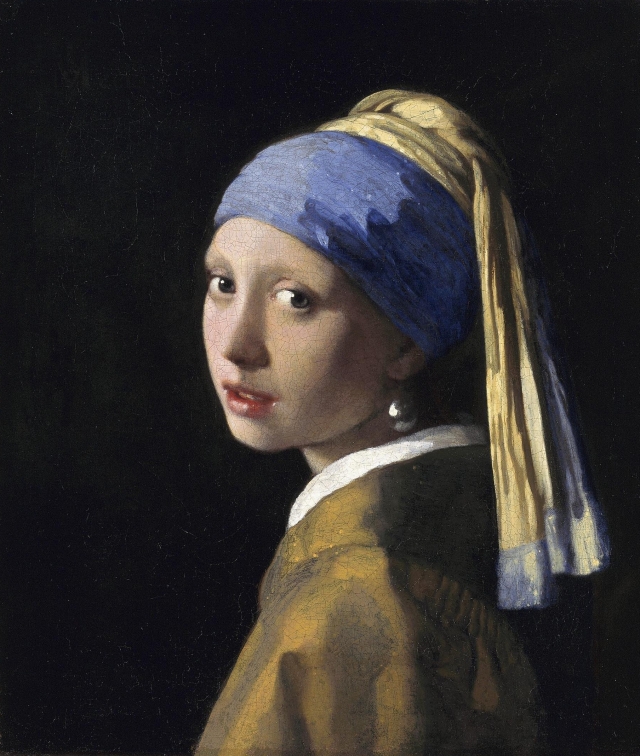
The Girl with the Pearl Earring
This short video explains why this Vermeer's painting is considered to be a masterpiece:


Thursday, October 8, 2015
Do you want to help me rebuild the art wall?
As I have told you this morning, I would like to rebuild the art wall we mede in class two years ago. If you have a colour printer and you want to collaborate with me in this task, here you have some instructions about how to do it:
- Choose one painting you like. In order not to have repeated paintings, I'll make a list of paintings and you can choose the one you prefer. The purpose is that the wall includes some of the most representative paintings of every art style.
- As the tiles of the class measure 20 x 20 cm, the paintings should be 20 cm wide and not more than 20 cm high. Use the Word ruler to know the measures of the painting you've chosen. It's better that you print the images horizontally, except Here you have an image where you can see the rule:

- The title of the painting has to be written with the Calibri font, size 16 and in bold. First we'll write the title in Spanish, a hyphen and finally the name in English. All this has to be written in the same line. The author's name will be written in a second line, below the title.
If you want to cooperate with this project, please leave a message in the comments' section. Thanks!
Saturday, November 22, 2014
THE GIRL WITH A PEARL EARRING, VERMEER
The Girl with a pearl earring was
painted by Johannes Vermeer. The author was born in 1632 and he died in 1675 in
the Low Countries. The current documentation shows that Vermeer wasn't a
famous painter in his period despite now is the most representative Dutch figure
of the 17th century. Probably Vermeer is famous due to his way of painting with strength
in their compositions and for the use of clear and shiny colours.Vermeer represents daily life scenes in his paintings.


We can
distinguish the contrasts and the shadows, the background is darkest than the
foreground because the painter used contrast of lights and colours to show the woman
better and in a first ground.
The painting
had, obviously, Baroque features: use of oil painting, predominance of colour
over drawing, warm colours, contrasts, movement…
Nobody knows
who the girl is, but there are some ideas of who can be:
-His older daughter,
Maria.
-The daughter
of his commissioner who had the same aspect as the girl in the painting.
-Griet, the
servant.
Vermeer made more paintings like The Girl with a pearl earring: The Girl with a flute and Study of a Young Woman. The three were included in the Dissius catalogue of 1696 due to their representations.
Sources:
I have found the photos in these sources.
Thursday, November 20, 2014
THE NIGHT WATCH, REMBRANDT
 |
| The Night Watch |
 |
| Rembrandt van Rijn |
The Night Watch is a painting made by Rembrandt Harmenszoon
van Rijn in 1642. It was painted with oil painting on canvas. Its sizes are 363
x 437 cm. Rembrandt received the
commission to paint The Night Watch for the Kloveniersdoelen, the guild
hall that housed the Amsterdam civic guard company of musketeers.
The work shows Captain Frans Banning Cocq and his lieutenant, Willem van Ruytenburgh, surrounded by sixteen of their men, other people were added later.
It is present in the Rijksmuseum, Amsterdam. In 1715 it
was cut to make it smaller, we can know its real sizes because there are some copies of the painting. It has also suffered different vandalism attacks
but it has been successfully restored.
 |
| Original sizes of the painting |
Rembrandt didn’t use a single painting technique, as we can
see in The Night Watch, there are elements worked in detail while others seem
to be painted quickly. Rembrandt used chiaroscuro’s technique in his paintings
with its emphasis on the mysterious, evocative qualities of shadow.
Here we can see some features of this painting:
The Night Watch’s action wasn’t happening during the night
and so that wasn’t its original title. When the critics and the public attached
that word to the painting, the canvas had become very darkened by dirt and
layers of varnish and it seemed to be at night. Its original title was Company
of Captain Frans Banning Cocq and Lieutenant Willem van Ruytenhurch.
Sources:
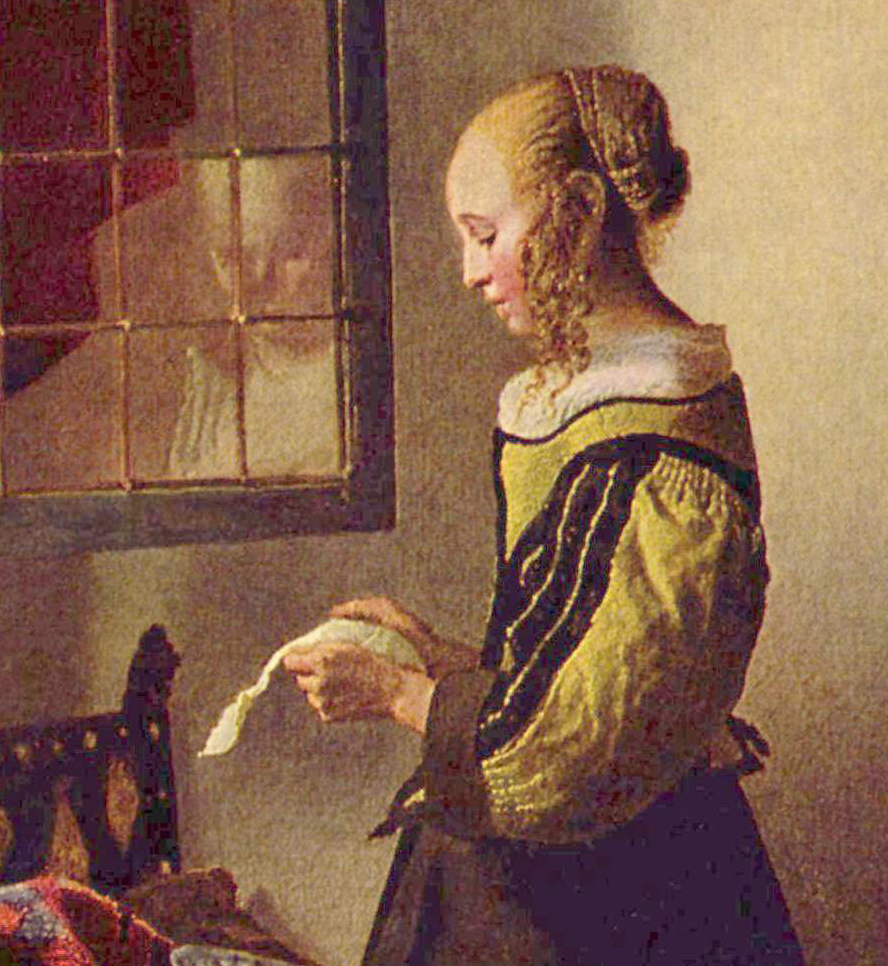
Girl Reading a Letter, Vermeer

Now this painting is at the Gemädegalerie in Dresde. But this painting before it was attributed to Vermeer in 1680 this painting was attributed to two painters, who were:
-Rembrandt in 1742
-Pieter de Hooch in 1826
As I have already said this painting is an oil painting on canvas, the style used by Johannes Vermeer in this painting is very similar to the style used by Rembrandt in his paintings and this is why in 1742 Augustus III of Poland attributed this painting to Rembrandt.
Apart from this, with respect to the technique Vermeer used for this painting it is very usual in Baroque Art, he used a dense brushstroke in the light, with enough impact, and more diluted painting in the shades. Also related with the techniques he uses; he uses like Rembrandt we can observe certain visible "pentimenti" in diverses places of the picture, for example in the right angle in the skirt of the protagonist, testifying that Vermeer changed the composition during the development of the painting.
 The picture shows us the corner of a room, with the presence of a woman, reading a letter opposite to an opened window. Although the woman is not in front of the view of the people it is possible to see her face thanks to the reflection of the crystals of the window. The figure occupies a small space in comparison with the total size of the painting. In the first ground a table covered by a carpet appears. This carpet and this plate with fruits are the same that we can see in other works of the same artist.
 The principal simbol of this painting is the presence of the opened window, it indicates the desire of the lady to be opening to the exterior world.
One of the most apparent pictorial features in this painting of the Baroque style in this painting is the "chiaroscuro". It consists of making effect of light on objects and prominent figures, creating a few effects promoted of lights and shades to call the attention of the people.
To end with this project, I have to say that the importance of this painting in the history of art is that this painting represents the beginning of Pointillism.
SOURCES
Other things I have written are said by me analyzing a little the
painting.
The Waterseller of Seville
The Waterseller of Seville, by Velázquez
.jpg)
http://es.wikipedia.org/wiki/El_aguador_de_Sevilla
The Waterseller of Seville is a Baroque painting by the Spanish painter Diego Velázquez (he was the main representative painter of Baroque
in the Hispanic Monarchy) The painting was finished in 1620 and nowadays it’s
located in The Wellington Museum in
London. The story of why the painting is in London
is the following: At first the painting was a present for the
priest Juan de Fonseca and it
was used to let him in the Court of Madrid, then Ferdinand VII gave the
painting as a present for the British general Arthur Wellesley to show gratitude for the British collaboration in the Peninsular
War.
It belongs
to the Baroque movement and it also belongs to the first painting stage of
Velázquez, in this stage he painted many paintings which have religious and ordinary themes (as this one)
The dimensions of the painting are: 106 x 82 cm and its technique is Oil on canvas (predominant since the Renaissance)
The painting is representing a daily situation, in which a waterseller, a young boy and a man in the background drinking something, are represented. The theme of the painting is simple: the portrait of a waterseller but there’s a theory that says that this painting is like an allegory of the three ages of the man. And there is also a theory that says that the young boy is the same boy who appears in another Velázquez’s painting: Old Woman Frying Eggs

http://es.wikipedia.org/wiki/El_aguador_de_Sevilla
Velázquez
in this painting used a large range of brown and ochre colors, and also the
contrast between the dark background and the foreground is an important feature
of the
Waterseller of Seville. The composition is complex, because the
painting is divided like in two triangular blocks, on one side we have the
triangle in which the heads of the men are, and on the other side we have the
triangle in which the two vases and the glass of water are.
There’s a
detail inside the glass of water:

(I have made this photo)
As a painting of the Baroque period, The Waterseller of Seville, has many Baroque’s painting features: The painter received a lot of influence by the Italian painter Caravaggio through copies of his works which came from Italy to the Iberian Peninsula.
- A great realism (you only have to see the great detail of the glass of water of the dents of the vane)
- Contrast of light and shadow
- Complex composition
- The technique was oil on canvas
A curiosity about the Waterseller of
Seville is that Velázquez made three different versions of the painting:

(I have made this photo)
SOURCES
- http://en.wikipedia.org/wiki/The_Waterseller_of_Seville_(Vel%C3%A1zquez)
- http://totallyhistory.com/diego-velazquez/
- http://www.arteespana.com/velazquez.htm
- http://www.miguelgual.com/lasimagenes/comentarios/60Barroco/Velazquez/El%20Aguador%20de%20Sevilla.htm
- http://www.artehistoria.jcyl.es/v2/obras/25.htm
- Book of “Artis, Historia del Arte (Bachillerato Segundo Curso)”
- “Espasa enciclopedia”
Main Square of Salamanca, Alberto Churriguera

https://www.flickr.com/photos/marcp_dmoz/4505026416/
The Main Square of Salamanca was built
by the architect Alberto Churriguera
in Salamanca, Spain, as an imitation of the Main Square of Madrid,
but as Churriguera died before, Andrés García de Quiñones finished the square. It belongs
to the Baroque period in the Hispanic Monarchy and its construction was agreed
in 1710 while Philip V was staying in Salamanca. He wanted to reward the city
for its loyalty in the War of Spanish Succession. The construction started in
1729 and it ended in 1755. The built of the Square was commissioned by the Gentleman Mayor Rodrigo y Llanes and
the main function of the Square was to regularize the space and at the same
time to create a place for public meetings. The material used for the building
was the stone from Villamayor (this was a very usual material used in buildings
because it was very easy to manipulate)
Churriguera’s work of art has a trapezoidal shape
(it isn’t a perfect square), the area is about 6,500 m2 and it has 3 floors. In the facade, there are a total of 88 semicircular arches
which have 89 medallions. These medallions have the faces of some kings,
conquistadors… All of them were made by the sculptor Alejandro Carnicero. Talking about the facade, we appreciate that
the wall has a total of 247 balconies and that it has a lot of ornamental
motifs: medallions, canopies… so, this made the Main Square of Salamanca’s
façade a more decorative facade that the one of the Main Square of Madrid.

http://www.photaki.es/foto-madrid-plaza-mayor-vista-de-dos-de-sus-fachadas_190395.htm
.JPG)

http://otraorillahistoria.forosactivos.net/t3046p20-arquitectura-y-urbanismo-1-
mitad-s-xviii
As
the Churriguera’s work belongs to the Baroque period, we can appreciate some of
the characteristics of the buildings of this period, for example:
- Decorative exuberance in the interior and the exterior of the building
- There are curved lines
- The statues in the roof, the facade, the balconies... all this has Baroque features.
- Some columns have Corinthian style
- The building has uniformity and homogeneity (except the town hall)
- Other Baroque features are the semicircular pediments over the windows and the grandeur or majesty of the bug square, similar to French Baroque.

(I have made the red circles and the information on the white gaps)
But The Main Square of Salamanca has also some features that aren't the ones of the Baroque, for example some columns inspired in the classical era and the type of floor plan wasn't typical of the Baroque.
SOURCES
- Book of “Artis, Historia del Arte (Bachillerato Segundo Curso)”
- http://www.salamancaturistica.com/salamanca/monumentos_plazamayor.php
- http://www.jdiezarnal.com/plazamayordesalamanca.html
- “Espasa enciclopedia”
Saint Hugo of Grenoble in the Carthusian Refectory, Francisco de Zurbarán.
This painting was started by Francisco de Zurbarán in
1655. The painting was for the “Painters Professional Asociation” of Seville. It
was painted in Seville, one year later after Zurbarán’s arrival to the city. It
was commissioned by the Fine Arts Museum of Seville.

Source: http://blogs.artinfo.com/secrethistoryofart/2011/03/02/inside-the-masterpiece-zurbarans-saint-hugo-in-the-refectory/
This painting has a size of 267x320 cm. The material
used is oil painting, technique that was predominant in the Baroque. The
painting is found in the Fine Arts Museum in Seville.
This painting represents a miracle that happened in
the Carthusian Refectory. They were seven, and Saint Bruno was the founder of
the Carthusian and they all ate due to Saint Hugo’s (bishop of Grenoble)
generosity. One Sunday, he sent them meat. Like they weren’t used to eat meat,
this brought them to a discussion of the abstinence, and while they arguing
they all became asleep. This dream lasted all the Lent, till the third day of
the Holy Week, the Wednesday. That day, the Carthusian woke up and Saint Hugo
visited them, and then suddenly, the meat transformed into ashes. This moment
is interpreted like an approbation of the abstinence of meat.
As this painting is baroque it presents the following
characteristics:
- · Use of oil painting. This painting is made with oil painting only.
- · Predominance of colour over drawing. We can observate a lot of colour in this Zurbarán’s painting, just the opposite as in Renaissance Art.
- · Warm colours, contrast, realism, movement, complex competitons to stoch the audience. We perceive the sensation of movement in the painting, and also we perceive the absence of cold colours: they’re all warm. Realism is also present, and that imply the sensation of movement.
Another interesting information is that the White
Colour of the Carthusian’s clothes reaches 100 different hues.
Here you have a portrait of Francisco de Zurbarán:

Source: http://es.wikipedia.org/wiki/Francisco_de_Zurbar%C3%A1n
My encyclopedia of art.
The Calling of Saint Matthew, Caravaggio

Source: http://biltrix.com/2012/09/21/caravaggio-the-calling-of-saint-matthew/
This painting was commissioned by the cardinal Francesco del
Monte. It was painted between 1599 and 1600 for the chapel of San Luigi
dei Francesi, Rome. It's an oil on canvas painting with a size of
322x340cm.

Source: http://www.abcroma.com/GalleriaFotografica.asp?Inizio=82
The painting represents Christ calling Matthew, who is
sitting in the tax office with other people. On the right we can see
Christ pointing at Matthew, and on the left we can see a group of
people, among which Matthew is sitting.
Colour is predominant over the drawing and the landscape is
secondary. People in the painting are dressed like in the 17th
century, but this is a Bible story. Colours are warm and they
have textures of velvets and soft fur. The painter has divided into two different parts one on the right in a vertical
rectangular way and the other one on the left in a horizontal block way.
The subject is biblical. Caravaggio represented the calling of
Saint Matthew: according to Matthew's Gospel. Caravaggio took
inspiration from the Creation of Adam of Michelangelo.

Source: http://en.wikipedia.org/wiki/The_Creation_of_Adam
We can observe many of the Baroque features on this painting:
use of oil painting, predominance of colour over drawing, use of warm
colours, contrast of light and shadow, realism, movement,
foreshortened figures, asymmetry …
This painting belongs to a collection of the life of Saint
Matthew: The Inspiration of Saint Matthew by Caravaggio and
The Martyrdom of Saint Matthew by Caravaggio. The painting is
now in the chapel of San Luigi dei Francesiin the city of Florence.

Source: http://www.pinterest.com/pin/338262621986554223/

Source: http://www.friendsofart.net/en/
Other artists painted the same theme painting: Hendrick ter Burgghen and
Bernardo Strozzi.
- http://es.wikipedia.org/wiki/Caravaggio
- http://www.artehistoria.jcyl.es/v2/obras/2343.htm
- http://es.wikipedia.org/wiki/La_vocaci%C3%B3n_de_San_Mateo_(Caravaggio)
- http://marauri.wordpress.com/2012/04/15/la-vocacion-de-san-mateo/
- http://www.artble.com/artists/caravaggio/paintings/the_calling_of_saint_matthew
The Anatomy Lesson of Dr. Nicolaes Tulp (Rembrandt)
The Anatomy Lesson of Dr. Nicolaes Tulp (Rembrandt) is a painting of the Dutch painter Rembrandt.
It was painted in 1632. It is an oil painting on canvas, its measures are 169.5 cm high and 216.5 cm wide. It is kept in the Mauritshuis in The Hague (Netherlands).
It was the first portrait painted by Rembrandt, who was 26 years old. It was commissioned by the powerful guild of surgeons, of which Doctor Tulp, a famous physician of Amsterdam, was an eminent representative. An anatomy piece of this kind has a central motif, an anatomy lesson, and a protagonist, the praelector or reader. This painting was occasioned by the anatomy lesson that Tulp gave in January 1632. Twice a week a leading physician gave the Amsterdam surgeons a theory lesson. One element of this extra training was attendance at practical demonstrations in the anatomy theatre in order to gain a greater understanding of human anatomy.
In 1828 the public sale of this painting was decided in favor of the box of widows of surgeons. King William I forbade the sale and ordered to buy this masterpiece for his "royal cabinet of paintings."

Source: https://www.flickr.com/photos/eoskins/6231528429/
The main Baroque painting characteristics we can observe in this painting are the use of oil painting, predominance of colour over drawing and contrast of light and shadow.
 Rembrandt was born in Leiden on July 15, 1606 - his full name Rembrandt Harmenszoon van Rijn. He was the son of a miller. Despite the fact that he came from a family of relatively modest means, his parents took great care with his education. Rembrandt began his studies at the Latin School, and at the age of 14 he was enrolled at the University of Leiden. The program did not interest him, and he soon left to study art - first with a local master, Jacob van Swanenburch, and then, in Amsterdam, with Pieter Lastman, known for his historical paintings.
He painted numerous dramatic masterpieces such as The Blinding of Samson (1636, Städelsches Kunstinstitut, Frankfurt)he Jewish Bride (1665), The Syndics of the Cloth Guild (1661, Rijksmuseum, Amsterdam), Bathsheba (1654, Louvre, Paris), Jacob Blessing the Sons of Joseph (1656, Staatliche Gemäldegalerie, Kassel, Germany), and a self-portrait (1658, Frick Collection).
If you like this kind of art and you like this painting see this vídeo to learn more about Rembrandt's painting (and some human anatomy).
Source: https://www.youtube.com/watch?v=lM-jTWC9jFU
Sources:
http://www.rembrandthuis.nl/en/rembrandt/belangrijkste-werken/de-anatomische-les-van-dr-nicolaes-tulp
http://www.rembrandtpainting.net/rembrandt_life_and_work.htm
http://es.wikipedia.org/wiki/Rembrandt
http://en.wikipedia.org/wiki/List_of_paintings_by_Rembrandt
It was painted in 1632. It is an oil painting on canvas, its measures are 169.5 cm high and 216.5 cm wide. It is kept in the Mauritshuis in The Hague (Netherlands).
It was the first portrait painted by Rembrandt, who was 26 years old. It was commissioned by the powerful guild of surgeons, of which Doctor Tulp, a famous physician of Amsterdam, was an eminent representative. An anatomy piece of this kind has a central motif, an anatomy lesson, and a protagonist, the praelector or reader. This painting was occasioned by the anatomy lesson that Tulp gave in January 1632. Twice a week a leading physician gave the Amsterdam surgeons a theory lesson. One element of this extra training was attendance at practical demonstrations in the anatomy theatre in order to gain a greater understanding of human anatomy.
In 1828 the public sale of this painting was decided in favor of the box of widows of surgeons. King William I forbade the sale and ordered to buy this masterpiece for his "royal cabinet of paintings."
Source: https://www.flickr.com/photos/eoskins/6231528429/
The main Baroque painting characteristics we can observe in this painting are the use of oil painting, predominance of colour over drawing and contrast of light and shadow.
He painted numerous dramatic masterpieces such as The Blinding of Samson (1636, Städelsches Kunstinstitut, Frankfurt)he Jewish Bride (1665), The Syndics of the Cloth Guild (1661, Rijksmuseum, Amsterdam), Bathsheba (1654, Louvre, Paris), Jacob Blessing the Sons of Joseph (1656, Staatliche Gemäldegalerie, Kassel, Germany), and a self-portrait (1658, Frick Collection).
Portrait of Rembrandt
Source: http://spreekbeurten.info/rembrandt.htmlIf you like this kind of art and you like this painting see this vídeo to learn more about Rembrandt's painting (and some human anatomy).
Sources:
http://www.rembrandthuis.nl/en/rembrandt/belangrijkste-werken/de-anatomische-les-van-dr-nicolaes-tulp
http://www.rembrandtpainting.net/rembrandt_life_and_work.htm
http://es.wikipedia.org/wiki/Rembrandt
http://en.wikipedia.org/wiki/List_of_paintings_by_Rembrandt
The Holy Family with a Bird, Bartolomé Esteban Murillo
THE HOLY FAMILY WITH A BIRD
The Holy Family with a Bird was painted by Bartolomé Esteban Murillo (1617-1682), Baroque painter from Seville. This painting was one of his most important paintings. It was painted around 1650. The Holy Family with a Bird is nowadays in El Prado Museum in Madrid, and Murillo used an oil technique over canvas to paint it. The painting’s size is 144 x 188 cm and it belongs to the Baroque style.

Bartolomé
Esteban Murillo
The painting's name comes from the little bird Jesus is showing to the dog and it represents the Holy Family as a normal family. The child, Jesus, who is the
most important figure of the painting, is playing with a bird and a dog, it seems that he is
happy. As he is the most important figure, he is painted in brighter colours.
On the left, we can see his mother, the Virgin Mary, who has stopped working
to look at his son, and on the right his father, Saint Joseph, who is also
looking at him. As you can see, the painting represents movement (the child
playing, the dog…), colour is predominant over drawing and the colours are
dark. The scene seems peaceful and calm. As you can see, the light that illuminates
the picture enters from the left side, and it only illuminates the figures, the
background is really dark and doesn’t allow to see that the house is simple and
humble. The figures of this painting are very realistic and perfect.

Source: http://www.artble.com/artists/bartolome_esteban_murillo/paintings/the_holy_family_with_a_little_bird
We can observe that this painting is from the Baroque
period because the painter uses contrasts in colours, this technique, known as “Chiaroscuro”, was usually used in the
Baroque paintings, to make them more realistic and perfect. Murillo uses other
techniques in this painting, mentioned above.
One curiosity is that Saint Joseph didn’t have much
importance in art, it was thought that he didn't educated Jesus well, but with the Counter-Reformation the devotion to him grew
considerably. This devotion was promoted by some religious institutions that inspired it since the 16th century. In this work, Murillo stands out
Saint Joseph’s value as a worker person and represents him as an ideal father.
Sources I used to make this project:
In both projects, I've used Wordreference to search the words I didn't know.
Square and Colonnade of Saint Peter’s basilica, Bernini.
This architectural work is placed at the Vatican City, in Rome, Italy. It is a massive square located in front of St. Peter’s Basilica. At the center of the square there is an Egyptian obelisk, erected at the current place in 1586. Gian Lorenzo Bernini was the man who designed this marvelous architecture, including the colonnades and a granite fountain. The construction of this architectural work was between 1656 and 1667. It was reformed after the construction of the basilica. It’s part of a religious building and enclosing the square, there is a colonnade that contains 140 statues of saints and martyrs of the catholic history.
The commissioner of this architectural work was the Pope.
The open space placed before the basilica was redesigned by Bernini from 1565 to 1667, he was directed by the Pope Alexander VII. Bernini had worked in the interior of the basilica a lot of time, for decades. It was an urban architecture with religious symbolism.The commissioner of this architectural work was the Pope.

In the middle of the square there is a big Egyptian obelisk of red granite of 25.5 meters tall supported on bronze lions. The obelisk, at first, was originally erected at Heliopolis, an important city of the Ancient Egypt, and it has been successfully moved three times. The Vatican Obelisk is the only obelisk in Rome that has not toppled since ancient Roman times. In the square there were also two fountains, one designed by Bernini and the other one designed by Carlo Maderno. The surface of the square was of 340 x 240 metres.

In his colonnade, Bernini used the Tuscan (form) and the Doric order. The Tuscan colonnades are four deep colonnades. And there were 244 Doric columns. The idea was to show a strict and austere aspect to give more importance to the Basilica’s façade. This will increase the size when you look at it. The materials used to build the colonnade were stones and marble. They are 15 meters tall.

In the colonnades there is an important characteristic of Baroque art: Bernini tries to represent movement with the ovato tondo’s long axis, that was parallel to the basilica's façade. The colonnades form the square, also known as “piazza”. This colonnades define the space and mask a large selection of Vatican structures.
The paving is composed of radiating lines in travertine marble to relieve what might otherwise be a sea of cobblestones. In 1817 circular stones were used to mark the noon with this circulars stones’ shadows. For this reason, we can deduce that the obelisk is a giant sun clock.
In general, the theme of this work was religious, such as in the Baroque works of art.
A curious piece of information about this, is that the Palace of the Concorde was made by copying the square of Saint Peter’s Basilica, and the obelisk and the fountains of this palace are placed exactly in the same place that the obelisk and the fountains of the square of this basilica.
And here you have a photo of Gian Lorenzo Bernini.

Sources of
the information:
From this
site web, I have read some things but I have not included anything:
http://es.slideshare.net/claracan/plaza-y-baslica-de-san-pedro-4041134
http://es.slideshare.net/claracan/plaza-y-baslica-de-san-pedro-4041134
Sources of
the pictures:
I have used
wordreference too to look for the meaning of words I didn’t know.
http://www.wordreference.com/
http://www.wordreference.com/
Subscribe to:
Posts (Atom)