Showing posts with label This day in history. Show all posts

Saturday, November 7, 2015

This day in history: birth of Francisco Zurbarán and the beginnig of the Revolt of the Comuneros.


Hi, I’m Carlos and it’s my turn to write in the section ‘this day in history’. I am going to explain  you the birth of Francisco Zurbarán and the beginning of the Revolt of the Comuneros.


FIRST EVENT: THE BIRTH OF FRANCISCO ZURBARÁN.

Francisco Zurbarán was born on the 7th November 1598 in ‘Fuente de Cantos’. He was a painter of the Spanish Golden Age. He was a friend of Velázquez and he stood out in religious paintings. He was a representative painter of the Counter-Reformation. At the beginning, he was influenced by Caravaggio. His paintings were characterized by the use of chiaroscuro and the paintings were away from realism. He tried to do simple paintings with simple perspectives.
The most important paintings were: 'Saint Hugo in the refectory' and 'defense of Cádiz against the English'.


https://mireiarteymusica.files.wordpress.com/2013/10/zurbarc3a1n.jpg?w=474


SECOND EVENT: THE BEGINNING OF THE REVOLT OF THE COMUNEROS.   

The Revolt of the Comuneros was a revolt to protest to the way of ruling of the king. The people thought that the king took advantage of his power and he damage the citizens.  The revolt started in Toledo. The rebels controlled the heart of Castile, ruling the cities of Valladolid, Tordesillas and Toledo. The revolt occurred in the wake of political instability in the Crown of Castile after the death of Queen Isabella I in 1504. Joanna the Mad, Isabella's daughter, inherited the throne with her Burgundian husband King Philip I. Philip I died two years later, and their son Charles was only six years old. Due to his youth and Joanna's mental instability, Castile was ruled by the nobles and her father, King Ferdinand II of Aragon. 


https://upload.wikimedia.org/wikipedia/commons/7/72/Comuneros.jpg

Saturday, October 31, 2015

This day in history: Martin Luther and the 95 Wittenberg Theses: beggining of Lutheranism and Protestant Reformation


Hi mates! Do you remember two years ago when we studied Lutheranism and the Protestant Reformation?
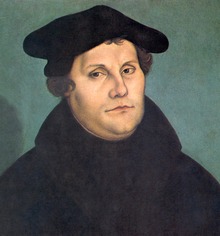
Well, today, but 498 years ago, Martin Luther pinned the 95 Theses on the doors of the Wittenberg Church as a protest of what the Dominicans were doing.
One of the things which the Dominicans did to collect money to rebuild St. Peter's Basilica, in Rome, was selling indulgences to the sinners in order to eliminate their sins; the unique incentive of Luther to write the '95 Theses' was to observe how the Dominicans abused of the people.

In the '95 Theses' he rejected the intermediaries between people and God, and expressed his opinion about the equality of the people to God, the unique who could saved or absolve our sins. The Clergy and the court tried to avoid the spreading of the '95 Theses' but they were copied and diffused before it..
In 1521 the Protestant Reformation started when Luther rejected to recant 41 of his thesis


This link will redirect you to Martin Luther's page, where you could found the 95 Theses, and I invite you to watch the film about this,'Luther' it's very interesting and entertaining and you will be able to understand better all this information.

See you!!


https://en.wikipedia.org/wiki/The_Ninety-Five_Theses
A replica of the 95 Theses, in Wittenberg                                                     


Saturday, October 24, 2015

This day in history: Signature of the Peace of Westphalia and end of The Thirty Years' War.

Hello, I'm Benjamín. Today, 24th October, 367 years ago, exactly in 1648, was signed one of the most important peace treaties, the Treaty of Westphalia, which ended the Thirty Years' War. I'll explain in a few sentences how began the Thirty Years' War and how it ended.

The Thirty Years' War.

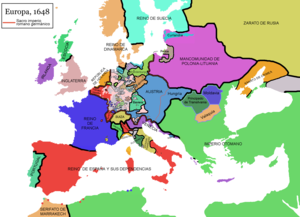
On October 24th 1648, the Treaty of Westphalia was signed, marking the end of the Thirty Years War, one of the most destructive conflicts in the history of Europe. The Thirty Years' War was a war fought in Central Europe between 1618 and 1648 in which most of the major European powers of the time participated.

The origin of the war was religious, consequence of a confrontation between the supporters of the Reform of the Church supported by Luther (Protestants) and the Catholic Church. However, the conflict spread and changed from being a religious war to a dynastic struggle between the German princes with the intervention of other European powers (especially Sweden and France) interested in controlling the power of the Habsburg family.

Europe map 1648-es.png


Signature of the Treaty of Westphalia.

The Westphalia area of north-western Germany gave its name to the treaty that ended the Thirty Years War. The Treaty was signed on October 24th in the Hall of Peace of the City of Münster, in the historical region of Westphalia, which ended by the Thirty Years 'War in Germany and the Eighty Years' War between the Hispanic Monarchy and the Netherlands. In this treaty participated the emperor of the Holy Roman Empire (Ferdinand III), the Hispanic Monarchy, France and Sweden, the United Provinces of the Low Countries and their allies among the princes of the Holy Roman Empire.

Westfaelischer Friede in Muenster (Gerard Terborch 1648).jpg


The consequences of the Treaty of Westphalia (1648) were:

  • All the kingdoms accepted the Peace of Augsburg (1555) which established religious freedom of the princes of the Holy Roman Empire, being able to choose either the Catholic or Lutheran confession but without admitting other as the Calvinist. With the Peace of Westphalia of 1648 the religious freedom established in this treaty it was extended and Calvinism became another of the religions allowed.
  • Independence of the Low Countries.
  •  The Hispanic Monarchy lost hegemony in Europe. The kingdom of France became hegemonic.
  • Consolidation of State-nations and Absolute Monarchy.
To understand better what I have written, I leave you a short video in English about the Peace of Westphalia:


Friday, October 23, 2015

This day in history: Charles I's coronation and the end of the Revolt of the Comuneros


Hey friends! It's Lucía. Today is my turn to explain what happened years and years ago. Yes! This is a new chapter of... THIS DAY IN HISTORY! And as you have seen in the title, today we have double event.

FIRST EVENT: CHARLES I'S CORONATION.
Today but in 1520, Charles was crowned as Emperor in Germany (by the Pope Clement VII). Three years ago, in 1517 he started to be(en) King of the Hispanic Monarchy, but in 1519 he left the Iberian Peninsula to be elected emperor, and because of that the Revolt of the Comuneros started.

                         
                               Source: http://gallery.enciclonet.com/gallery/docs/comun/per/ptitia54.jpg
But Charles I actually was named the heir of Emperor Maximilian when he was 6, when his father Philip the Handsome died. His grandfather died in January 1519 and Charles was elected Emperor by the German electors in July 1519. In Germany there was a tradition: when a new Emperor was elected, they had to celebrate three ceremonies. The first was in the Palatine Chapel of Aachen second one was a coronation to name Charles "The king of Burgundies" and the third one was in Rome. this one didn’t take place until the 23rd February 1530, when Charles V was crowned Emperor by the Pope Clement VII.

Here you have a documentary of his entire life, if you want you can watch it (it's long, and in Spanish).

     
                    Source: https://www.youtube.com/watch?v=3AWhoBtXpA0

This is the link to Charles V's video in English: 
https://www.youtube.com/watch?v=MRYzW3BSj0I 

SECOND EVENT: THE END OF THE REVOLT OF THE COMUNEROS WITH THE SURRENDER OF THE LAST CITY, TOLEDO. (1521)
Joanna the Mad, Isabella's daughter, inherited the throne with her Burgundian husband King Philip I. However, Philip died two years after the beginning of their reign, and their son Charles was only six years old. Due to his youth and Joanna's mental instability, Castile was ruled by the nobles and her father, King Ferdinand II of Aragon, as a regency. After Ferdinand's death in 1516, the sixteen-year-old Charles was proclaimed king of both Castile and Aragon. In 1519, Charles was elected HolyRoman Emperor. He departed to Germany in 1520, leaving the Dutch cardinal Adrian of Utrecht to rule Castile in his absence. Soon, a series of anti-government riots broke out in the cities.


Two men and a priest stand in the center, overseeing the proceedings. A dead body lies on the ground; a man triumphantly lifts up his severed head in the background. A bearded man with hands bound is being brought forward to be executed next.
Source: https://commons.wikimedia.org/wiki/File:Comuneros.jpg#/media/File:Comuneros.jpg

  On 23rd of October 2015, we celebrate when the towns of northern Castile soon succumbed to the king's troops, with all its cities returning their allegiance. Today also Toledo, the last city where the revolt continued, declared surrender.                                     

BatallaDeVillalar.jpg
"BatallaDeVillalar" by The artist is Manuel Picolo López, born in 1851 and died in 1913 (source: https://commons.wikimedia.org/wiki/File:BatallaDeVillalar.jpg#/media/File:BatallaDeVillalar.jpg)
                                           

Wednesday, October 21, 2015

This day in history: a decisive marriage

On the 21st October 1496 a decisive marriage took place in the city of Lille, in Burgundy: Joanna of Castille and Aragón, later known as Joanna the Mad, married Philip of Burgundy, later known as Philip the Handsome. This marriage, together with another one between John of Castile of Aragón and Margaret of Austria in 1497, sealed the double alliance between the Catholic Monarchs and the Habsburg dynasty. In 1500 Joanna the Mad and Philip the Handsome had a baby called Charles, who would later become king and emperor: Charles V.


On this link you have some more information about Joanna's trip to Burgundy and the love at first sight Philip and her had the first time they met: 


And here you have a short video from the TV series Isabel with some curiosities about Joanna's trip to meet her future husband and the first time they saw each other: 

Tuesday, October 13, 2015

This day in history: Pedro de Mena's death

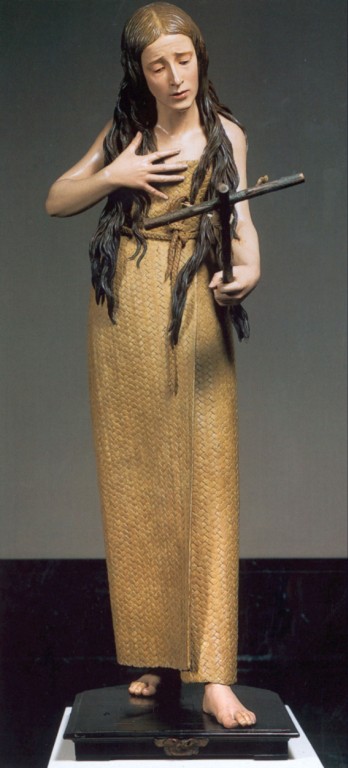
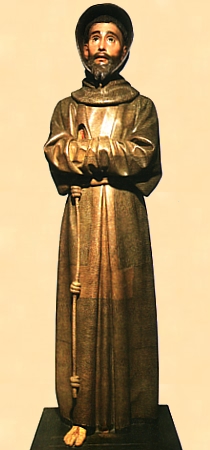
On the 13th October 1688 Pedro de Mena, one of the most important Baroque sculptors, passed away in Málaga. He was one of the most outstanding sculptors of the Baroque Andalusian school. He worked mainly for the Church and sculpted works for the cathedrals of Málaga and Toledo. Here you have some of his main works. You can include some of them on your travel journal: 


Penitent Magdalen


Saint John the Baptist


Ecce Homo


Saint Francis of Assisi

Thursday, October 8, 2015

This day in history: the Battle of Lepanto

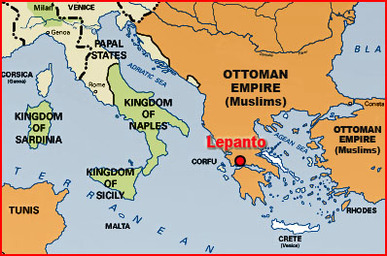
On the 7th October 1571 the Holy League fleet captained by John of Austria defeated Suleyman the Magnificent's fleet in the Gulf of Lepanto, near the coast of Greece. This battle was decissive, because it stopped the Turk threat in the Eastern Mediterranean, 


John of Austria, Philip II's half brother


Here ou have a map of the location of Lepanto, now called Naufpaktos: 


Picture


And on this link you can download a presentation with an animated map of the battle: 


As you know, Miguel de CErvantes participated in the battle and was injured in his left hand. The reason why he participated in the battle was because he had enlisted in the navy in Italy in 1570. We don't know for sure why he was in Italy at the moment, but he might have fled there to avoid being arrested for having participated in a duel and injured his oponent, Cervntes described the Battle of Lepanto as “the highest and most memorable occasion that past and future centuries will ever hope to see”. Hopefully, Cervantes didn't die there and he could write the Quixote. 


Cervates jauregui.jpg


Tuesday, October 6, 2015

This day in history: Elizabeth of France's death

I'm inaugurating a new section on the blog called "This day in history". It consists of explaining some historical events happened on a specific date in the past. You can contribute with your own events, but respecting some rules: the events you elect have to be related to what we' ve studied in class.

On the 6th October 1644 Elizabeth of France, Philip IV's first wife, died in Madrid at the age of 41. She was the daughter of Henry IV of France and Mary of Medicis. She gave birth to 8 children, but when she died only two survived: prince Balthasar Charles, dead two years later when he was 15, and infanta Maria Theresa of Austria, whose marriage with Louis XIV of France was arranged in the Peace of the Pyrenees. 

These are some portraits by Queen Elizabeth painted by Diego de Silva and Velázquez, Philip IV's court painter: 

Isabel de Borbón, by Diego Velázquez.jpg

Source: https://en.wikipedia.org/wiki/Elisabeth_of_France_(1602%E2%80%931644)


Source: https://en.wikipedia.org/wiki/File:Retrato_ecuestre_de_Isabel_de_Borb%C3%B3n,_by_Diego_Vel%C3%A1zquez.jpg

File:Retrato de Isabel de Borbón, by studio of Diego Velázquez.jpg

Source: https://en.wikipedia.org/wiki/File:Retrato_de_Isabel_de_Borb%C3%B3n,_by_studio_of_Diego_Vel%C3%A1zquez.jpg


As prince Balthasar Charles died in 1646, Philip IV needed a new heir to the throne and in 1649 he married his niece Mariana of Austria. They had 5 children. Charles II was the youngest one and the only surviving boy. This was the reason why he became the king of the Hispanic Monarchy.

The French branch of Charles II's family played a significant role when the monarch died. Philip of Anjou, Louis XIV and Maria Theresa of Austria's grandson, was designated by Charles II as the heir to the throne in his last testament. He finally became the king of Spain, after the WAr of Spanish Succession.