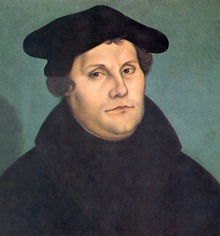
Showing posts with label Protestant Reformation. Show all posts

Friday, June 16, 2017

Some videos and songs about the Protestant Reformation

Here you have some videos and songs about the Protestant Reformation:

Causes of the Protestant Reformation:


Martin Luther Song by History Teachers:


The Protestant Reformation in a nutshell:


Reformation Rock:

Turning points in history: the Protestant Reformation:


Results of the Protestant Reformation:


Henry VIII's six wives, by Histoy Teachers:


Henry VIII and Anglicanism:


Saturday, July 9, 2016

Press conferences with important figures of the Reformation and Counter-Reformation

This was a project made by the 3rd ESO students in June. In groups of 3-4 students they had to prepare a press conference and ask questions to one of the main figures of the Protestant Reformation and the Counter-Reformation. In some of these interviews there were some snoop journalists who asked inappropriate questions. 


- INTERVIEW TO POPE LEO X (Chaoyi Lin, Laura Quintanar and Elena Violero)


- INTERVIEW TO MARTIN LUTHER (Elena Abad, Silvia Alberca, Daniel Martínez de la Hidalga and Marcos J. Manzanares)


)


- INTERVIEW TO JOHN CALVIN (Mª Rosa Amores, Rubén González, Ángel Villafranca and Cristina Naranjo)


- INTERVIEW TO HENRY VIII (Sergio Olivares, Ángela Bustamante, Laura Ortiz and Paula Manzaneque)


- INTERVIEW TO EMPEROR CHARLES V (Mª Antonia Costea, Marta Huertas and Sergio Alarcos)


- INTERVIEW TO POPE PIUS IV (Jesús Herencia, Cristina García and Beatriz Olivares)

This group had problems to work together, so they made two different interviews:


Saturday, October 31, 2015

This day in history: Martin Luther and the 95 Wittenberg Theses: beggining of Lutheranism and Protestant Reformation


Hi mates! Do you remember two years ago when we studied Lutheranism and the Protestant Reformation?
Well, today, but 498 years ago, Martin Luther pinned the 95 Theses on the doors of the Wittenberg Church as a protest of what the Dominicans were doing.
One of the things which the Dominicans did to collect money to rebuild St. Peter's Basilica, in Rome, was selling indulgences to the sinners in order to eliminate their sins; the unique incentive of Luther to write the '95 Theses' was to observe how the Dominicans abused of the people.

In the '95 Theses' he rejected the intermediaries between people and God, and expressed his opinion about the equality of the people to God, the unique who could saved or absolve our sins. The Clergy and the court tried to avoid the spreading of the '95 Theses' but they were copied and diffused before it..
In 1521 the Protestant Reformation started when Luther rejected to recant 41 of his thesis


This link will redirect you to Martin Luther's page, where you could found the 95 Theses, and I invite you to watch the film about this,'Luther' it's very interesting and entertaining and you will be able to understand better all this information.

See you!!


https://en.wikipedia.org/wiki/The_Ninety-Five_Theses
A replica of the 95 Theses, in Wittenberg                                                     


Saturday, September 29, 2012

Henry VIII´s six wives


You may know about this story for The Tudors, the TV series, but here you have a music video from the History for Music Lovers´ channel on Youtube. They performed a song using Abba´s song Money, Money, Money. Henry VIII of England provoked another schism in the Catholic Church when the Pope rejected to annule his marriage with Catalina of Aragón. Henry VIII declared himself the Supreme Head of the Church of England, divorced Catalina and married Ann Boleyn. But later he had four more wives. Play the video if you want to learn more about them and have fun. 

Paris is well worth a Mass


Henry IV of France

Yesterday we studied that religious conflicts intermingled with political affairs very frequently during the 16th and 17th centuries. That happened in the German Empire, where many German princes supported Martin Luther´s ideas as a way of facing the power of the Emperor, Charles V. The same happened with the wars of religion in France, which took place in the second half of the 16th century.  The quote Paris is well worth a Mass, pronounced by Henry IV of France in 1593, can be another example of this. 

There were eight wars of religion in France between 1562 and 1598. This fact reflects the extension of religious intolerance in those changing times. The doctrine spread by John Calvin had found a certain support in France, where a community of Huguenots (the name Calvinists received in France) was created. The Huguenots were initially tolerated, but later persecuted. The big noble families of the French kingdom aligned in different sides (Huguenots and Catholics) and violent confrontments broke out. 

Henry III of Navarre was the king of Navarre, son of Antoine of Bourbon, a respected Huguenot and heir to France´s throne. In the religion wars he fought with the Protestants against the Catholics, especially after Saint Bartholomew´s Day Massacre: on the 24th August 1572 several thousands of Huguenots who had come to Paris to Henry III´s wedding, were killed by Catholics. The order was given  by Catherine of Medicis, King Charles IX´s mother. Henry III, who was in the line of succession to the French throne, escaped the massacre under the promise of converting to Catholicism. But some years later he abjured and rejoined the Huguenots, who continued to fight against the Catholics. In 1584, when the French king died without successors, Henry III became the legitimate heir to the throne. A new war started: the War of the Three Henries: Henry III of Navarre, Henry of Guise, a Catholic nobleman supported by Philip II and Henry III of France, supported by the Catholic League. Political interests mixed with religion again: the Catholic League rejected Philip II´s intervention in France and when their leader King Henry III died without children, they looked for an agreement and accepted Henry III of Navarre, the Huguenot, as the new king of France if he converted to Catholicism. And so did he in 1593. This is the origin of his statement Paris is well worth a Mass. The quote means that becoming the king of France was worth the sacrifice of changing religion. Henry III of Navarre was crowned king of France in 1594 and he reigned as Henry IV. He was the first king of the Bourbon dynasty in France. 

The experience of religious intolerance and so many religion wars made King Henry IV aware of the importance of respecting the others´ beliefs. In 1598 he enacted the Edict of Nantes, which meant religious tolerance in France and granted the Huguenots equality of rights with the Catholics. This was an important step in the path to secularization, because it established the principle of religious freedom in France and meant the end of religion wars in this country.

The quote Paris is well worth a Mass is commonly used to talk about sacrifices which are worth doing, because the expected compensation is worthwhile. 

There is a 1994 French film called La reine Margot (Queen Margot), which tells the story of the religion wars in France, focusing on Margot, Henry III of Navarre´s wife. Here you have the teaser. You will discover Miguel Bosé, the singer, who plays the role of Henry of Guise.

Thursday, September 27, 2012

Presentations used this week

At some students´ request, here you have the presentations we´ve been using this week to study the Age of Discovery and some of the cultural changes during the Modern Era.