Sunday, October 12, 2014

Presentation of the Indies and something else


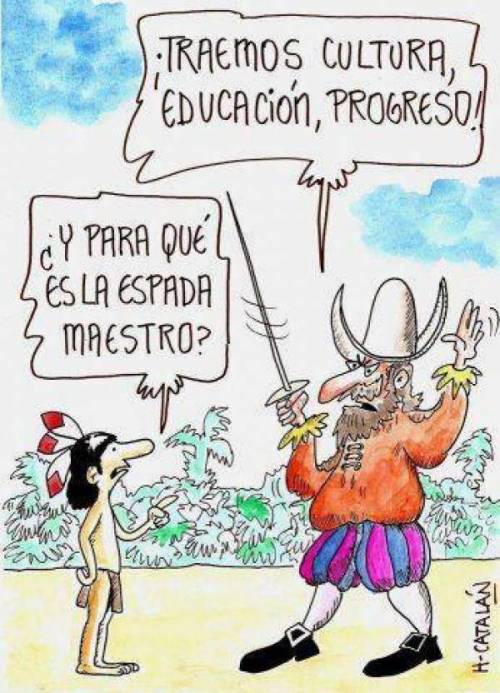
This is the presentation for this part of the unit. As you know, today is the 12th of October, the day Christopher Columbus and his crew arrived in the Bahama Islands and were the first Europeans to communicate their "discovery". This was the beginning of the occupation and exploitation of the Indies. Here you have a small text by Uruguayan writer Eduardo Galeano to think about the "discovery" of America: 

THE 12th OCTOBER, THE DISCOVERY OF AMERICA AND OFFICIAL HISTORY

Did Christopher Columbus discover America in 1492? Or was it the Vikings before him? And before the Vikings, what about the people who lived there? Didn’t they exist?

Official history relates that Vasco Núñez of Balboa was the first man who saw both oceans, standing on a peak in Panama. Were the inhabitants of that area blind?
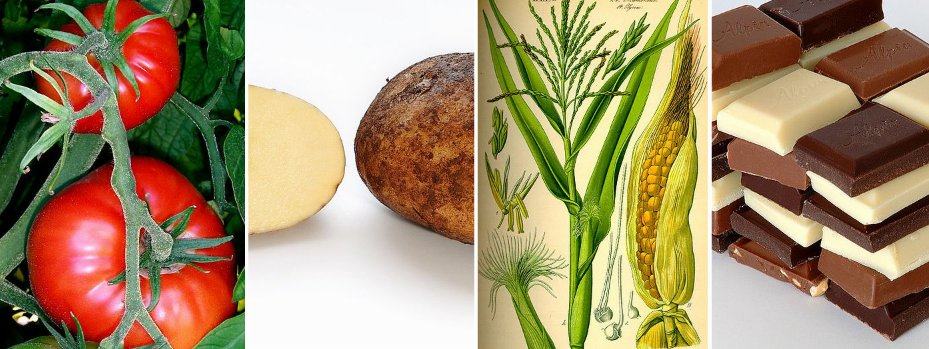
Who gave maize and potatoes and tomatoes and chocolate and the rivers and mountains of America their names? Hernán Cortés? Francisco Pizarro? Were the people who were already living there mute?

We have been told, and still are, that it was the pilgrims of the Mayflower that populated America. Had it been empty before?

Because Columbus didn’t understand what the Indians were saying, he concluded that they didn’t know how to speak. Because they wore no clothes, were gentle, and gave away everything they had, he concluded they lacked the capacity for reason. And because he was certain of having discovered the Orient by the back door, he believed they were Indians from India.

Afterwards, during the second voyage, the admiral promulgated an act establishing that Cuba was part of Asia. The document of June 14, 1494, stated as evidence that the crew of the three ships recognized it as such. Whoever said otherwise was given thirty lashes, fined 10,000 maravedíes, and had his tongue cut out.

The notary, Hernán Pérez de Luna, attested, and the sailors who could write signed at the bottom.

The conquistadors demanded that America be something it wasn’t. And they treated the Americans as if they were what they imagined the pagans of the Orient to be.

Christopher Columbus said he saw on the shores of Cuba sirens with men’s faces and chicken feathers, and supposed that not far from there men and women had tails.

In Guyana, according to Sir Walter Raleigh, there were people with eyes in their shoulders and mouths in their chests.

In Venezuela, according to Pedro Simon, there were Indians with ears so long they dragged on the ground.

In the Amazon, according to Christopher of Acuña, the natives’ feet were shaped backwards, heels forward and toes behind, and according to Pedro Martín de Anglería, women mutilated one breast to be able to fire their arrows better.

Anglería, who wrote the first history of America, though he never set foot there, also affirmed that in the New World there were people with tails, and these tails were so long the natives could sit only in chairs with holes.

The Black Code prohibited the torture of slaves in the French colonies. But it wasn’t to torture them but to educate them that slaves’ masters whipped their backs and cut their tendons when they fled.

The Laws of the Indians, which protected those in the Spanish colonies, were quite moving. But the gallows and pillory set up in the center of every Main Square were even more affecting.

The reading of the Request for Obedience was very convincing. This occurred on the eve of the assault on each village. It explained to the Indians that God had come to the world and left St. Peter in his place, and that the successor of St. Peter was the Holy Father, and that the Holy Father has shown favor on the Queen of Castilla, who rules all this land. For this reason, they should go from here or pay tribute in gold, and if they don’t or if they stay, war would be declared on them, and they would be made slaves along with their wives and children. But the Request was read in the middle of the night from the mountain in Spanish and without an interpreter, in the presence of the notary but no Indians, as they were asleep, miles away, and hadn’t the faintest idea what was awaiting them.

Until not long ago, October 12 was Race Day.

But does such a thing even exist? What is race but a useful lie to exploit and exterminate one’s neighbor?

When the U.S. entered the Second World War, the American Red Cross decided that the blood of black people would not be accepted in its blood banks. Has anyone seen, by chance, black blood?

Afterward, Race Day became the Day of Encounter.

Were colonial invasions encounters, whether those of yesterday or those of today? Shouldn’t they be called rapes or violations instead?

Perhaps the most revealing episode in the history of the Americas occurred in 1563 in Chile. Indians besieged the fortress of Arauco, depriving the Spanish of food and water, yet Captain Bernal refused to surrender.

From the stockade he screamed out, “There will be more and more of us!”
“With what women will you make them?” the Indian chief asked.
“With yours. We will make them bear children who will be your masters.”

The invaders called the original Americans idolaters because they believed that nature is sacred and that we are the brothers and sisters of all those with feet, paws, wings, or roots.

And they called them savages. But they were not wrong about this. The Indians were such savages that they ignored the fact that they had to obtain a visa, a certificate of good behavior, and a work permit from Columbus, Cabral, Cortés, Alvarado, Pizarro, and the pilgrims of the Mayflower.


Here you have the text in Spanish: 


Friday, October 10, 2014

Friday, 10th of October 2014 Inés Sánchez .

Hello! I'm going to start with my journal!.

Today in class of Social Science, We have started whith a review of what we have read the other day about the Economy in the 16th century. 

In this century there was a price revolution, as a consecuence of the big amount of precious metals from Indies. And there was not enough production to satisfy the demand.Many products  were imported from Europe.
Economy was more developed in the Crown of Aragon.
Then we have done a scheme of the CONQUEST ADMINISTRATION AND EXPLOITATION OF THE INDIES. We have learned about the conquest and its features were:
Quick conquest due to Military superiority of the conquistadors: horses, gun, gunpowder


http://static3.absolutportugal.com/wp-content/uploads/2010/10/1150.jpg

- Ambitions of the conquistadors.
-Impact of the European diseases over the Amerindians.
And we have learned and written on our schemes the stage, There were 3:
1st the conquest of the Antilles, 2nd the conquest of the Aztec Empire, and finally the conquest of the Inca Empire. 
The the teacher Paqui has said we have to do the rest of the scheme in our home for homeworks.
The she has given our projects on Renaisance Art back, but the teacher has to look our job again, I would like to get  more mark. And we have learned new vocabulary like:inflation , deflation, saving... and a lot new more words !
And this is all for Today, have a nice wekend! 

Thursday, October 9, 2014

Thursday, 9th of October 2014

Hello everybody! I'm Antonio José and this is my first time to write on this blog.

Today in our Social Sciences lesson, Paqui has started the class checking the notebooks for see if we had done the homework. Then we have corrected the homework, about Philip II the objectives of reign and problems.
-Defense of Catholicism: He refused to give his subjects religious freedom and he forbade Protestism in his kingdoms. This caused huge problems, especially in the Low Countries.

  • He reinforced the Inquisition to chase heretics.
  • He forbade the students to study abroad.
  • He forbade the import of books from Europe
  • He established the concept of "blood cleanliness": the people who had Muslim of Jewish ancestors couldn't get posts in the administration.
  • Repression of the Moorish of Granada: prohibition of speaking Arabic, wearing their clothes and preserving their customs. This caused a revolt in the Alpujarras in 1567. The punishment was severe: 80,000 Moorish were exiled to other parts of the Peninsula.

-Preservation of his Empire: This led to several wars:

  • Wars against France: The French were defeated in the Battle of Saint Quentin, in 1557, but Felipe II continued to interfere in France: he took part in the wars of religion, supporting the Catholics.
  • Revolt in the Low Countries: Authoritarianism of the governors and religious policy provoked a revolt against the king in the Northern Provinces (Holland), which declared the independence. The conflict lasted 80 years and it wasn't solved until 1648.
  • Confrontation with the Ottoman Turks: the Turks threatened the Mediterranean and a coalition was organized to confront them. The Holy League defeated the Turks in the Battle of Lepanto in 1571.
  • Conflict with England: the English supported the Protestants and their corsairs attacked the fleets that came from the Indies. Felipe II decided to invade England and he prepared a big navy, the Invincible Armada. But the Armada sunk in 1588.

All these wars were very expensive and they ruined the economy. Felipe II was forced to declare bankruptcy several times.

Like every day, we have written some words on the glossary. For example:
blood cleanliness-limpieza de sangre
in force-vigente
to banish/exile-desterrar
to vanish-esfumarse, desaparecer
Moorish-Morisco (former Muslim who has converted to Catholicism)
delay-retraso
to delay-retrasar
Huguenot-Hugonote (Calvinist in France)
duchess-duquesa
bogeyman-coco, hombre del saco
to threaten-amenazar
to warn-advertir 
West Indies Fleet-Flota de Indias
privateer-corsario (legal pirate, who has received carte blanche, permission, to attack ships of another nation)
carte blanche-patente de corso
to the detriment of-en perjuicio de
to sink-hundirse
failure-fracaso, desastre
expenses-gastos

At the end of the lesson Paqui has given the homework for tomorrow, to read the point 3.ECONOMY IN THE 16th CENTURY.

Here you have a image of the Battle of Lepanto:


And that's all for today!


Thursday, 9th of October 2014

Hello everybody! How is it going? I'm going to write my first journal of the year.

Today in Social Sciences we've been talking about the economy and the price revolution. Paqui has told us that the arrival of precious metals (which came from the Indies) provoked a huge inflation because prices increased so much. That was because there was not enough production to satisfy the demand. Many products were imported from Europe and the wealth of the Indies wasn't used to develop a productive economy. We also know that the Indies were a Castilian Monopoly. The Aragonese economy couldn't take advantage of the Empire.

Then we've started another scheme about the conquest, organization and explotation of the Indies. Before starting it, we've read page 95 on our books and then Paqui has allowed us time to copy the information to our summaries while she was checking Pablo and Debora's journals. Most of us haven't got time to finish it in class so we're going to finish it at home. We have to add to our summary:
-The conquest of the Indies and its stages.
-The administration and its institutions.
-The colonization and explotation.
-The colonial society.

Paqui has given us the demographic impact of the colonization of the Indies, which means that the indigenous people of the Indies died because European people trasmitted them illnesses from the Indies.

We have also seen some Castilian conquistadors from the Modern Era like: Hernando Cortés, Francisco Pizarro, Juan Ponce de León and Alvar Nuñez Cabeza de Vaca (who has inexplicably made us laugh such a lot).

We've added some new words to our glossary:
-Fulfill: completar
-Gunpowder: pólvora
-Default: suspensión de pagos, quiebra
-Bankrupcty: bancarrota

And finally, Paqui has shown us some products which came from the Americas:


Tuesday, October 7, 2014

Tuesday, 7th of October 2014

Hello my classmates! I'm Pablo and this is my first journal of the year.

Today is Tuesday so we have started the lesson at the 4th period, after the break time.
We have started remembering briefly what we spoke about yesterday, Philip II, and after this we have completed its scheme which was our homework today.

When we have finished with Philip II the teacher Paqui has asked who wanted to do the journal, but there hasn't been voluntaries but I said that I could, so here I am.

We have continued speaking about the revolts in the Low Countries and how Philip II gave this territory to his daughter Isabel Clara Eugenia but as she didn't have any descendat, it returned to the Hispanic Empire and the revolts restarted. Then we have spoke about the wars against France and the conflicts with England because:
  1. They supported the Protestants in the Low Countries' revolt.
  2. The English privateers (or corsairs) attacked the Fleets which came from the Indies.
  3. Philip II supported Mary, the Catholic Queen of Scotland, to the detriment of the Anglican Elizabeth.
Finally we have talked about the wars against the Ottoman Turks and to finish the lesson we have started speaking about Philip II's children. Paqui has spent a lot of time explaining this because Philip II's family is a really big mess because of imbreeding!! Philip II had four wives:

  • María Manuela of Portugal (Philip II's cousin). He had one son with her, Charles who was mental disable so he couldn't be Philip II's heir.
  • Mary I of England (Philip II's aunt), they didn't have any descendant.
  • Elisabeth of Valois, and they had two daughters, Isabel Clara Eugenia and Catalina Micaela.
  • Anna of Austria (Phlip II's niece), and they had one daughter, María, and four sons: Ferdinand (who died at 6), Carlos Lorenzo (who died at 2), Diego Félix (who died at 7) and Phlip, who finally would become king as Philip III of Spain.

Philip III, son of Philip II and Anna of Austria


To finish my journal I'm going to include all the words we have included today to the glossary:

  • To prohibit/forbid - Prohibir
  • The bogeyman - El hombre del saco
  • Loot - Botín
  • Bounty - Recompensa
  • Privateer - Corsario
  • Bankruptcy - Bancarrota
  • Default - Quiebra
  • Debt - Deuda
  • Inbreeding - Endogamia
For homework we have to do a family tree with Philip II's offspring.

And that's all for today!


Tuesday, October 7, 2014

Hello everybody!
Today in class we have finished the scheme of the Charles I's reign. We have studied the external problems: Revolt of the germanias in Aragon, from 1521 to 1523, and the revolt of Comuneros in 1521. Jose Mari and Amalia have corrected this and I didn't have it so I have a negative. After this Paqui has started to explain the Charles I's sucession. In 1556, he abdicated and his heritage was divided between his brother Ferdinand(emperor) and his son Philipp(the rest except Burgundy). He retired to the monastery of Yuste, where he died in 1558. Later we have copied like a scheme about the Philipp II's reign(1556-1598) We have copied his heritage and his territories added, but we haven't had time to copy the government and the objetives of his reign and problems, so we have to finish at home. After this we have gone to the breaktime, because we have social sciences at 3th hour. Also in class we have copied some words on the glossary:
-Low rank noble: Noble de categoría inferior
-to changue side: Cambiar de bando
-Barbary pirates: piratas berberiscos
- to siege: sitiar
-peace of Ausburg: paz de Ausburgo
-Habsburg: hasburgo(dinasty)
-To stink/suck: Apestar
Here you have an image of Philipp II,:

Monday, October 6, 2014

Monday, 6th of October 2014

Hello everybody!

Today in our Social Sciences lesson, Paqui has started the class remembering the scheme about Charles I's heritage and the way of ruling of (Charles I's). His heritage belonged to his grandmother Isabella of Castile, grandfather Ferdinand of Aragon, grandmother Mary of Burgundy and grandfather Maximiliam of Habsburg, and his way of ruling was:

  • Not unified state: Empire made up of different territories with their own laws, languague. The only thing they had in common was the monarch.
  • Itinerant court.
  • Castile was the place where the king had more power and most of the money for wars was called there. This wasn't enough and the monarchs had to get loans from bankersguaranteed with the gold and silver from the Indies.
Then we have corrected the second part of the scheme which is divided into:
  • Main facts: Iberian kingdoms and Outside the Iberian kingdoms
  • Succesion
When we have finished to correct it, Paqui has started explaining the life of Philip II (1556-1598) and at the same time we have copied some things:

  • Philip II inherited all the territories his father Charles I had accumulated except for the Holy Roman Empire and Burgundy.
  • He added some territories from his empire. In 1565, he annexed the Philippines Islands and in 1580 he added Portugal and its colonies in America, Africa and Asia in 1580.
  • Government: the capital city in Madrid, growth of political centralization: the king didn't call the Cortes and personal government.
  • Objectives and policy: - Defense of catholicism: religious intolerance caused many problems and wars. -Preservation of the empire: wars against France, the Muslims (Ottoman Turks) and England.
During the class we have added some new words for the vocabulary like:
-Ally: aliado
-Alliance: alianza 
-Policy: política (decisions someone makes)
-Politics: política (science)
-Politician: político (persona)
-Political science: ciencias políticas
-Willing to: deseosos de...
And a lot of more words.

Finally, she has given to finish the scheme about Philip II for homework and in my case to do the journal before 20:00 o'clock.

Here you have a photo about Charles V's Abdication:

File:Abdication de charles quint Louis Gallait.jpg

Saturday, October 4, 2014

Friday 3rd October 2014

Hello everybody!

First of all sorry for the delay, yesterday I was busy all the time and I couldn't do the journal.

In class of Social Sciences I had given the books to Paqui. Then she has copied a scheme about some different monarchs, like Isabella of Castile and Ferdinand of Aragón and Maximilian of Austria and Mary of Burgundy. Also in the scheme Paqui has written the heirs of these two reigns, Isabella and Ferdinand had a daughter, Joana the Mad. Maximilian of Austria and Mary of Burgundy had a son, Philip the Handsome. Then, Charles I was born (he was the son of Joana and Philip), and he inherited many territories, like the Crown of Castile, Sicily, Sardinia, the Indies, etc. With all these territories, he formed an enormous Empire.

After that, Paqui has written another scheme about the features of Charles I's reign on the blackboard.
The reign had some features, like the type of government and the problems.
-Government: The Empire wasn't a unified state, the power varied depending on the territory. The king was constantly moving to different places.

Later, Paqui has told us to complete the scheme, we have had to write on it the internal and external problems of the reign.

Like every day, we have written some words on the glossary. For example:

Memory stick: Lápiz de memoria or "pen drive".
By pure chance: De carambola.
Viceroy: Virrey.
Wool: Lana.
To rent: Alquilar.
Renting conditions: Condiciones de arriendo.
Schmalkaldic League: Liga de Esmalcalda.

There is a photo of king Charles I of Spain:


Source: http://www.kingsacademy.com/mhodges/02_The-West-to-1900/09_Religious-Reformation/09_Religious-Reformation.htm
See you!

Friday, October 3, 2014

Presentation to study the Hispanic Monarchy in the 16th -17th centuries

This is the presentation we are going to use to study the government of the monarchs of the House of Austria (Habsburg) in the 16th and 17th centuries. Please, use it to complete your notes.


Thursday, October 2, 2014

Thursday, 2th of October 2014

Hello everybody!!

Today, it's the last day of the week that we have Social Sciences, in today's lesson. Firstly Paqui has revised that we were all in the class and the she has said to correct the homework that we had for today, the homework was to finish the scheme we didn't finish on Tuesday and we had to copy the heritage of Charles the First.

Paqui has asked some people to correct the homework, and then she has started to copy a scheme of Charles the First on the blackboard and she has divided it into 4 points:

            - Heritage: It is divided also into other 4 points.
            - Way of Ruling: Divided into 3 points.
            - Main Facts: Divided into: Iberian Kingdoms and outside the Iberian Kingdoms.
            - Sucession.
         
       
Paqui has explained to us all these things starting from the Heritage and finishing with the Iberian Kingdoms and outside the Iberian Kingdoms.

After all the explanations Paqui has asked to all the class who of us wanted to do the journal today and I said that I wanted to do it because today it's my birthday and I wanted to it. Then, like always, Paqui has written some words for our glossary on the blackboardin the blackboard today there weren't many words for the glossary, the words are:

           
            - Male Chauvisimn: Machismo.
            - Loan: Préstamo.
            - To suffocate: Sofocar.
            - To threaten: Amenazar.
            - Threat: Amenaza.
            - To recant: Retractarse.
            - To abdicate: Abdicar.
Suleyman the Magnificent.
Souce:http://upload.wikimedia.org/wikipedia/commons/thumb/4/4c/Suleiman_the_Magnificent_of_the_Ottoman_Empire.jpg/879px-Suleiman_the_Magnificent_of_the_Ottoman_Empire.jpg