Tuesday, November 10, 2015

Baroque art travel journals

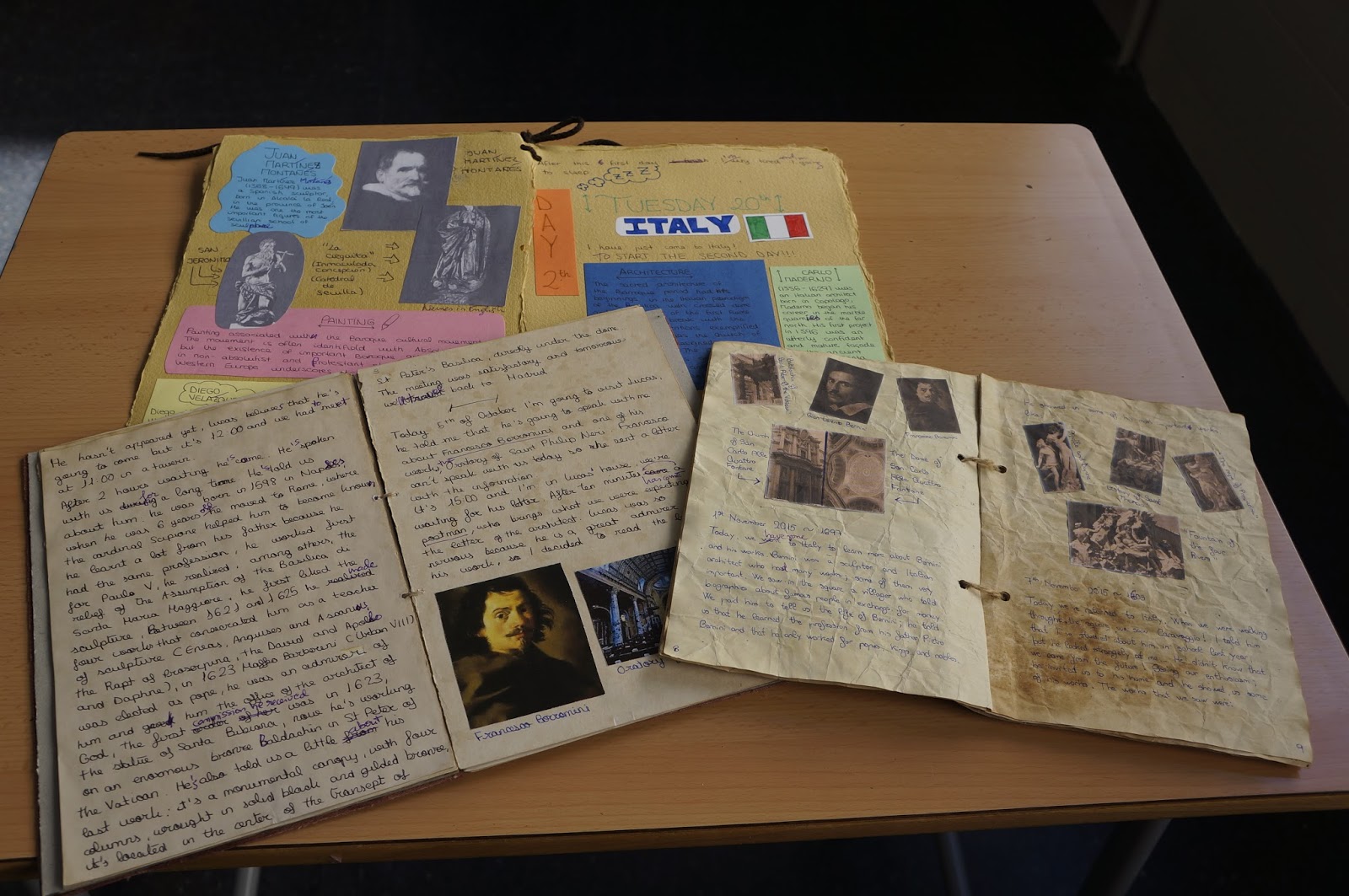
Here you have the pictures of your travel journal I've taken this morning. I hope you will find some time to have a look on your classmates journals and also that you try to improve them. I'm sure that the next project will be better. 


The last four pictures correspond to María Pérez's travel journal. In my opinion it combines both a good design and almost complete content. 


Tuesday, 10th November 2015

Hello, I,m Lidia. Today I will explain what we have done in social sciences class. At the beginning of the class we have continued with the theory, we started with Independence of the brithish colonies of North America and we have learned: The English has created 13 colonies on the coast of North America. 
Reasons for the colonist discontent:

  • No representatives in the British Parliament: they couldn't express their opinion or oppose the laws against their interest
  • Constant tax increase
  • British trade monopoly over the colonies: they couldn't buy or sell their products to other places
Paqui then explained to us with an outline on the blackboard the American War of Independence Revolutionary War (1775- 1783) and explained us:
  • First confrotment: Battles of Lexiston and concord. The British were defected. The colonist got France and Spain support
  • 2nd Continental Congress (1776): Declaration amplia difusion of Independence of the USA(  (4th July 1776)
  • Leador of the Colonist army George Washington
  • Man battles: Saratoga (1777) and Yaktown (1781). Finally the Brithish were defeacted
  • 1783: Treatry of Paris

We ended up completing the scheme in the notebook on American War of Independence Revolutionary War (1775- 1783) and we continue with the declaration of independence ( 4th July 1776) 

Declaration of independence-> During the 2nd Continental Congress of Philadelphia the delegates of the 13 colonies decided to the declare the independence from Great Britain.

Declaration of independence: CONTENT-> 

  • All men are equal and free and have some unallenable rights. The govermmet's role is to guarantee these rights.
  • King George hasn't fulfilled his role with respect to the North American colonies
  • The colonies have decided to break their political connection with GreatBritain and became an independence nation.


When finished Paqui explain the declaration of independence, we put in Benjamin Frankish internet to teach a picture of the, for us to know who he is.
Benjamin Frankish is a politician, scientist and inventor.


And in the last 10 minutes Paqui class explained as should have been the work of my travel journal, she told us what most people failed, and gave him to see notos and to see the faults we had. And at the end of the class we left on a shelf

NEW VOCABULARY

Trade: comerciar
Widespread:  amplia difusión
East India Company: Compañia de las Indias Orientales
Poth: Camino


Monday, November 9, 2015

Monday, 9th November 2015


Hello,  I'm Jaime. Today it's my turn to do the review of the class. So, Come on. At the beginning we have watched a video about Enlightened thinkers. This onetalked about philosophers who wanted to illuminate the darkness of the world with the light of reason. One example of this was the challenge promoted by the philosopher Immanuel Kant. Jean Rond D'Alembert and Denis Diderot developed the yearning to know and created the Encyclopedia. The first edition was published in 1751.
The thinking of the Enlightenment can be divided into:
-Political Thinking:

  1. Voltaire: he defended that the power of the king had to be limited by the Parliament, a universal tax system and religious tolerance.
  2. Montesquieu: he defended the division of powers into three institutions ( executive, legislative and judicial)
  3. Jean Jacques Rousseau: he defended the social contract and the general will.

-Economic Thinking:
Mercantilism had been the predominant economic policy in the 16th  and the 17th centuries:
the wealth of a country depends on the quantity of precious metals it accumulates and exporting more than importing was the best way to achieve this
Physiocracy was the new economic trend. They considered agriculture the most important economic activity.

You can find this information on a video of the blog.

After the video, we have done a review of the last class. Then Paqui has explained the Enlightened Despotism and the Independence of U.S.A. with a scheme on the digital board andthe blackboard

Enlightened Despotism
-Definition: Absolutism plus the Ideas of Enlightenment
-Reforms made: Educational, Economic and Administrative reforms
- Enlightened Despotism motto: " Everything for the people, but without the people”
-Limits of the reform: They didn't touch (of) the structure of absolute power and privileges(estate- based society). Reforms were insufficient
-Examples of enlightened monarchs: Catherine II of Russia (for the people , but without people.)

Independence of the USA
-Eastern Coasts of North America
-The north American colonists didn't have representatives in the British Parliament, the British government constantly increased the taxes and had the monopoly of trade with the North American colonies

The main features of the U S A.:
-The Constitution and the Bill of the Rights
-A government chosen by the citizens: A republic
-Division of powers
- USA is divided into different states


Finally Paqui has given us to complete the scheme of the Independence of the USA. While we were finishing the scheme, she has set the date of the Exam of the unit about 17th century.


You can find this information on a presentation and in the book of 4th of Eso

NEW VOCABULARY

-Motto: Lema
-Tea Tax: Impuestos de Tasas
-Staple production: de 1º necesidad


Sunday, November 8, 2015

Video in Spanish about the enlightened thinkers

I'm taking a course to improve as teacher and I had to prepare a video with questions for one of the activities. It's in Spanish, but I think it can also be interesting for you. Here you have it. We´ll do something similar with another project, so start preparing your Velleda markers ;)


The video with the questions is here. Challenge yourselves and try to answer without studying: 


Saturday, November 7, 2015

This day in history: birth of Francisco Zurbarán and the beginnig of the Revolt of the Comuneros.


Hi, I’m Carlos and it’s my turn to write in the section ‘this day in history’. I am going to explain  you the birth of Francisco Zurbarán and the beginning of the Revolt of the Comuneros.


FIRST EVENT: THE BIRTH OF FRANCISCO ZURBARÁN.

Francisco Zurbarán was born on the 7th November 1598 in ‘Fuente de Cantos’. He was a painter of the Spanish Golden Age. He was a friend of Velázquez and he stood out in religious paintings. He was a representative painter of the Counter-Reformation. At the beginning, he was influenced by Caravaggio. His paintings were characterized by the use of chiaroscuro and the paintings were away from realism. He tried to do simple paintings with simple perspectives.
The most important paintings were: 'Saint Hugo in the refectory' and 'defense of Cádiz against the English'.


https://mireiarteymusica.files.wordpress.com/2013/10/zurbarc3a1n.jpg?w=474


SECOND EVENT: THE BEGINNING OF THE REVOLT OF THE COMUNEROS.   

The Revolt of the Comuneros was a revolt to protest to the way of ruling of the king. The people thought that the king took advantage of his power and he damage the citizens.  The revolt started in Toledo. The rebels controlled the heart of Castile, ruling the cities of Valladolid, Tordesillas and Toledo. The revolt occurred in the wake of political instability in the Crown of Castile after the death of Queen Isabella I in 1504. Joanna the Mad, Isabella's daughter, inherited the throne with her Burgundian husband King Philip I. Philip I died two years later, and their son Charles was only six years old. Due to his youth and Joanna's mental instability, Castile was ruled by the nobles and her father, King Ferdinand II of Aragon. 


https://upload.wikimedia.org/wikipedia/commons/7/72/Comuneros.jpg

Thursday, November 5, 2015

Wednesday,4th, November, 2015

Today in Social Sciences we have continued speaking about the Encyclopedia. Diderot and D'Alembert compiled all the knowledge of their time asking to scientist and philosophers to colaborate with them. Paqui has told us about Rousseau, Montesquieu and Voltaire.
Roussseau was a philosopher and teacher that defended the social contract: the agreement the people and the governors, sign to preserve social order; and the general will, that consists in the power of the people to decides directly by themselves and not by a representative.
Montesquieu defended the division of powers (executive, legislative and judicial) and an independent judicial power.
Voltaire defended that the power of the king has to be limited by the Parliament, that everybody have to pay taxes (universal tax system) and he critized the church because he thought that the church was intolerant.
Then, she has explained the physiocracy and economic liberalism.
Physiocrats considered agriculture to be the most important economic activity of a country and they supported privated property, free trade, free industry, and they were against any intervention of the State in economy. Quesnay was the most important physiocrat and Adam Smith was an economy teacher in a University and he was the advocate of the economic liberalism.
Finally we have talked about the Enlightened despotism. Some monarchs adopted ideas of the Enlightenment and introduced some reforms in their kingdoms, but as they wanted to preserve their absolute power: they did "everything for the people, but without the people". They didn't  touch the structure of power, the privileges of nobles and clergy and also they thought  that the people were like ignorant children or they couldn't think, so the reforms they made were insufficient.
Encyclopedia by Diderot 
                                                    and D'Alembert
Source: http://www.alquiblaweb.com/2012/11/03/la-enciclopedia/

Diderot
Source:http://www.alquiblaweb.com/2012/11/03/la-enciclopedia/

D'Alembert
Source:https://es.wikipedia.org/wiki/Criterio_de_d%27Alembert

Montesquieu
Source:http://uscivilliberties.org/biography/4166-montesquieu-16891755.html

Rousseau
Source:https://es.wikipedia.org/wiki/Jean-Jacques_Rousseau

Voltaire
Source: http://www.biografiasyvidas.com/biografia/v/voltaire.htm

Quesnay
Source:http://www.biography.com/people/fran%C3%A7ois-quesnay-39200

 Adam Smith
Source:http://livingeconomiesforum.org/Adam-Smith

Catherine the Great
Source: https://world-civ-2012-13.wikispaces.com/The+Enlightened+Despots+(1B)
Joseph II of Austria
Source:https://world-civ-2012-13.wikispaces.com/The+Enlightened+Despots+(1B)

Frederick the Great
Source:https://world-civ-2012-13.wikispaces.com/The+Enlightened+Despots+(1B)

Wednesday, November 4, 2015

This day in history: the Revolt of the Germanías (Brotherhoods)

The 4th of November 1519 was the begining of the Revolt of the Brotherhoods.

The Revolt of the Brotherhoods was a revolt by artisan guilds (Germanies) against the government of King Charles I in the Kingdom of Valencia, part of the Crown of Aragon. It took place from 1519–1523, with most of the fighting occurring during 1521. The Valencian revolt inspired a related revolt in the island of Majorca, also part of Aragon, which lasted from 1521–1523.

The revolt was an anti-monarchist, anti-feudal autonomist movement inspired by the Italian republics.


La pau de les Germanies, by Marcelino de Unceta.

The Revolt's failure is often seen as a political catalyst for Valencia's shift to a modern, centralized, and authoritarian state away from a feudal one. The local nobility were weakened, and needed to call upon royal power to defeat the rebels. The conversion of the mudéjars shrank the pool of cheap labor that the noblemen had relied upon. And though the timing may be a coincidence, Germaine's appearance in Valencia helped weaken the old nobility and reinforce royal power in Valencia.

Tuesday, November 3, 2015

Tuesday, 3rd November 2015

Hi, what's up? It's Lucía. Today it's my turn to do the journal. So, let's review the lesson :)
At the beginning of the class, we've reviewed what we did on Monday.
 That's Enlightenment and his features, in 18th century (century of lights):

–They used the Reason to learn and understand the world and improve it. Philosophers said that they wanted to "Eliminate the darkness of the world with the lights of reason". So they rejected all that couldn't been explained (superstitions, traditions, revelations, miracles...)
– They were tolerant of religions. No religion was superior to another. But they thought that religions gave more problems than positive things.– They rejected the authority principle, this means not to do things that always have been done only because it was traditional or someone ordered it.– They considered education the most important thing.– They criticized absolute monarchies and defended freedom of all the human beings.– They considered knowledge as the basis of happiness and they were very optimistic.
 

Salon de Madame Geoffrin.jpg
Source: https://commons.wikimedia.org/wiki/File:Salon_de_Madame_Geoffrin.jpg#/media/File:Salon_de_Madame_Geoffrin.jpg
KANT.
Source:
www.libropatas.com
After that, the class has started straying. We have started to speak about Spain and the similarities between the present/current world and the Enlightenment. We think that education should be free or cheaper, like in France or Denmark, and make the economy a little easier. You can change a kilo of potatoes for a kilo of tomatoes, or maybe another person can repair your piping. in exchange forpainting his house. I don't know, we can do many things better but no one tries to do it. Maybe the way is to pay more taxes (but not stupid taxes), like Paqui hassaid hahaha.
Source: www.quotationof.com
And at the end, Paqui has started explaining the Encyclopedia.Before Enlightenment, books which contradicted Dogma were forbidden because the Church thought they were dangerous. Knowledge "was dangerous". But in 18th century, Denis Diderot and Jean Rond D'Alembert issued the first Encyclopedia in France in 1751 with 35 volumes, asking philosophers and scientists for advice.
Source: www.pinterest.com
NEW VOCABULARY:
ACQUIRE: Adquirir.
AUTHORITY PRINCIPLE: Principio de autoridad.
BIASED: Tendencioso.
GRANT: Beca.
IN INSTALMENTS: A plazos.
PURSUE: Consecución, alcanzar un objetivo.
PRECAUTION: Precaución.
TRUST: Confiar.
TAX FRAUD: Fraude fiscal.
TIME BANK: Banco de tiempo.
WILLING TO: Dispuesto a.


-----------------------------------------------------------------------------------------------------
And here you have a very beautiful picture that I've found looking for images of Enlightenment!

Monday, November 2, 2015

Monday, 2nd November 2015

Hi, mates, I'm Irene, let's see what we' ve studied today in class:

First, we' ve reviewed about what did we studied last day in class, Ancien Régime and we have drawn this pyramid:


It's about the Ancien Régime society and explains the differences between the three estates: Nobility (divided into high and low) had lands and rents and they charged taxes to peasants; Clergy (divided into high: cardinals and bishops, and low: divided into monks and priests) had also land and charged the tithe; and finally the Third Estate (which included peasants, bougeois, servants, manual workers, merchants and craftsmen), formed by 90% of population, they worked to survive, paid taxes, didn't have participation in politics and didn't have rights.


Then, we have continued with the scheme but we have studied Changes in production: peasants continued using fallow technique and that was the reason for low production. Peasants had to pay taxes and the tithe to the privileged people, 10% of their production was destined to clergy. Guilds controlled production.


After that we've seen the Power Pyramid and what the French revolutionaries wanted to obtain:
-representative government, elected by citizens
                              - a society based on equality of all the citizens, without priviledges
                                              -a productive economy, where those who had initiative could make business without limitations


Power Pyramid in Ancien Règime


Finally, we have started with Enlightenment which was an intellectual movement during 18th century in Europe which questioned all Ancien Règime principles and was based on Reason. We have copied this in class about Enlightenment:
     -15th-16th century: HUMANISM-> human being, center of interest and reduction of the influence of religion
    -17th century: SCIENTIFIC REVOLUTION-> Rationalism and Empiricism. It was a reason and experience where the best mean to learn
        -18th century: ENLIGHTENMENT-> use of Reason (intelligence) to learn, understand the world and improve it


Remember, for homework we must do a scheme about Enlightenment in which we have to include definition of Enlightenment and its features.


-Glossary
  Rents-> rentas
  Gallicanism-> Galicanismo
  Fallow-> barbecho
  Drought-> sequía
  Double-> duplicar, doblar
  Claim-> reivindicar
  Culmination-> culminación
  Enlightened-> ilustrado
  Elitist-> elitista

See you tomorrow!

Sunday, November 1, 2015

This day in history: 1st November 2015, CharlesII's death

THIS DAY IN HISTORY...

315 years ago, Charles II of Spain, died.

A bit information about Charles II of Spain

Charles II's (Spain) description.

He was born in Madrid, the 6 of november 1661

His parents were Felipe IV os Spain and Mariana of Austria

People described him as short, lame, epileptic, senile, and completely bald before 35, he was always on the verge of death, but repeatedly baffled Christendom by continuing to live.Charles was physically and mentally disabled and infertile, possibly due to this massive inbreeding. Due to the deaths of his half brothers, he was the last member of the male Spanish Habsburg line.


Charles did not learn to speak until the age of four nor to walk until eight, and was treated as virtually an infant until he was ten years old.


Charles II's (Spain)reign

The years of Charles's reign were difficult for Spain. The economy was stagnant, there was hunger in the land, and the power of the monarchy over the various Spanish provinces was extremely weak. Spain’s finances were perpetually in crisis. Charles' unfitness for rule meant he was often ignored, and power during his reign became the subject of court intrigues and foreign, particularly French and Austrian, influence.


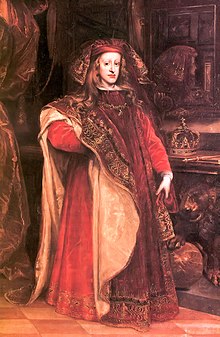
Charles wearing the robes of the Order of the Golden Fleece, in about 167


Now, I'll talk about Charles II's death, that was 315 years ago.
He began to torture with the idea that he was possessed. He had hallucinations and his life became a torment. People also began to think that spell was true.

Toward the end Charles' life, Charles's health deteriorated and he became increasingly hypersensitive and strange, at one point demanding that the bodies of his family be exhumed so he could look upon the corpses.

He officially retired when he had a nervous breakdown caused by the amount of pressure put on him to try to pull Spain out of the economic trouble. He lived a simple life since then, playing games and other activities.His death was slow and painful and ended in Madrid on 1 November 1700, five days before his 39th birthday.He had signed the will in favor of the Elector of Bavaria, but he died before Carlos. Then he signed in favour of Philip of Anjou, grandson of Louis XIV, as the pressures received at his deathbed.


The physician who practiced his autopsy stated that his body "did not contain a single drop of blood; his heart was the size of a peppercorn; his lungs corroded; his intestines rotten and gangrenous; he had a single testicle, black as coal, and his head was full of water.


Resultado de imagen para muerte de carlos ii de españa

And that's all!!!

BYE.