Showing posts with label Congress of Vienna. Show all posts
Showing posts with label Congress of Vienna. Show all posts
Wednesday, January 10, 2018


Monday, February 29, 2016
Restoration, revolutions and unifications video projects (Part two)
These are the remaining video projects. Leave your comments, please:
IRENE AND MARÍA L-T
CONGRESS OF VIENNA
IDEOLOGIES
REVOLUTIONS
UNIFICATIONS
FÁTIMA AND MARÍA M
CONGRESS OF VIENNA
IDEOLOGIES
REVOLUTIONS
UNIFICATIONS
ANCA, DIANA AND FERNANDO
CONGRESS OF VIENNA
IDEOLOGIES
REVOLUTIONS
UNIFICATIONS
LORENA AND SARA
CONGRESS OF VIENNA AND IDEOLOGIES
REVOLUTIONS
UNIFICATIONS
CARLOTA, JORGE AND LIDIA
CONGRESS OF VIENNA
IDEOLOGIES
REVOLUTIONS
UNIFICATIONS
IRENE AND MARÍA L-T
CONGRESS OF VIENNA
FÁTIMA AND MARÍA M
CONGRESS OF VIENNA
CONGRESS OF VIENNA
LORENA AND SARA
CONGRESS OF VIENNA AND IDEOLOGIES
CARLOTA, JORGE AND LIDIA
CONGRESS OF VIENNA
IDEOLOGIES
Wednesday, February 24, 2016
Restoration, revolutions and unifications video projects (Part one)
Here I'm going to embed the Youtube versions and the links to Educanon questions, so that you can see your classmates' projects and decide on which are the best ones. I'm including them in order of arrival to my e-mail account and your names appear in alphabetical order:
EVA O AND MARÍA P.
CONGRESS OF VIENNA
IDEOLOGIES
REVOLUTIONS
UNIFICATIONS
LUCÍA AND MANAL
CONGRESS OF VIENNA
IDEOLOGIES
REVOLUTIONS
UNIFICATIONS
ANTONIO AND CARLOS
CONGRESS OF VIENNA
IDEOLOGIES
REVOLUTIONS
UNIFICATIONS
ANDREI, EVA L AND SANTIAGO
CONGRESS OF VIENNA
IDEOLOGIES
REVOLUTIONS
UNIFICATIONS
BENIAMIN AND JAIME
CONGRESS OF VIENNA
IDEOLOGIES
REVOLUTIONS
UNIFICATIONS
Thursday, January 28, 2016
Some interactive maps and videos: Congress of Vienna, Italian and German unification
Here you have some interactive maps to visualize the territorial changes in Europe as a consequence of the Congress of Vienna and the unification processes of Italy and Germany. Click on the images to play the maps of the Congress of Vienna and the German unification. The map of the Italian unification is a GIF file.
/cdn0.vox-cdn.com/uploads/chorus_asset/file/2507764/Italian-unification.0.gif)


And these are some videos. You can use them to get ideas, but don't copy them. Remember that your work has to be ORIGINAL:
Thursday, January 21, 2016
Thursday, 21st January 2016
Hello, it's Lucía again. Today it's my turn to do the journal, so let's try to do it well!
At the beginning of the class, we have revised the Congress of Vienna and its corresponding scheme we did on Tuesday. The main conclusions are:
– They restored absolutism after the exile of Napoleon to Elba.
– They created the Holy Alliance.
Here you have the map that Paqui uses in class:
Here you have the map that Paqui uses in class:
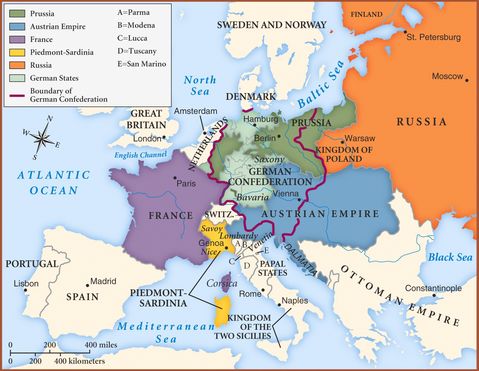 |
| Source: zonu.com |
But, as the United Kingdom didn't agree with their purposes, they created the Quadruple Alliance, formed by the members of the Holy Alliance plus the United Kingdom; Austria had under its power central Europe, Russia had Eastern Europe and the United Kingdom controlled the seas routes and some islands.
 |
| These men are the leaders of the Holy Alliance. Source: |
 |
| Source: pinterest.com This photo shows the similarities of the Congress of Vienna and the fall of Napoleon, because when he came back from Elba and the Hundred Days Empire started, the Congress was taking place. |
LIBERALISM:
It’s an ideology that defends that humans are born free and with some rights guaranteed by the State (Social Contract). They agreed with the division of power (but power belonged to the citizens, who chose their representatives). The State couldn't intervene in economy.
The main trends in this ideology were:
– CLASSICAL LIBERALISM: only those who had a good level of wealth or owned properties couldvote (Census Suffrage)
– DEMOCRATIC LIBERALISM: everybody was equal before the law and could vote. (Universal Suffrage).
 |
| Sources: |
NATIONALISM:
It defended the right of the nations to decide by themselves and form independent States.
The main two conceptions of nation:
– CONSERVATIVE OR EXCLUDING: they accepted only those who share some common features, like for example language or the "race". (The concept of race in humans doesn't exist, remember this and spread it, please, you're helping to create a better world ♥♥).
– PROGRESSIVE OR INCLUSIVE: they accepted all those who want to belong to the nation, if they accepted its laws.
Unfortunately, the predominant one was (and is) the excluding or conservative.
 |
| Source: |
--------------------------------------------------------------------------------------------------
NEW VOCABULARY HERE!
Attend: asistir.
Cape Colony: Colonia del Cabo.
Ceylon: Ceilán.
Quadruple Alliance: Cuádruple Alianza.
Balance of Powers: equilibrio de poderes.
Threaten: amenaza.
Turncoat: chaquetero.
Snatch: arrebatar, quitar violentamente.
Trend: tendencia.
Wealth: riqueza.
Classical Liberalism: Liberalismo clásico.
Democratic Liberalism: Liberalismo radical o democrático.
Self-determination: autodeterminación.
Adress to the German Nation: Discursos de la nación alemana.
AND THAT'S ALL FOLKS! ♥
Wednesday, January 20, 2016
Tuesday, 19th January 2016
Hi mates! It's Irene! Let's see what we' ve studied today in class,
Paqui has explained us about the following project that we have to do; we must do 4 videos including 5 questions in each one (6 in case of the last topic). This work is really too easy, we just have to explain the main topic helping with drawings about it. Te main topics are:
-Congress of Vienna
-Revolutionary ideologies
-1820, 1830, 1848 Revolution
-Unification of Italy and Germany (this video must include 6 questions, 3 about Italy and 3 about Germany)
DEADLINE-> 15th FEBRUARY
We can use websites like "Educanon" or programmes like "Windows Movie Maker "to edit our videos.
Here you have some ideas of videos:
Syria's War in 5 minutes: you can use maps and color them
The French revolution: Stop Motion is creative but harder
Enligthtened thinker's: this video is just what Paqui wants
or you can use images from Google, record the process drawing your pictures or use gifs! Good luck!
After the project we have started with second point of the unit, the Congress of Vienna.
We have studied the people who participated in the Congress of Viena, the decisions of the Congress, the main changes of the map of Europe and we have compared the differences between Europe during Napoleonic Empire and Europe after the Congress; we have copied the structure of this new scheme and we have to complete it for homework
CHRONOLOGY-> 1814-1815
CONGRESS OF WHO PARTICIPATED?-> Talleyrand
VIENNA Duke of Wellington
(1814-1815) Gómez de Labrador
MAIN PROBLEMS-> Hundred Years Empire
Solution: Battle of Waterloo
Restoration of absolutism
MAIN DECISIONS-> Reorganization of the map of Europe* -France
came back to its bordies in 1791
-Two buffer states
Creation of the Holly Alliance to stop revolution
CONSEQUENCES
* we have just studied these two points

Europe during Napoleonic Empire

Europe in 1789
VOCABULARY
SCROOGE- tacaño
BUFFER STATE- estado tapón
RHINELAND- Renania
SAXONY- Sajonia
EDIT- editar
Paqui has explained us about the following project that we have to do; we must do 4 videos including 5 questions in each one (6 in case of the last topic). This work is really too easy, we just have to explain the main topic helping with drawings about it. Te main topics are:
-Congress of Vienna
-Revolutionary ideologies
-1820, 1830, 1848 Revolution
-Unification of Italy and Germany (this video must include 6 questions, 3 about Italy and 3 about Germany)
DEADLINE-> 15th FEBRUARY
We can use websites like "Educanon" or programmes like "Windows Movie Maker "to edit our videos.
Here you have some ideas of videos:
Syria's War in 5 minutes: you can use maps and color them
The French revolution: Stop Motion is creative but harder
Enligthtened thinker's: this video is just what Paqui wants
or you can use images from Google, record the process drawing your pictures or use gifs! Good luck!
After the project we have started with second point of the unit, the Congress of Vienna.
We have studied the people who participated in the Congress of Viena, the decisions of the Congress, the main changes of the map of Europe and we have compared the differences between Europe during Napoleonic Empire and Europe after the Congress; we have copied the structure of this new scheme and we have to complete it for homework
CHRONOLOGY-> 1814-1815
CONGRESS OF WHO PARTICIPATED?-> Talleyrand
VIENNA Duke of Wellington
(1814-1815) Gómez de Labrador
MAIN PROBLEMS-> Hundred Years Empire
Solution: Battle of Waterloo
Restoration of absolutism
MAIN DECISIONS-> Reorganization of the map of Europe* -France
came back to its bordies in 1791
-Two buffer states
Creation of the Holly Alliance to stop revolution
CONSEQUENCES
* we have just studied these two points

Europe during Napoleonic Empire

Europe in 1789
VOCABULARY
SCROOGE- tacaño
BUFFER STATE- estado tapón
RHINELAND- Renania
SAXONY- Sajonia
EDIT- editar
Tuesday, January 19, 2016
Presentations for the project of the Restoration and the unifications
Here you have the presentations you will need for the project and to complete your schemes. When I have some more time, I'll write a post with the links to insert the questions in the videos.
Saturday, February 2, 2013
Interactive activities to review
Here you have some review activities about the crisis of the Ancien Régime in Spain, Restoration and the revolutions in the first half of the 19th century. The MEC server is not working today (I don´t know why). I´ve sent an e-mail to the person in charge, but I don´t know if they are working during the weekend. If the problem is not solved and someone wants to review, please, send me an e-mail and I´ll send you the packs of activities and the instructions to practice.
P.S (3rd February): the problems were solved and everything works right now.
Link to the post to review the French Revolution:
http://todayinsocialsciences.blogspot.com.es/2013/01/interactive-activities-about-french.html
- Activities about Charles IV´s reign and the Peninsular War:
P.S (3rd February): the problems were solved and everything works right now.
Link to the post to review the French Revolution:
http://todayinsocialsciences.blogspot.com.es/2013/01/interactive-activities-about-french.html
- Activities about Charles IV´s reign and the Peninsular War:


Friday, January 18, 2013
An interactive map of the Congress of Vienna

This is a very good resource to learn about the territorial changes in Europe decided in the Congress of Vienna after the Napoleonic wars. The animated map includes an oral explanation of evry change. If you want to watch it, click on the image above.
The map belongs to a website called The Map As History, where you can find a complete series of interactive maps both in English and French (still not in Spanish).
Subscribe to:
Posts (Atom)