Monday, February 28, 2011

The Atlas of the Real World

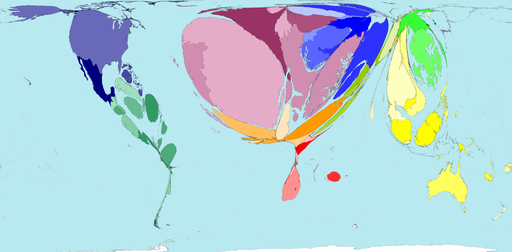
Today we have discovered a new way of representing different facts on world maps. It´s a project called The Atlas of the Real World. The authors represent the countries of the world not by their real size, but by their demographic importance on different subjects. Here you have some examples related to tourism. 

TOURIST ORIGINS


TOURIST DESTINATIONS


TOURISM EXPENDITURE


TOURISM PROFIT

This interesting book is called The Atlas of the Real World: Mapping the way we live, by Daniel Dorling, Mark Newnan and Anna Bartford and it was published byThames and Hudson. 

You can also find these maps on Worldmapper. Every map includes a short explanation and they are very useful to understand many world facts: 


Finally, here is the link to all the world maps about tourist: 

Presentation about tourism

This is the Powerpoint presentation we have used to study tourism. You can review the main world tourist destinations, the most visited countries, the countries that earn more money with tourism and the positive and negative impacts tourism has. 

28th of February


Today at the begining of the class, we have prepared our costumes for P.E and Paqui and Kelly have become angry because we have spoken. After that we have talked about tourism, and we have seen a PowerPoint presentation about the most visited places in Europe, then we have read the page number 52, then Paqui has explain us the impact of tourist activities, and we have done the exercises 29 to 33 in the class, and Kelly has spoken with some people about their projects.

Saturday, February 26, 2011

25TH FEBRUARY 2011

Today in Social Sciences the first thing we have done has been to check the chart about the different means of transport.
We have to write about uses, infrastructures, advantages and disadvantages.
A curious thing for me has been that all the class was discussing and thinking in the advantages and disadvantages.
I think it will be usefull and I have included the chart. I someone didn't correct it now she/he can do it:


USE
INFRASTRUCTURES
ADVANTAGES
DISADVANTAGES
GROUND
TRANSPORT
ROAD
For small amount of freight and people.
Short distances.
Highways and road tolls
Cheaper than other means of transport.
Price depends on the variation of oil price.
Pollution.
Traffic congestions.
RAILWAY
Freight and people in short, médium and long distance.
Rail tracks
Stations
Electricity
 installation.
Ecological.
Competitive prices.
Fast.
Safer.
No traffic congestions
Inflexibility (passangers have to adapt to lines)
Delays
Strict timetable
Blackouts
MARITIME
TRANSPORT
Big cuantity of freight
Ports and shipyards.
Open spaces for containers.
Big capacity to carry big amount of freight.
Cheap price
Depending on the weather
Slow.
Risk of accidents
Inflexibility
AIR TRANSPORT
Passangers in long distance travels.
Very expensive and light weight goods
Airports (runways, terminals, hangars)
Fast. Security ( the safest mean of transport)
Expensive price.
Air pollution and acoustic pollution near the airports and flight routes.


After that we have read about tourism . This is a very interesting point because tourism is a very important activity in Spain.

Tourism is: The economic activity that consist in organazing trips and stays  for the people in their leisure time.
Tourism appeared in the 19th century but did not become massive until the 2nd middle of the 20th century.
Tourism appeared in Spain in the 60s.


Friday, February 25, 2011

Challenge number 9


Trains are this week´s topic. As we have studied, trains have important advantages over other means of transport. This week´s challenge includes some questions about history and some others about current trains. 

QUESTION 1

What was the first railway passenger line in the world? When did it start working?

QUESTION 2

What was the first railway passenger line in Spain?When did it start working?

QUESTION 3

What is track/ rail gauge? What is the difference between the Spanish gauge and the European gauge?

QUESTION 4

What is the longest railway line in the world? How many kilometres does this line have? What cities does this line connect?

QUESTION 5

What is Maglev? How it works? 

QUESTION 6

What train holds the record of maximum speed in service? What cities does this train connect?

QUESTION 7

What is the highest railway line in the world? At what altitude do trains circulate in this line?

Remember to write your own answers. Don´t copy and paste!


Wednesday, February 23, 2011

Different means of transport: advantages and disadvantages


Here you have some help to do Friday´s homework. The following links include useful information to complete the chart about the different means of transport, their advantages and their disadvantages. 

Wednesday, 23rd February 2011


View more presentations from papefons

Today in Social Sciencies, Ana Margarita has came to the class. We have checked the exercisers about trade. The first exercise consisted in say what is the relationship between the number of workers in the tertiary sector and the development of a country. The relationship is: THE MORE DEVELOPED A COUNTRY IS, THE MORE WORKERS WILL WORK IN THE TERTIARY SECTOR. The second exercise was the definition of trade. Trade is the economic activity that consists of exchanging products for money or other products ( barter). In other exercise we have explained the difference between wholesale and retail trade. In WHOLESALE TRADE, big amounts of products are exchanged. Wholesalers buy big amounts of products to the producers and they sell them to other traders or enterprises. In RETAIL TRADE, products are sold in small quantity in shops, markets, supermarkets...We have explained also, the difference between exports and imports, EXPORTS are the sales of a country to other countries and IMPORTS are the purchases of products of other countries. In the last exercise we have explained the difference between Trade Balance and the Balance of Payments. Ana Margarita has asked us some questions about the things that we learnt last day, to do a rewiev. Afterwards, we have continued with the power point about the means of transports and we have seen the infrastructures of every mean of transport. Talking about the infrastructures of the planes,Paqui has told us, that the most serious accident of plane was caused by don´t clean the runway, so, when the plain took off, it crashed with a piece of another plain and it produced a big explosion. All the people died. Paqui has said us that, the big companies such as IBERIA are safer. Then we have read on the book the last part of transport and it was about the Transport Revolution in 19th century. Speed increased and the duration and cost os trips reduced. More people could travel and international relations and trade increased.


Every mean of transport needs different infrastructures and has adevantages and disadvantages. Paqui has said to us that we have to do a chart about the different uses, infrastructures, advantages and disadvantages of the ground and maritime transport for homework. We have started to do it in the class but the bell has rang. At the end os the lesson I have asked to Paqui some questions about the project of the Secondary or Tertiary sector.
Here I include a link about the plane accidents: http://www.planecrashinfo.com/

Monday, February 21, 2011

Monday 21-February- 2011

Today Kelly has been with us.
Today in social sciences we have started checking the exercises from 18 to 21, that asked about things of the industries of Spain.

Then we have started to study the Transport; an activity from the tertiary sector. It consists of used means of transport (vehicles) to take people or goods from one place to a different one.

While we were reading the book, Paqui has shown us a powerpoint with the different means of transport and the infrastructures needed for every type of transport. It can be of three ways:
Ground transport( in which we divided into road transport; cars, buses and trucks that circulate through roads and highways, and railway

transport, trains and tramways), maritime ships; ships sail through oceans and seas; and air freight transport; planes and helicopters fly across the sky.
We also have seen that the main routes of planes are between the developed countries, They leave out many routes to the developing countries.


Images:

http://www.mundofotos.net/foto/negro_blanco/730788/industrias-contaminacion
https://elcuadernodelviajero.wordpress.com/tag/transporte/

Friday, February 18, 2011

Friday, 18th February

Trade
View more presentations from papefons.
Today in social sciences journal Paqui has collected all the maps that people don´t pass it and she also has explained that we can send her the project of industry or terciary sector if we need any help.
Silvia has read the differences between the developed and developing countries, Paqui has explained this differences and she has learnt us new words and a sentence,for example: tarifts(arranceles), GATT(general agreement on tarrifs and trade), NAFTA(north free trade agreement), whatever happens (pase lo que pase)
Then we have seen the power point which is the principal of this journal, are photograhs that explain the trade in the world, this photographs explain the inland and exterior trade, the most important oil exportant and oil important countries(in this list is Spain),the balance of payments, world trade forms(Enrique doesn´t like this slide!but Paqui like.
Finally Paqui has give us some excercises from the page 56 is for monday and we have a nice weekend!!!

Challenge number 8


Source: www.capital.es 

Trade is the topic of this week’s challenge. You will have to research Spain’s commercial relations with other countries and answer the following questions:
QUESTION 1
Who are Spain’s major trade partners? What five countries receive the highest percentage of Spain’s exports? From what five countries does Spain import the most products?
QUESTION 2
What products does Spain export to other countries? What products does Spain import?
QUESTION 3
What are Spain’s commercial relations with the USA? What kind of products does Spain export to the USA? What kind of products does Spain import from the USA? Does Spain have a deficit or surplus trade balance with the USA?
QUESTION 4
Economy and politics are closely linked many times. Why is Spanish official policy so generous towards countries such as Equatorial GuineaLibya or Saudi Arabia? What commercial interests does Spain have in these countries?