Thursday, February 17, 2011

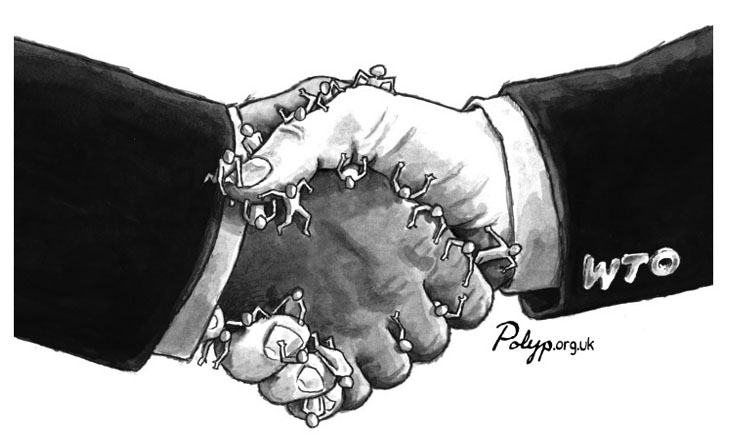
The WTO and free trade in some cartoons

Here you have some cartoons about the role of the WTO in international trade relations. Free trade has benefited the most developed countries and the multinational corporations, but it hasn´t been so good for developing countries and for many workers in the world. 


And the last cartoon reflects another blatant reality: the European free market is closed for the poorer. 


Wednesday, February 16, 2011

Wednesday, 16th of February

Today Ana Margarita has been with us. We have continued with the unit, we have seen trades, types of trades, like wholesale trade, retail trade, etc. We have also talk about BOP (balance of payments) that consists on the economic exchanges of a country with another ones, WTO (World Trade Organization) to reduce tariffs and GATT (General Agrements on Tariffs and Trade). We have talk about Mercadona, the difference between when we buy in a market and when the market buy the products.We have learned also that before the invention of money people trade with animals, vegetables or other products. I think that trade was very important in the past, but now is important too, because many people live for this trades. Paqui has said us to read a page for homework.


Monday, February 14, 2011

Trade balance

On this short video you will  understand  better how the trade balance works and the differences between the trade balances of the most and the least developed countries in the world. 


And here you have a link to a webpage where you can see the Spanish trade balance in the last two years. It is obviously negative. This means that the country has spent more money buying products than the money it has earned selling its products to other countries. This is called deficit:


http://www.tradingeconomics.com/Economics/Balance-Of-Trade.aspx?Symbol=esp

Monday, 14th of February


Today in Social Sciences, we have eaten breakfast in the classroom because we were on a speech and first Paqui has given us the Africa's map back and some people have to repeat them. Today Kelly has been with us. Then we have started checking the 3 exercises from homework about the present situation of the secondary sector in Spain and the main regions which are Catalonia, Madrid, the Basque country and the Valencian Community. After, Paqui while she has shown us a powerpoint of graphics and percentages , she has explained that Spain is one of the most industrialized countries in the world, the main industrial regions in Spain, the importance, etc. Then we have started reading point 2: The tertiary sector , that includes the activities that consist of rendering services to the people and we have started with one activity: Trade. It consists of exchanging products for money or other products and we have seen two types depending on the quantity of products exchanged: Wholesale trade that is comercio al por mayor and Retail trade; al Retall . Depending on the place where products are exchanged we can see: Inland trade and Exterior trade , that includes Exports ( when we sell to other countries) and Imports ( when we buy it from outside). We have copied a scheme on our notebooks about this. Paqui and Kelly have looked for: cementerios nucleares but they haven't found (Now Paqui knows: nuclear waste dump). Suddenly, a teacher has brought some Saint Valentine's cards to some people. Finally, no one wanted to do the journal and Paqui has told me to do it.
SORRY FOR THE DELAY! I couldn't do it before.

Take action! (if you want)


As you might remember, we studied the thousand of millions of € that escape to the control of the governments every year. Different international organizations have started a campaign to end tax haven secrecy. You can send an e-mail to the G-20 leaders to ask them to take action and stop tax havens´ secrecy


Friday, February 11, 2011

Friday, 11th February


Today in social sciences we have corrected the exercises from 11 to 14 of the page 56.
Then Paqui has showed us some graphics about the renewable energies in Spain has and in other countries. Then we have read the page about the industry in Spain. Then Paqui has showed some graphics too about all these things. For example in Germany there is less amount of fields where we produce with renewable energy but they produce more amount of renewable enegy and Spain have more fields were produce renewable energy but we produce less amount of time.We have been commenting on outsourced companies and the Playfair Compaign. . At the beggining of the class Paqui was very angry with us because she said that we always come late! and because some of us don't stop taking and don't pay attention, even if she ask us to be silent!At the end of the class she has given us for homework exercises from 14 to 17. I couldn't write the journal before because I was in extracurricular class. Sorry!!
Have a happy weekend!

Challenge number 7


This week you will have to research on the Spanish production of energy. The questions refer to different renewable energy sources. They are not very difficult: 

QUESTION 1

What is the autonomous community that concentrates more wind farms? 

QUESTION 2

What has been the record of production of electricity coming from wind power?

QUESTION 3

What´s this? Where is this facility located?


QUESTION 4

There is a peculiar solar farm in Manzanares and another one is being built in Fuente el  Fresno. What kind of solar farms are these? How do they work?

QUESTION 5

Where is located the only wave energy plant in Spain?

QUESTION 6

What is the Zèfir Test Station? Where will it be located?

QUESTION 7

What are the European Union objectives of renewable energy production for 2010?

Cheer up! Be more active!

Wednesday, February 9, 2011

Some more information about outsourcing

Checking the labels of our clothes, we´ve discovered today that many of the textiles sold in Spain have been produced in other countries. Many companies have outsourced their factories to places such as Bangladesh, Indonesia, India, China, Turkey, Thailand, Philippines, Pakistan or Mexico. Here you have some cartoons that show the reality of globalization in industry: 

The first cartoon shows how the theory of capitalism can affect to the same people who are its main supporters: 


This cartoon plays with a very know quote in the USA: it used to be "What´s good for General Motors (the car company) is good for America".


This one shows the dilemma of many Mexican workers: 


The executive of this cartoon justifies outsourcing as a good thing for American citizens: 


This one shows the reality of many companies of the developed countries: their workers live in other countries. 


And the last one is focused on consumers. 


Source of all the images: http://www.davar.net/IT/CARTOONS.HTM

The truth is that the high consumption levels of the most developed countries are only possible because many of the goods we enjoy come from countries where the working conditions and the rights of workers are not respected. If you´re interested in this topic, you can watch the following video about working conditions on the sweatshops in Bangladesh: 


And if you want to take action, this is the link to the Playfair 2012 Campaign. This is an international campaign  whose purpose is to put pressure on the sport companies that produce sportwear in outsourced factories in Asia. You can send an e-mail to the major companies and ask them to respect the rights of their workers: 


You can also play the game "Unfair factory" and learn how´s a workday in the sweatshops: 


Wednesday 09/02/2011

At the beginning of the class I have gone for the remote control of the projector. Later, when I have come back, Paqui was telling things about Sudan ,the African country divided in two parts.
Paqui said that Sudan is going to beacame two different countries, there are big differences between the north part (desert, very few water…) and the south part (very green, lots of rain...).
Later Paqui has collected Africa´s maps.
Afterwards we have read “Main world industrialized regions” in the book. The main industrialized regions in the world are:
• Europe
• U.S.A.
• Japan
• China

We  have also compared where our clothes have been made. Because this morning we have seen information about industrialized countries. Industrialized developing countries where the price is lower.

Then we have seen the PowerPoint about industry and we have started seeing the PowerPoint about The secondary sector in Spain.
We have seen the main energy resource in Spain. Yolanda R. has said she uses coal in her house.
In Spain we are privilege because we have a lot of renewable energy sources such as wind, solar energy…
Later Paqui has given exercise for homework (9 to 14 from the review).
The bell has rung and Paqui has told me to write the journal.

Tuesday, February 8, 2011

Maquiladoras of Tijuana

In class, I talked about my experiences visiting the places where the maquiladora workers live in Tijuana, Mexico. Neverthless, I want to write about it on the blog as well.


In the summer of 2008, I visited and volunteered the border zone between the United States and Mexico. I was volunteering and building schools there, but we also took advantage of the experience to learn about topics of migration and immigration and about the maquiladoras.


A group of women activists from the organization Colectivo Chilpancingo (Pro Justicia Ambiental) showed us around and explained the reality of the maquilas. This group of women, fight for the rights of the workers and for the enviromental conditions in the place where they live. These women showed us one area of shanty towns located at the bottom of a hill. On the top of the hill is the maquila, where many of the shanty town residents work.


In these two photos you can see the maquila and the shanty town.

The women explained, that when it rains this electronics maquila took advantage of the situation to release the toxic chemicals from the factory. The problem is that this toxic water comes running down the hill contaminating the water and the neighborhood where these people live. The residents of the shanty have no rights and the police do not stop the situation because of corruption and bribes. The police protect the interests of the maquilas.


This is the hill which leads to the shanty town.


And here you can see the contaminated water and shanty where the maquila workers live.

If you want to know more about this situation or want to help you can visit Colectivo Chilpancingo (Pro Justicia Ambiental)'s website at http://www.environmentalhealth.org/BorderEHC/BorderCommActnTm2Hist.html

You can also watch this documentary called "Maquilopolis". This was made with the help from the women who I met. It's very interesting and it's mostly in Spanish. This way you can share it with your family and friends.