Showing posts with label Fernando. Show all posts

Thursday, January 8, 2015

Thursday, 8th January 2015


Hello everybody! I’m Fernando!

Happy new year to everyone!

Today has been the first day of class of the year and at second period we have had Social Sciences. The first thing we have seen is a whiteboard where we can write our favourite quotes. Later Paqui has remered us what we were studing before the holidays and then she has copied a scheme to do during the class and if we didn’t have time to finish at home. The scheme is about the development of the French revolution and it’s divided into three parts:

-Moderate stage (1789-1792):
  • National assembly (1789-1791): the most important decision they made was to establish a constitution.
The national assembly
Source:http://historymad.stmaryscollegehull.co.uk/3ContentPages/KS3/enemies/GuidetoFrenchRev2012.htm
  • Legislative Assembly (1791-1792): Their main decisions is the abolition of the guilds, a universal tax system, prohibition of torture, creation of a national army, confiscation and sell of the properties of the Chruch and Civil Constitution of the Clergy. They also finished with the monarchy in France.
- Radical stage (1792-1794):
  • Girondist convention (1792-1793): The main decision was to execute the king by guillotine, but they had some problems with this execution, because this provoked the formation of a coalition of the European monarchies against France.
The execution of the king by guillotine
Source:http://larevolucionfrancesa1789.blogspot.com.es/2010/05/la-toma-de-la-bastilla.html
  • Jacobin Convention(1793-1794):Their main decisions were a new constitution, the law of the maximum, the distribution of the properties of the counter-revolutionary for the poor, the sell of the properties of the Cruch, Churches were closed and cult to Reason was established, compulsory education, mobilization of all the available men to stop the foreign invasion and liberties were suspended. A policy was created called the Age of Terror, this consist in the right to execute all the suspected counter-revolutionaries by guillotine. At the end Thermidor a conservative coup d’eat deposed the Jacobins and their leaders were guillotined.
-Directory (1795-1799): In this period they elaborated a new constitution which created a collegiate government, the directory, and two legislative chambers. The Directory was attacked both by the absolutists and the people. In 1799 General Napoleon Bonaparte, encouraged by part of the bourgeois, led a coup d’état, put an end to the Directory and tood power.

See you tomorrow!

Wednesday, November 19, 2014

The Milkmaid by Johannes Vermeer


The Milkmaid is a painting painted by the Dutch painter Johannes Vermeer. We don’t know so much about Johannes Vermeer life. He was married with Catherina Bolnes and he had eleven children. This artist is one of the most important painters of the Baroque period in the Law Countries.
The painting was made between 1660 and 1661, approximately, in the city of Delft where Johannes Vermeer lived.
The painting is very small about 45,4 x 41 cm like the most of the works of Johannes, the materials that he used are oil painting over canvas. At present the painting is in the Rijskmuseum in Amsterdam.


The milkmaid
Source: http://es.wikipedia.org/wiki/Johannes_Vermeer#mediaviewer/File:Jan_Vermeer_van_Delft_021.jpg

The painting has very reduced dimensions probably he used very small brushes and also lens to see better. In the painting we can distinguish three parts:
-The woman, a servant that is pouring milk in a container.
-The still life that formed by of the different elements over the table and in the wall.
-The corner when the action is developed.

One of the most representatives elements of the paintings of Vermeer's is the use of light. In this case the light comes from the window.

The theme of the painting is a domestic theme (in Protestant countries the themes of the paintings were more private because the works of art were commisioned by the bourgeois). In this painting the use of light and colour and the movement predominate.


The Milkmaid is a one of the most important paintings of the 17th century and has been appreciated by the best painters of 17th century. Another famous painting by Vermeer is the Girl with the pearl earring which is considered Vermeer's masterpiece.


Sources:
http://educacion.ufm.edu/jan-vermeer-la-lechera-oleo-sobre-tela-1660/
http://es.wikipedia.org/wiki/La_lechera
http://www.artehistoria.jcyl.es/v2/obras/3060.htm

The rape of Proserpina by Gian Lorenzo Bernini


The rape of Proserpina is an sculpture made by Gian Lorenzo Bernini. He is one of the most important artist of the Italian Baroque who worked for the pope. The sculpture belongs to the first stage of the artist.


Portrait of Bernini.
Source: http://en.wikipedia.org/wiki/Gian_Lorenzo_Bernini#mediaviewer/File:Gian_Lorenzo_Bernini,_self-portrait,_c1623.jpg

The sculpture was made between 1621 and 1622, probably in the city of Rome where Bernini lived. It was commissioned by Scipione Borghese. Scipione Borghese was a cardinal who gave the sculpture to another cardinal called Ludovico Ludovisi.


The rape of Proserpina
Source: http://www.arteiconografia.com/2010/07/el-rapto-de-proserpina.html


It has a height of 2.95 meters and is made of marble. At present the sculpture is in the Borghese gallery, in Rome.

The sculpture has a mythological theme. The sculpture is a representation of the rape of Proserpina. It’s a scene of the metamorphosis, one of the most important works about mythology. A lot of artist in Baroque period based their works in myths of the antiquity. In the work we can see Proserpina( the goddes of agriculture) being kidnapped by Pluto (the god of the underworld). Also there is a dog with three heads known as the Cerebeus who was responsible for not letting anyone escape from the underworld.

We can see the predominance of the movement and realism, very common characteristics of the Baroque art.The work has a violent character, representing the resistence of Prosperina to Pluto, who is represented as a very violent person.

The sculpture was in the village of the cardinal Ludovico Ludovise until 1908 when the Italia government got the sculpture.

Sources:
http://tom-historiadelarte.blogspot.com.es/2007/04/anlisis-de-una-obra-escultrica-de.html
http://www.arteiconografia.com/2010/07/el-rapto-de-proserpina.html
http://es.wikipedia.org/wiki/El_rapto_de_Proserpina


Tuesday, November 18, 2014

18th November of 2014 (Tuesday)


Hello everybody!
Today in the class of Social Sciences the teacher Paqui has checked if we had the scheme about the Ancien Régime, the first point of the unit 2 "The 18th century". Only three people had done the homework. Then we have corrected the three parts of the scheme:
-Definition: It was a term used by the French revolutionaries to define all they wanted to get rid of.
-Main features: Absolute monarchy was the predominant system in politics, and the society was divided into privileged and unprivileged people.In economy the most important activity was agriculture based on the three year system of Crop rotation.
-Changes in the 18th century: It was a period of relative peace in Europe, there were less big epidemics, mortality decreased...
Then we have started with the second point of the unit "Enlightenment".
Enlightenment was an intellectual movement developed in Europe in the 18th century that questioned all the Ancient Regime Principles. The enlightened Philosophers defended the use of Reason as the best way to know the world and transform it.
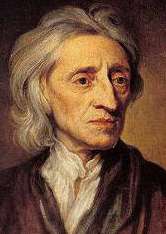
John Locke and Isaac Newton are considered to be precedents of Enlightenment. They lived in the 17th century.


Jhon Locke
Source:http://www.portalplanetasedna.com.ar/hombres_ilustracion5.htm

We have studied the main features of Enlightenment, for example, the absolute faith in reason as the best way to understant the world or knowledge as the basis of happines. The last thing we have studied is the creation of the encyclopedia by Denis Diderot and Jean Rond D'Alambert. The encyclopedia was created to compile all the knowledge of their time. The first Encyclopedia appeared in 1751 and it had 35 volumes.
la_enciclopedia.gif
The first encyclopedia
Source:http://dhpedia.wikispaces.com/La+Enciclopedia+o+Diccionario+razonado+de+las+ciencias,+las+artes+y+los+oficios.
The words that we have included to the glossary are:
Rudimentary: rudimentario.
Demand for: demanda de
Enlightenment: ilustraciòn.
Enlightened: ilustrado.
To gather: reunirse, juntarse.
Gathering: reunión
Brain wash: lavado de cerebro.

Tuesday, October 14, 2014

14th October 2014 (Tuesday)

Hello everybody! I'm Fernando
Today in the class of social sciences we have started reading and talking about a text that Paqui published last Sunday. Last Sunday was the 12th of October, it's a importat day because we celebrate the "discovery of América" by Columbus. The text talks about all these things. Also we have seen some photos to think about what, the discovery supposed the indigenous people that live in América.

Columbus with the indegenous people of America.
Source: http://elpais.com/diario/2006/05/14/domingo/1147578759_740215.html

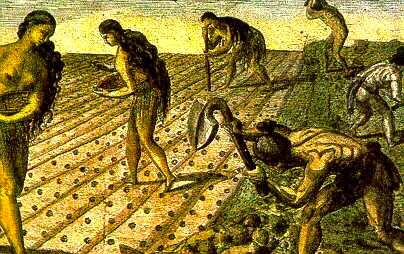
Latter we have started to correct the part of the scheme about the indies (América) that we had to complete at home. First we have corrected the administration of the Indies, Some institutions were created to rule the indies. They created Viceroyalties, Cabildos and Courts of Justice to rule the Indies. Also we have corrected exploitation of the Indies. They had two systems to exploit the indigenous people, the Encomienda system to exploit the lands and the Mita system to exploit the mines. We haven't corrected the colonial society, another part of the scheme.

Indigenous working the land.
Source: http://www.members.tripod.com/~panamahistoria/encomienda.htm
We have added some new words to our glossary:
Viceroy: virrey
Vice-royalty: virreinado
On the outskirts: a las afueras
Royal fifth: quinto real
Load: carga
Customs: aduana
Greed: codicia, avarícia
Greedy: avaricioso
On my side: de mi parte
To enslave: esclavizar